Department of Vascular Diseases, Ljubljana University Medical Centre, Zaloška cesta 7, SI-1000 Ljubljana, Slovenia.
Department of Endocrinology, Diabetes and Metabolic Diseases, Ljubljana University Medical Centre, Zaloška cesta 7, SI-1000 Ljubljana, Slovenia.
Int J Mol Sci. 2019 Apr 14;20(8):1844. doi: 10.3390/ijms20081844.
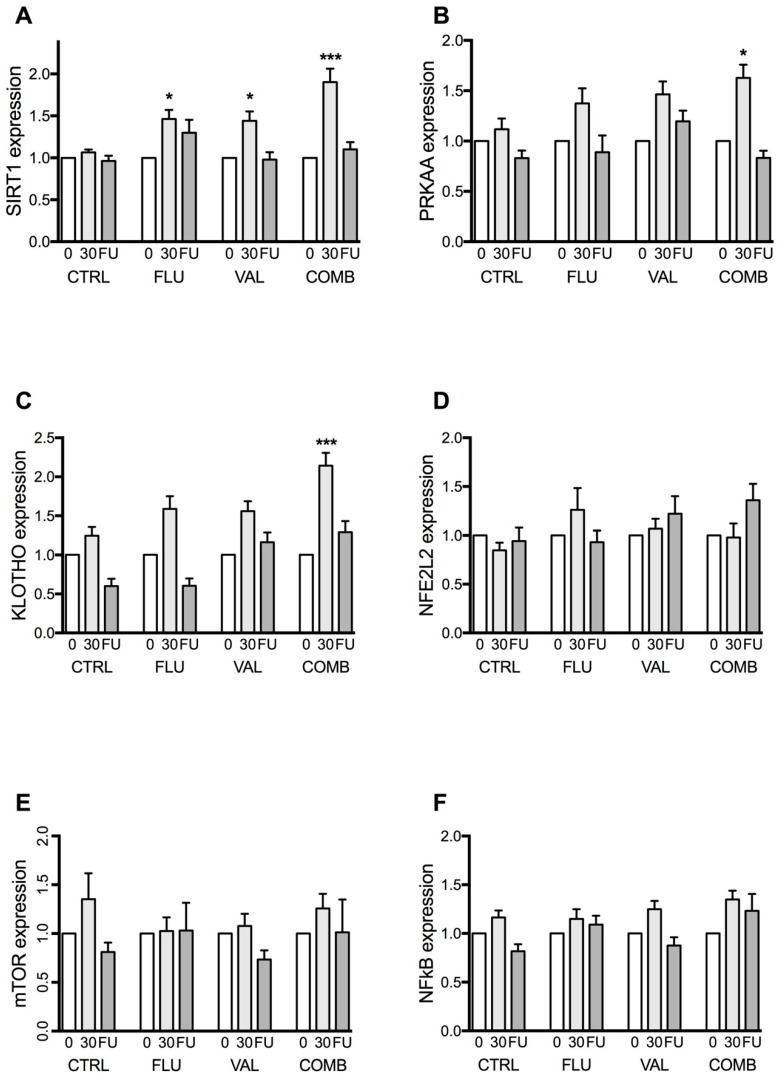
The incidence of aging-related disorders may be decreased through strategies influencing the expression of longevity genes. Although numerous approaches have been suggested, no effective, safe, and easily applicable approach is yet available. Efficacy of low-dose fluvastatin and valsartan, separately or in combination, on the expression of the longevity genes in middle-aged males, was assessed. Stored blood samples from 130 apparently healthy middle-aged males treated with fluvastatin (10 mg daily), valsartan (20 mg daily), fluvastatin-valsartan combination (10 and 20 mg, respectively), and placebo (control) were analyzed. They were taken before and after 30 days of treatment and, additionally, five months after treatment discontinuation. The expression of the following longevity genes was assessed: , , , , , and . Treatment with fluvastatin and valsartan in combination significantly increased the expression of (1.8-fold; < 0.0001), (1.5-fold; = 0.262) and (1.7-fold; < 0.0001), but not , and . Both fluvastatin and valsartan alone significantly, but to a lesser extent, increased the expression of , and did not influence the expression of other genes. Five months after treatment discontinuation, genes expression decreased to the basal levels. In addition, analysis with previously obtained results revealed significant correlation between and both increased telomerase activity and improved arterial wall characteristics. We showed that low-dose fluvastatin and valsartan, separately and in combination, substantially increase expression of , , and genes, which may be attributed to their so far unreported pleiotropic beneficial effects. This approach could be used for prevention of ageing (and longevity genes)-related disorders.
衰老是一个复杂的过程,受多种因素的影响,包括环境因素和遗传因素。衰老的特征是生理功能逐渐下降,导致与年龄相关的疾病的易感性增加。衰老过程与基因表达的改变有关,包括长寿基因的表达降低。
长寿基因是指那些与延长寿命和延缓衰老相关的基因。这些基因的表达可以通过各种策略来调节,包括饮食、运动、压力管理和药物干预。药物干预是一种有前途的方法,可以通过调节长寿基因的表达来延缓衰老过程和预防与年龄相关的疾病。
他汀类药物是一类广泛使用的药物,具有降低胆固醇和抗炎作用。一些研究表明,他汀类药物可能通过调节长寿基因的表达来发挥其抗衰老作用。血管紧张素转换酶抑制剂(ACEI)是另一类常用于治疗高血压和心力衰竭的药物,也被发现具有抗衰老作用。
本研究旨在评估低剂量氟伐他汀和缬沙坦单独或联合使用对中年男性长寿基因表达的影响。研究纳入了 130 名健康的中年男性,他们被随机分配接受氟伐他汀(10mg/d)、缬沙坦(20mg/d)、氟伐他汀-缬沙坦联合治疗(分别为 10 和 20mg/d)或安慰剂治疗。在治疗前、治疗 30 天后和治疗停止 5 个月后,采集了他们的血液样本。检测了以下长寿基因的表达:klotho、SIRT1、FOXO3a、IGF-1、IGF-1R 和 p16。
结果显示,氟伐他汀和缬沙坦联合治疗显著增加了 klotho、SIRT1 和 FOXO3a 的表达(分别增加了 1.8 倍、1.5 倍和 1.7 倍),但对 IGF-1、IGF-1R 和 p16 的表达没有影响。氟伐他汀和缬沙坦单独治疗也显著增加了 klotho 和 SIRT1 的表达,但程度较轻。治疗停止 5 个月后,基因表达恢复到基础水平。此外,与之前获得的结果进行分析显示,klotho 与端粒酶活性的增加和动脉壁特征的改善呈显著相关。
综上所述,本研究表明,低剂量氟伐他汀和缬沙坦单独或联合使用可显著增加 klotho、SIRT1 和 FOXO3a 的表达,这可能与其尚未报道的多效性有益作用有关。这种方法可能用于预防与衰老相关的疾病。