Stichting Epilepsie Instellingen Nederland, Heemstede, The Netherlands.
Research Institute of Child Development and Education, University of Amsterdam, Amsterdam, The Netherlands.
PLoS One. 2019 Apr 24;14(4):e0214548. doi: 10.1371/journal.pone.0214548. eCollection 2019.
Frequent infant crying is associated with parental exhaustion, depression, or even infant hospitalization and shaken baby syndrome. Effective prompt soothing methods are lacking for infants under 6 months. We examined whether swaddling, sound, and movement evoked an immediate calming response (CR) when parents soothed their infants and using a smart crib, and whether infant age affected the CR.
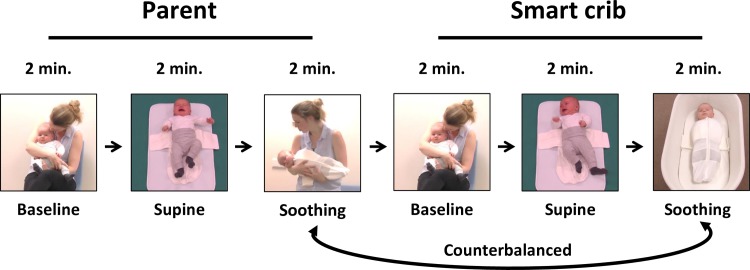
Infants' CR was assessed in a community sample of 69 infants (0-6 months) in a counterbalanced experiment with two conditions (parent, smart crib) each composed of three two-minute phases (baseline, supine, soothing). During baseline 1, parent and infant were sitting together; in supine 1, fussiness was elicited by putting the infant suddenly supine, followed by parental soothing (shushing and jiggling of the swaddled infant). Baseline 2, supine 2, and soothing by the crib followed. Fussiness was observed and infant heart rate (HR) and heart rate variability (HRV) were recorded. The CR was operationalized as decreased fussiness and HR, and increased HRV during soothing compared to lying supine.
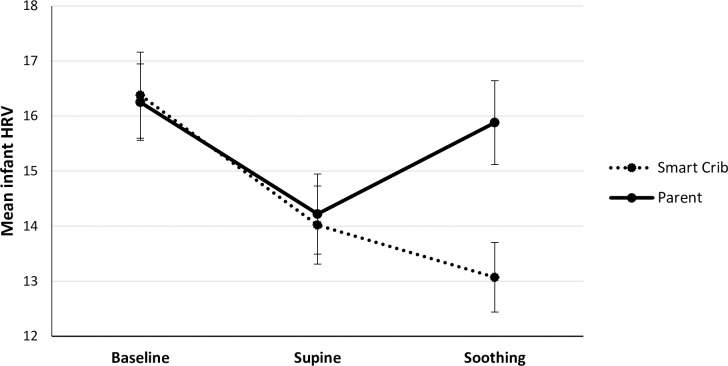
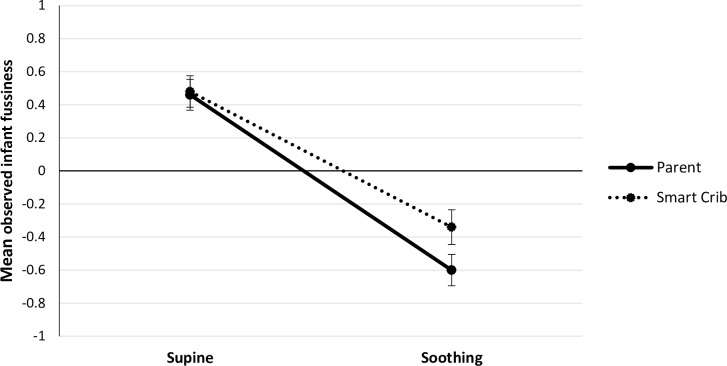
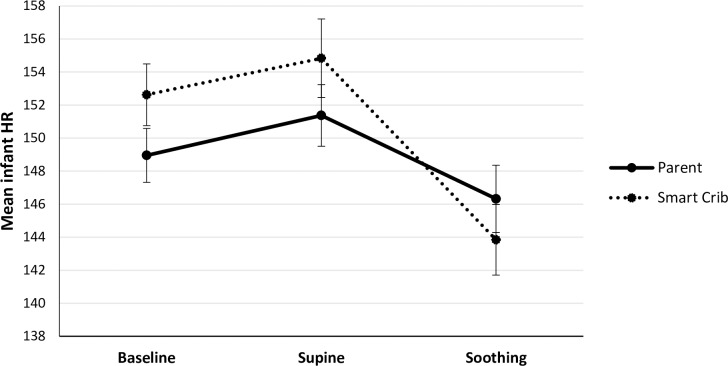
Infant fussiness and HR were lower in both soothing phases compared to the supine phases. Infant HRV tended to be higher during parental soothing than during supine, but did not significantly differ between mechanical soothing and supine. Younger infants responded with a stronger CR (decreased fussiness and increased HRV) to parental soothing, but not to mechanical soothing. For HR, infants' CR was stronger in the crib than in the parent condition, whereas for HRV, infants' CR was stronger in the parent condition. For fussiness, infants' CR tended to be stronger in the parent condition.
Parental and mechanical soothing using swaddling, sound, and movement promptly induced a CR in infants. This has important clinical implications for soothing fussy and crying infants. Future studies should investigate the effects of parental versus mechanical soothing in the home setting.
频繁的婴儿啼哭与父母的疲惫、抑郁,甚至婴儿住院和摇晃婴儿综合征有关。6 个月以下的婴儿缺乏有效的即时安抚方法。我们研究了襁褓、声音和运动是否能在父母安抚婴儿时立即引起婴儿的安抚反应(CR),以及婴儿的年龄是否会影响 CR。
在一项社区样本中,69 名婴儿(0-6 个月)参与了一项对照实验,实验有两种条件(父母、智能婴儿床),每个条件由三个两分钟的阶段(基线、仰卧、安抚)组成。在基线 1 期间,父母和婴儿坐在一起;在仰卧 1 期间,将婴儿突然仰卧,引发烦躁不安,然后由父母安抚(襁褓中的婴儿发出嘘声和抖动)。接下来是基线 2、仰卧 2 和婴儿床安抚。观察婴儿的烦躁不安程度,并记录婴儿的心率(HR)和心率变异性(HRV)。CR 的操作定义为与仰卧相比,安抚期间烦躁不安程度降低、HR 降低、HRV 增加。
与仰卧阶段相比,在两个安抚阶段,婴儿的烦躁不安程度和 HR 都较低。与仰卧相比,父母安抚时婴儿的 HRV 往往较高,但与机械安抚相比,两者没有显著差异。较小的婴儿对父母的安抚反应更强(烦躁不安程度降低、HRV 增加),但对机械安抚没有反应。对于 HR,婴儿在婴儿床的 CR 强于父母条件,而对于 HRV,婴儿在父母条件的 CR 强。对于烦躁不安,婴儿在父母条件的 CR 倾向于更强。
使用襁褓、声音和运动的父母和机械安抚立即引起了婴儿的 CR。这对安抚烦躁和哭泣的婴儿具有重要的临床意义。未来的研究应在家中环境中研究父母与机械安抚的效果。