Goncalves Alexander, Gentil Paulo, Steele James, Giessing Jürgen, Paoli Antonio, Fisher James P
School of Sport, Health and Social Science, Southampton Solent University, UK.
Faculty of Physical Education and Dance, Federal University of Goias, Brazil.
Eur J Transl Myol. 2019 Feb 27;29(1):8052. doi: 10.4081/ejtm.2019.8052. eCollection 2019 Jan 11.
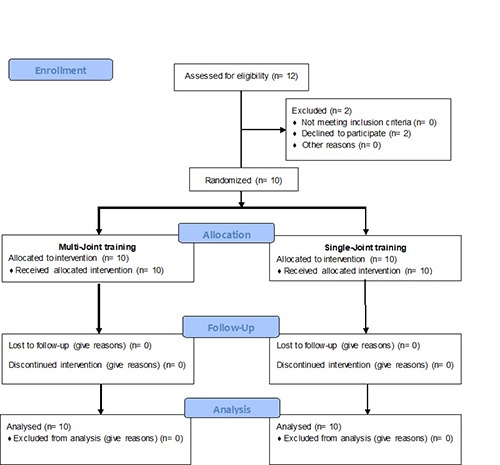
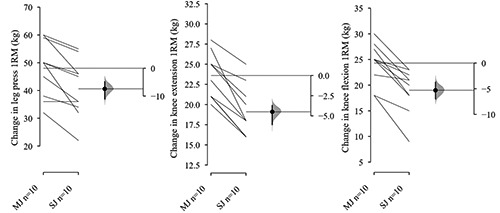
The present study compared strength increases resulting from either single-joint (SJ) or multi-joint (MJ) lower body resistance exercise. A within-participants design was utilised. Ten recreationally active participants (males; n=5, and females; n=5) had their lower limbs randomly allocated to perform both unilateral MJ (leg press; LP) and unilateral SJ (knee extension; KE, and seated knee flexion; KF) exercises. Participants trained 2 d.week-1 for 6 weeks. Pre- and post-intervention maximal strength (1-repetition maximum; 1RM) was measured for leg press, knee extension, and seated knee flexion exercises. Statistically significant strength increases occurred for both SJ and MJ groups, with significantly greater increases in 1RM for the MJ compared to the SJ group (p < 0.001 for all exercises). This study supports the use of MJ exercise for strength increases across lower body MJ and SJ movements, suggesting a time-efficient, and simple approach to resistance training may be efficacious. This might serve to promote greater adherence in the lay population as well as serving useful for rehabilitation professionals and strength and conditioning coaches in managing resistance exercise around skill/sport specific training.
本研究比较了单关节(SJ)或多关节(MJ)下肢抗阻训练所带来的力量增长情况。采用了受试者内设计。十名有运动习惯的参与者(男性5名,女性5名),其下肢被随机分配以进行单侧多关节(腿举;LP)和单侧单关节(伸膝;KE,以及坐姿屈膝;KF)训练。参与者每周训练2天,共训练6周。在干预前后,测量腿举、伸膝和坐姿屈膝训练的最大力量(1次重复最大值;1RM)。SJ组和MJ组的力量均有显著增加,MJ组的1RM增加幅度显著大于SJ组(所有训练项目的p均<0.001)。本研究支持使用MJ训练来增加下肢多关节和单关节运动的力量,这表明一种省时且简单的抗阻训练方法可能是有效的。这可能有助于提高普通人群的依从性,也有助于康复专业人员以及体能训练教练在围绕特定技能/运动训练安排抗阻训练时发挥作用。