The Rehabilitation Medicine Department The First Affiliated Hospital of Nanjing Medical University Nanjing Jiangsu China.
The Second Clinical Medical School Nanjing University of Chinese Medicine Nanjing Jiangsu China.
Ann Clin Transl Neurol. 2019 Mar 19;6(4):778-787. doi: 10.1002/acn3.759. eCollection 2019 Apr.
To investigate the efficacy and safety of Tui Na for treating spasticity of the upper limbs of stroke patients.
A prospective, multicenter, blinded, randomized controlled intervention study.
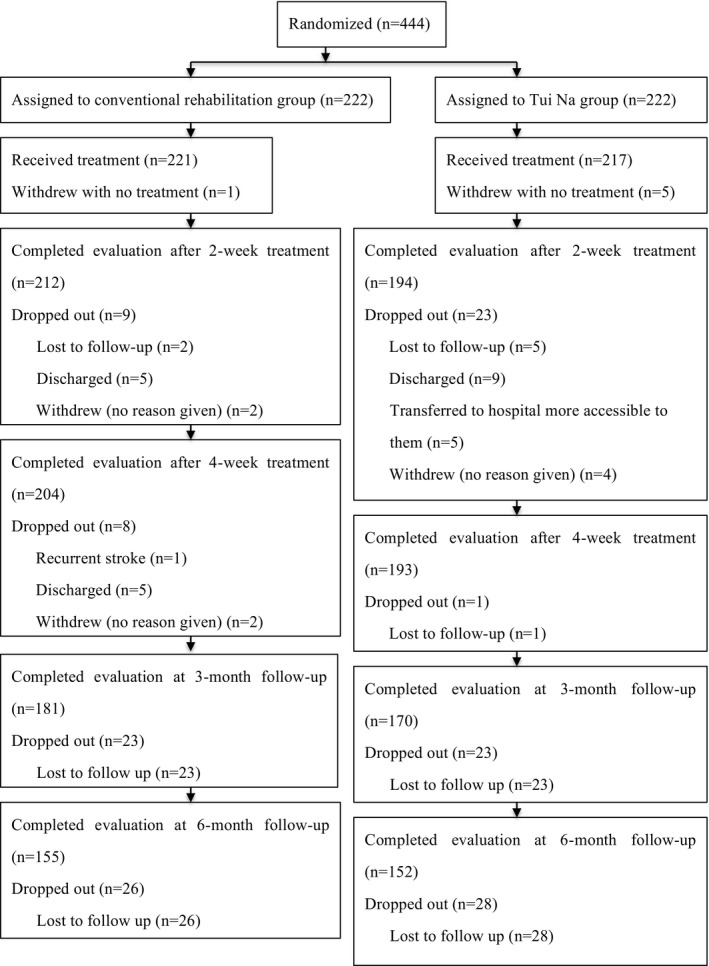
Stroke patients with upper limb spasticity who were treated between December 2013 and February 2017 in 16 participating institutions in China were randomly assigned to receive either Tui Na plus conventional rehabilitation (Tui Na group, = 222,) or conventional rehabilitation only (control group, = 222).
Eligible adult patients (aged 18-75 years) were enrolled 1-12 months after stroke and randomly allocated in a 1:1 ratio to the two groups. Outcome assessors were blinded to treatment allocation. Muscle tone in the spastic muscles was evaluated using the Modified Ashworth Scale (MAS), and the primary endpoint was the change in MAS score over 4 weeks of treatment.
Among patients who had experienced stroke 1-3 months before treatment, the Tui Na group experienced significantly greater reductions in MAS scores for three muscle groups than did the control group after 4 weeks of treatment. These improvements were sustained at the 3- and 6-month follow-ups. However, among patients who suffered from stroke 4-6 months and 7-12 months before treatment, the change in MAS with treatment did not differ significantly between those who did and those who did not receive Tui Na. No Tui Na-related adverse events during treatment were reported the groups.
Tui Na was effective and safe for alleviating poststroke spasticity within 1-3 months after stroke onset.
研究推拿治疗脑卒中患者上肢痉挛的疗效和安全性。
前瞻性、多中心、盲法、随机对照干预研究。
2013 年 12 月至 2017 年 2 月在中国 16 家参与机构接受治疗的脑卒中后上肢痉挛的患者,按 1:1 比例随机分为推拿加常规康复组(推拿组,n=222)和单纯常规康复组(对照组,n=222)。
入选的成年患者(18-75 岁)在脑卒中后 1-12 个月入组,按 1:1 比例随机分为两组。结果评估者对治疗分配情况设盲。痉挛肌肉的肌张力采用改良 Ashworth 量表(MAS)进行评估,主要终点是治疗 4 周时 MAS 评分的变化。
在治疗前脑卒中发生 1-3 个月的患者中,推拿组三个肌肉群的 MAS 评分在治疗 4 周后较对照组显著降低。这些改善在 3 个月和 6 个月的随访中得以维持。然而,在治疗前脑卒中发生 4-6 个月和 7-12 个月的患者中,推拿组和对照组治疗前后 MAS 评分的变化差异无统计学意义。两组均未报告与推拿相关的不良事件。
推拿对脑卒中后 1-3 个月内的痉挛性偏瘫患者有效且安全。