Institut für Biologie / Mikrobiologie, Humboldt-Universität zu Berlin, Berlin, Germany.
PLoS Genet. 2019 Apr 25;15(4):e1008059. doi: 10.1371/journal.pgen.1008059. eCollection 2019 Apr.
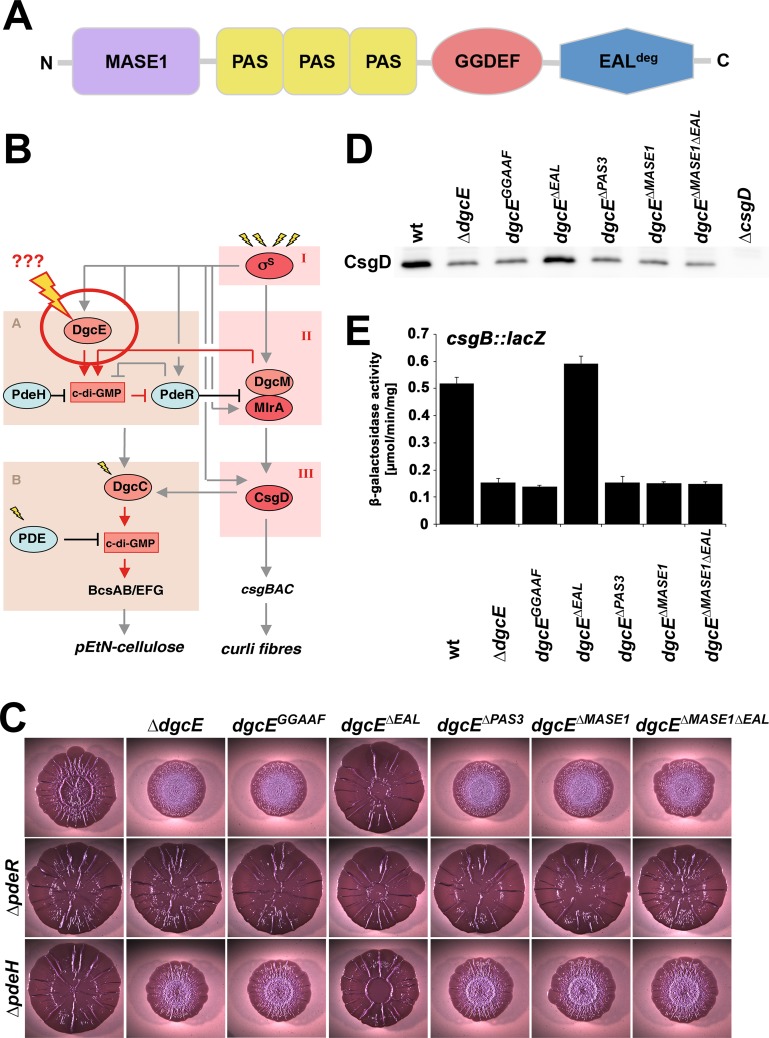
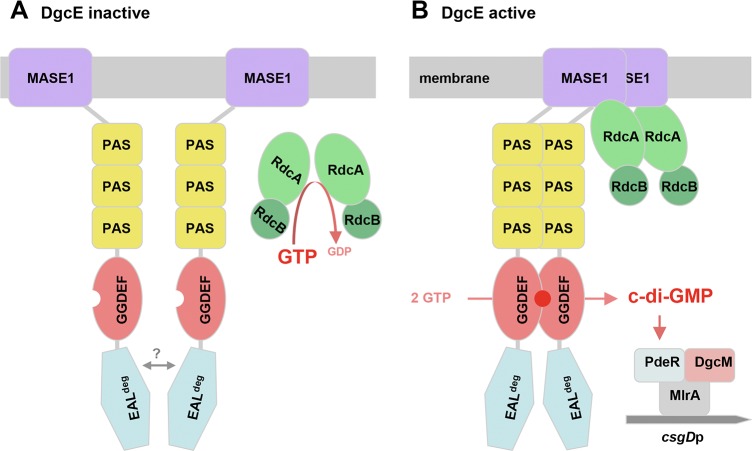
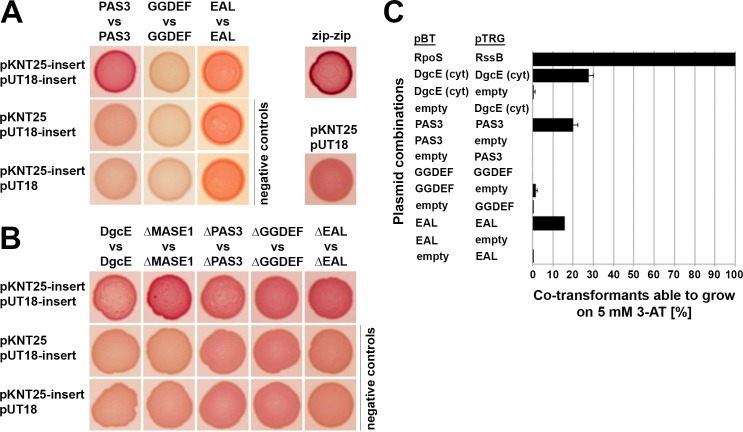
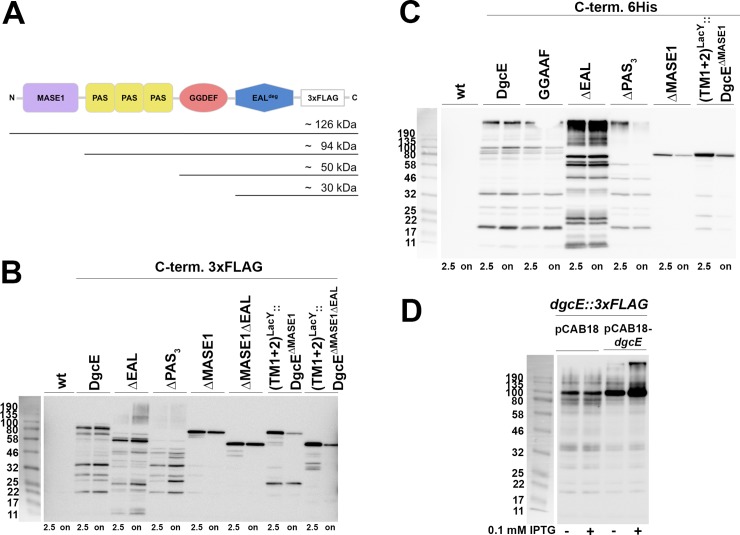
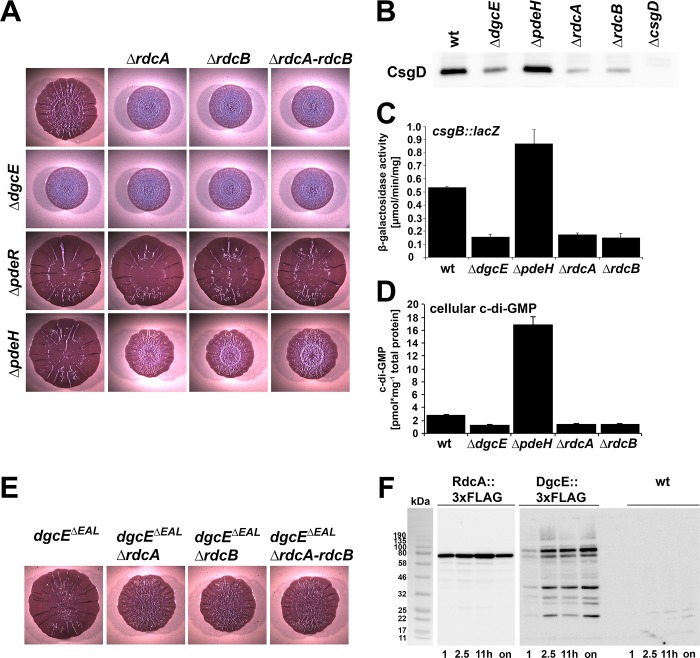
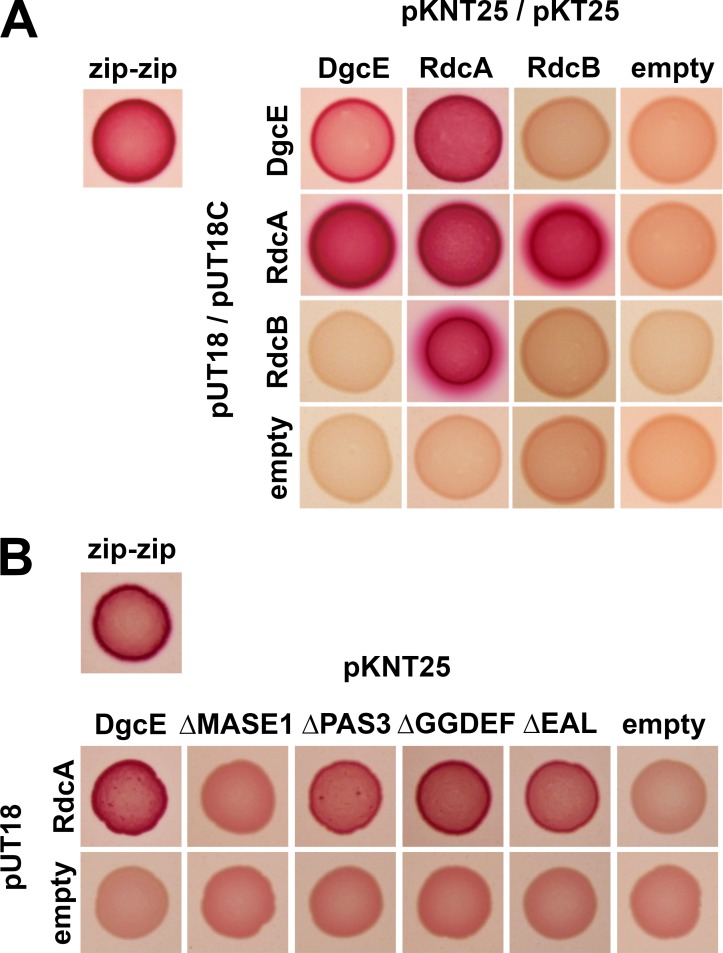
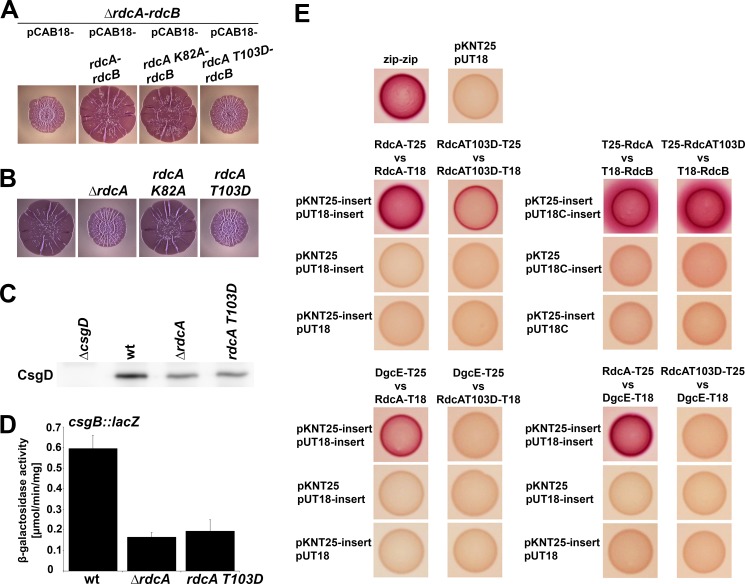
The ubiquitous second messenger c-di-GMP promotes bacterial biofilm formation by playing diverse roles in the underlying regulatory networks. This is reflected in the multiplicity of diguanylate cyclases (DGC) and phosphodiesterases (PDE) that synthesize and degrade c-di-GMP, respectively, in most bacterial species. One of the 12 DGCs of Escherichia coli, DgcE, serves as the top-level trigger for extracellular matrix production during macrocolony biofilm formation. Its multi-domain architecture-a N-terminal membrane-inserted MASE1 domain followed by three PAS, a GGDEF and a degenerate EAL domain-suggested complex signal integration and transmission through DgcE. Genetic dissection of DgcE revealed activating roles for the MASE1 domain and the dimerization-proficient PAS3 region, whereas the inhibitory EALdeg domain counteracts the formation of DgcE oligomers. The MASE1 domain is directly targeted by the GTPase RdcA (YjdA), a dimer or oligomer that together with its partner protein RdcB (YjcZ) activates DgcE, probably by aligning and promoting dimerization of the PAS3 and GGDEF domains. This activation and RdcA/DgcE interaction depend on GTP hydrolysis by RdcA, suggesting GTP as an inhibitor and the pronounced decrease of the cellular GTP pool during entry into stationary phase, which correlates with DgcE-dependent activation of matrix production, as a possible input signal sensed by RdcA. Furthermore, DgcE exhibits rapid, continuous and processive proteolytic turnover that also depends on the relatively disordered transmembrane MASE1 domain. Overall, our study reveals a novel GTP/c-di-GMP-connecting signaling pathway through the multi-domain DGC DgcE with a dual role for the previously uncharacterized MASE1 signaling domain.
普遍存在的第二信使 c-di-GMP 通过在潜在的调节网络中发挥多种作用来促进细菌生物膜的形成。这反映在大多数细菌物种中分别合成和降解 c-di-GMP 的二鸟苷酸环化酶(DGC)和磷酸二酯酶(PDE)的多样性上。大肠杆菌的 12 个 DGC 之一 DgcE,作为在宏观菌落生物膜形成过程中产生细胞外基质的顶级触发因素。其多结构域架构——一个 N 端膜插入 MASE1 结构域,后面跟着三个 PAS、一个 GGDEF 和一个退化的 EAL 结构域——表明通过 DgcE 进行了复杂的信号整合和传输。DgcE 的遗传剖析揭示了 MASE1 结构域和二聚体有效的 PAS3 区域的激活作用,而抑制性 EALdeg 结构域则抵消了 DgcE 寡聚体的形成。MASE1 结构域直接被 GTPase RdcA(YjdA)靶向,RdcA 是一种二聚体或寡聚体,与它的伴侣蛋白 RdcB(YjcZ)一起激活 DgcE,可能通过对齐和促进 PAS3 和 GGDEF 结构域的二聚化来实现。这种激活和 RdcA/DgcE 相互作用依赖于 RdcA 的 GTP 水解,这表明 GTP 是一种抑制剂,并且在进入静止期时细胞内 GTP 池的显著减少,这与 DgcE 依赖的基质产生激活相关,可能是 RdcA 感知的输入信号。此外,DgcE 表现出快速、连续和连续的蛋白水解周转,这也依赖于相对无序的跨膜 MASE1 结构域。总的来说,我们的研究揭示了一种通过多结构域 DGC DgcE 的新型 GTP/c-di-GMP 连接信号通路,该通路具有以前未表征的 MASE1 信号结构域的双重作用。