Human Molecular Genetics, de Duve Institute, Université catholique de Louvain, Brussels, Belgium.
Institute of Statistics, Biostatistics and Actuarial Sciences, Université catholique de Louvain, Louvain-la-Neuve, Belgium.
Cancer Med. 2019 Jun;8(6):3036-3046. doi: 10.1002/cam4.2122. Epub 2019 Apr 25.
In uveal melanomas, immune infiltration is a marker of poor prognosis. This work intended to decipher the biological characteristics of intra-tumor immune population, compare it to other established biomarkers and to patients' outcome.
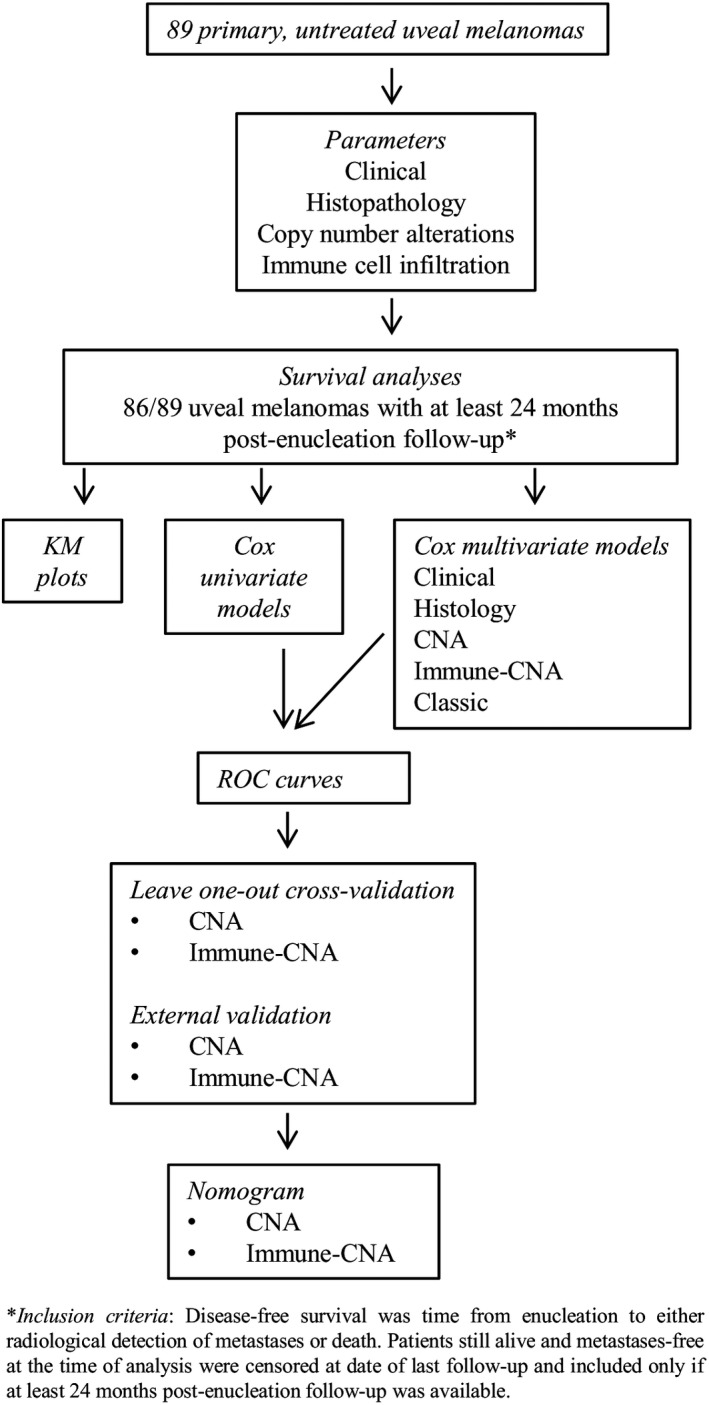
Primary, untreated, and mainly large uveal melanomas with retinal detachment were analyzed using: transcriptomic profiling (n = 15), RT-qPCR (n = 36), immunohistochemistry (n = 89), Multiplex Ligation-dependent Probe Amplification (MLPA) for copy number alterations (CNA) analysis (n = 89), array-CGH (n = 17), and survival statistics (n = 86).
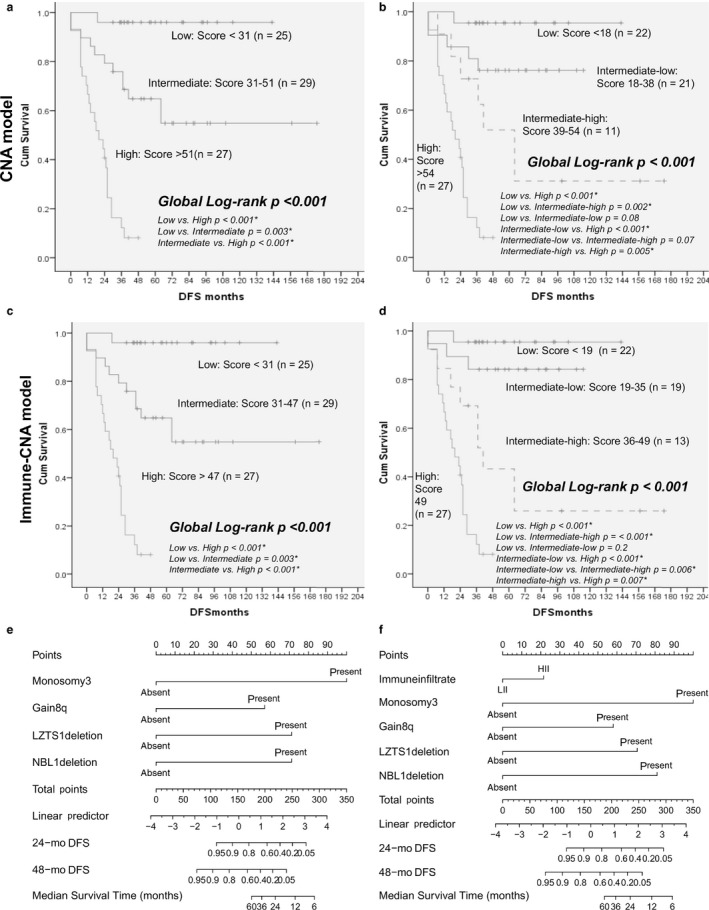
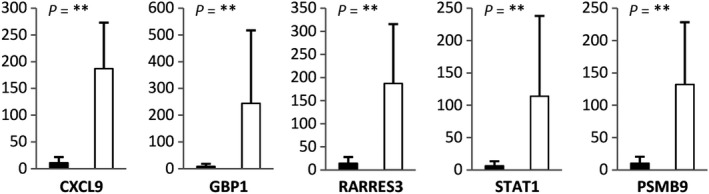
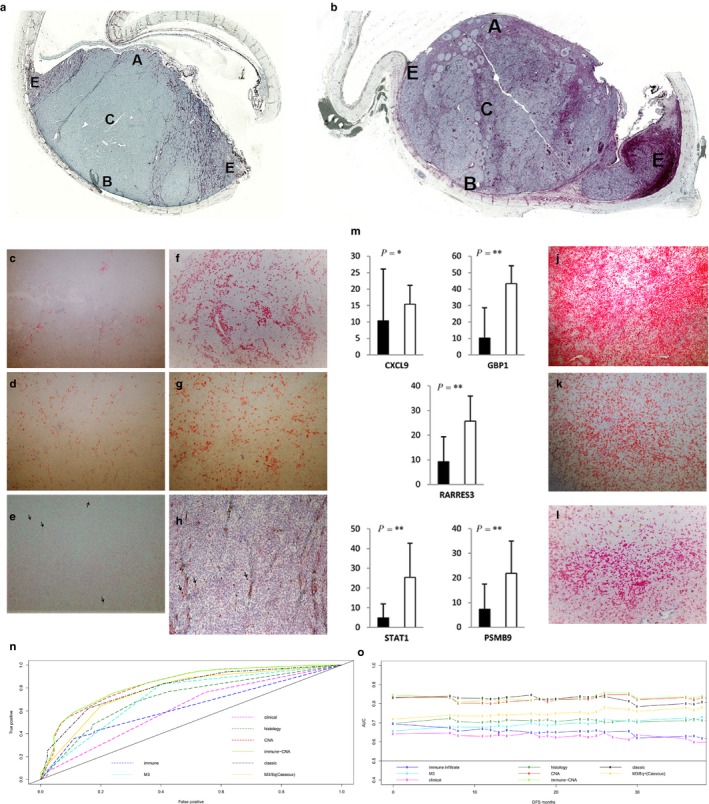
Gene expression analysis divided uveal melanomas into two groups, according to the IFNγ/STAT1-IRF1 pathway activation. Tumors with IFNγ-signature had poorer prognosis and showed increased infiltration of CD8 T lymphocytes and macrophages. Cox multivariate analyses of immune cell infiltration with MLPA data delineated better prognostic value for three prognostic groups (three-tier stratification) than two (two-tier stratification). CNA-based model comprising monosomy 3, 8q amplification, and LZTS1and NBL1 deletions emerged as the best predictor for disease-free survival. It outperformed immune cell infiltration in receiver operating characteristic curves. The model that combined CNA and immune infiltration defined risk-groups according to the number of DNA alterations. Immune cell infiltration was increased in the high-risk group (73.7%), where it did not correlate with patient survival, while it was associated with poorer outcome in the intermediate risk-group.
High degree of immune cell infiltration occurs in a subset of uveal melanomas, is interferon-gamma-related, and associated with poor survival. It allows for two-tier stratification, which is prognostically less efficient than a three-tier one. The best prognostic stratification is by CNA model with three risk-groups where immune cell infiltration impacts only some subgroups.
在葡萄膜黑素瘤中,免疫浸润是预后不良的标志物。本研究旨在破译肿瘤内免疫群体的生物学特征,将其与其他已建立的生物标志物进行比较,并与患者的预后进行比较。
对未经治疗的原发性、主要为伴有视网膜脱离的大型葡萄膜黑素瘤进行分析:转录组谱分析(n=15)、RT-qPCR(n=36)、免疫组织化学(n=89)、多重连接依赖性探针扩增(MLPA)进行拷贝数改变(CNA)分析(n=89)、阵列比较基因组杂交(array-CGH)(n=17)和生存统计分析(n=86)。
基因表达分析根据 IFNγ/STAT1-IRF1 通路的激活将葡萄膜黑素瘤分为两组。具有 IFNγ 特征的肿瘤预后较差,且 CD8 T 淋巴细胞和巨噬细胞浸润增加。用 MLPA 数据对免疫细胞浸润的 Cox 多变量分析,比用两分层(two-tier stratification)法更能清晰地区分预后较好的三个分组(three-tier stratification)。基于 CNA 的模型,包括单体 3、8q 扩增、LZTS1 和 NBL1 缺失,是无病生存的最佳预测因子。它在受试者工作特征曲线中优于免疫细胞浸润。结合 CNA 和免疫浸润的模型根据 DNA 改变的数量定义风险组。高风险组(73.7%)的免疫细胞浸润增加,与患者的生存无关,而在中危组中与较差的预后相关。
高度的免疫细胞浸润发生在葡萄膜黑素瘤的一个亚组中,与干扰素γ有关,并与不良预后相关。它可以进行两分层,比三分层在预后上效率较低。最佳的预后分层是通过 CNA 模型进行的,该模型有三个风险组,其中免疫细胞浸润仅影响某些亚组。