Institute of Medical Microbiology and Hospital Hygiene, University of Düsseldorf, Düsseldorf, Germany.
Cluster of Excellence EXC 1003, Cells in Motion, Münster, Germany.
Front Immunol. 2019 Apr 12;10:778. doi: 10.3389/fimmu.2019.00778. eCollection 2019.
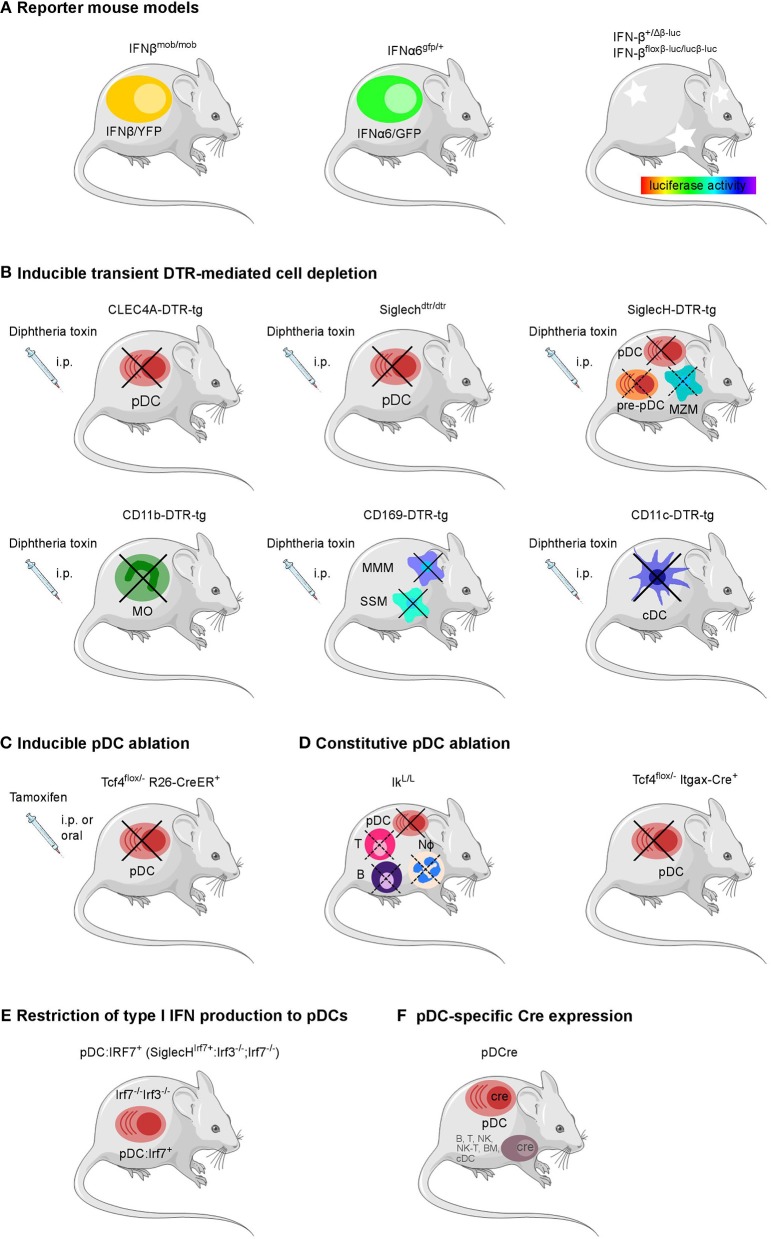
Type I Interferons (IFNs) are hallmark cytokines produced in immune responses to all classes of pathogens. Type I IFNs can influence dendritic cell (DC) activation, maturation, migration, and survival, but also directly enhance natural killer (NK) and T/B cell activity, thus orchestrating various innate and adaptive immune effector functions. Therefore, type I IFNs have long been considered essential in the host defense against virus infections. More recently, it has become clear that depending on the type of virus and the course of infection, production of type I IFN can also lead to immunopathology or immunosuppression. Similarly, in bacterial infections type I IFN production is often associated with detrimental effects for the host. Although most cells in the body are thought to be able to produce type I IFN, plasmacytoid DCs (pDCs) have been termed the natural "IFN producing cells" due to their unique molecular adaptations to nucleic acid sensing and ability to produce high amounts of type I IFN. Findings from mouse reporter strains and depletion experiments in infection models have brought new insights and established that the role of pDCs in type I IFN production is less important than assumed. Production of type I IFN, especially the early synthesized IFNβ, is rather realized by a variety of cell types and cannot be mainly attributed to pDCs. Indeed, the cell populations responsible for type I IFN production vary with the type of pathogen, its tissue tropism, and the route of infection. In this review, we summarize recent findings from models on the cellular source of type I IFN in different infectious settings, ranging from virus, bacteria, and fungi to eukaryotic parasites. The implications from these findings for the development of new vaccination and therapeutic designs targeting the respectively defined cell types are discussed.
I 型干扰素 (IFNs) 是免疫反应中产生的标志性细胞因子,可针对所有病原体类别。I 型 IFNs 可以影响树突状细胞 (DC) 的激活、成熟、迁移和存活,但也可以直接增强自然杀伤 (NK) 和 T/B 细胞的活性,从而协调各种先天和适应性免疫效应功能。因此,I 型 IFNs 长期以来被认为是宿主抵抗病毒感染的重要因素。最近,人们清楚地认识到,取决于病毒的类型和感染的过程,I 型 IFN 的产生也可能导致免疫病理学或免疫抑制。同样,在细菌感染中,I 型 IFN 的产生通常与宿主的有害影响有关。尽管身体中的大多数细胞都被认为能够产生 I 型 IFN,但浆细胞样树突状细胞 (pDC) 因其独特的分子适应核酸感应的能力和产生大量 I 型 IFN 的能力而被称为天然的“IFN 产生细胞”。在 感染模型中的小鼠报告株和耗竭实验的研究结果带来了新的见解,并确立了 pDC 在 I 型 IFN 产生中的作用不如预期的重要。I 型 IFN 的产生,尤其是早期合成的 IFNβ,是由多种细胞类型实现的,不能主要归因于 pDC。事实上,负责 I 型 IFN 产生的细胞群体因病原体的类型、其组织嗜性和感染途径而异。在这篇综述中,我们总结了最近在不同感染环境下,包括病毒、细菌和真菌以及真核寄生虫,针对 I 型 IFN 的细胞来源的 模型的研究结果。讨论了这些发现对针对各自定义的细胞类型制定新的疫苗接种和治疗设计的意义。