Madadi Asl Mojtaba, Vahabie Abdol-Hossein, Valizadeh Alireza
Department of Physics, Institute for Advanced Studies in Basic Sciences (IASBS), Zanjan, Iran.
School of Cognitive Sciences, Institute for Research in Fundamental Sciences (IPM), Tehran, Iran.
Basic Clin Neurosci. 2019 Jan-Feb;10(1):1-12. doi: 10.32598/bcn.9.10.125. Epub 2019 Jan 1.
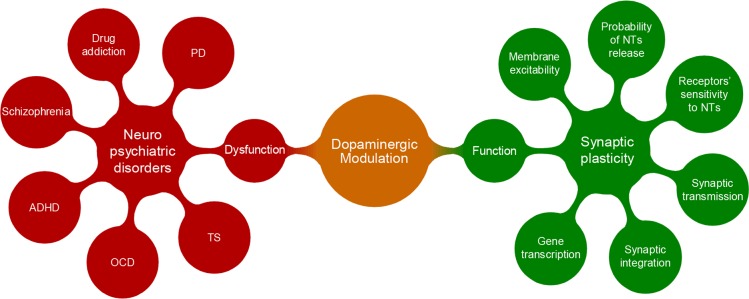
Neuromodulators modify intrinsic characteristics of the nervous system in order to reconfigure the functional properties of neural circuits. This reconfiguration is crucial for the flexibility of the nervous system to respond on an input-modulated basis. Such a functional rearrangement is realized by modification of intrinsic properties of the neural circuits including synaptic interactions. Dopamine is an important neuromodulator involved in motivation and stimulus-reward learning process, and adjusts synaptic dynamics in multiple time scales through different pathways. The modification of synaptic plasticity by dopamine underlies the change in synaptic transmission and integration mechanisms, which affects intrinsic properties of the neural system including membrane excitability, probability of neurotransmitters release, receptors' response to neurotransmitters, protein trafficking, and gene transcription. Dopamine also plays a central role in behavioral control, whereas its malfunction can cause cognitive disorders. Impaired dopamine signaling is implicated in several neuropsychiatric disorders such as Parkinson's disease, drug addiction, schizophrenia, attention-deficit/hyperactivity disorder, obsessive-compulsive disorder and Tourette's syndrome. Therefore, dopamine plays a crucial role in the nervous system, where its proper modulation of neural circuits may enhance plasticity-related procedures, but disturbances in dopamine signaling might be involved in numerous neuropsychiatric disorders. In recent years, several computational models are proposed to formulate the involvement of dopamine in synaptic plasticity or neuropsychiatric disorders and address their connection based on the experimental findings.
神经调质会改变神经系统的内在特性,以便重新配置神经回路的功能特性。这种重新配置对于神经系统在输入调制基础上做出反应的灵活性至关重要。这种功能重排是通过改变包括突触相互作用在内的神经回路的内在特性来实现的。多巴胺是一种重要的神经调质,参与动机和刺激-奖励学习过程,并通过不同途径在多个时间尺度上调节突触动力学。多巴胺对突触可塑性的调节是突触传递和整合机制变化的基础,这会影响神经系统的内在特性,包括膜兴奋性、神经递质释放概率、受体对神经递质的反应、蛋白质运输和基因转录。多巴胺在行为控制中也起着核心作用,而其功能失调会导致认知障碍。多巴胺信号受损与多种神经精神疾病有关,如帕金森病、药物成瘾、精神分裂症、注意力缺陷多动障碍、强迫症和妥瑞氏症。因此,多巴胺在神经系统中起着至关重要的作用,其对神经回路的适当调节可能会增强与可塑性相关的过程,但多巴胺信号的紊乱可能与许多神经精神疾病有关。近年来,人们提出了几种计算模型来阐述多巴胺在突触可塑性或神经精神疾病中的作用,并根据实验结果探讨它们之间的联系。