Zhou Mengyi, Hua Tongtong, Ma Xiaofang, Sun Haijun, Xu Li
College of Chemical Engineering, Nanjing Forestry University, Nanjing, Jiangsu 210037, People's Republic of China.
Advanced Analysis and Testing Center, Nanjing Forestry University, Nanjing, Jiangsu 210037, People's Republic of China.
R Soc Open Sci. 2019 Mar 13;6(3):181571. doi: 10.1098/rsos.181571. eCollection 2019 Mar.
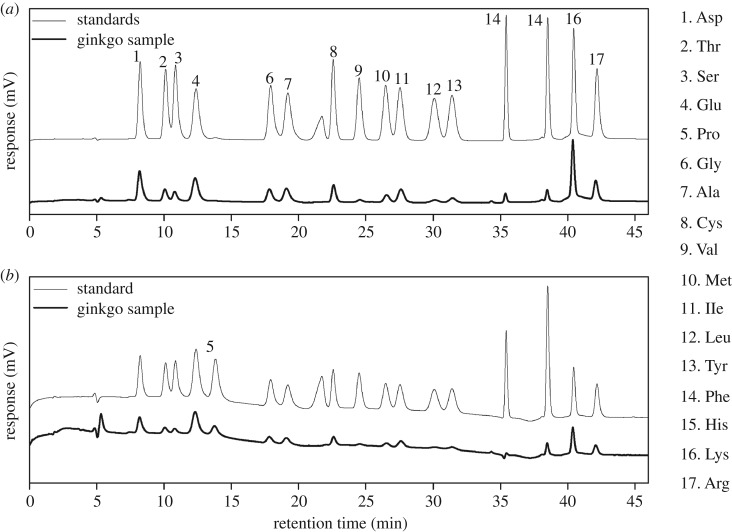
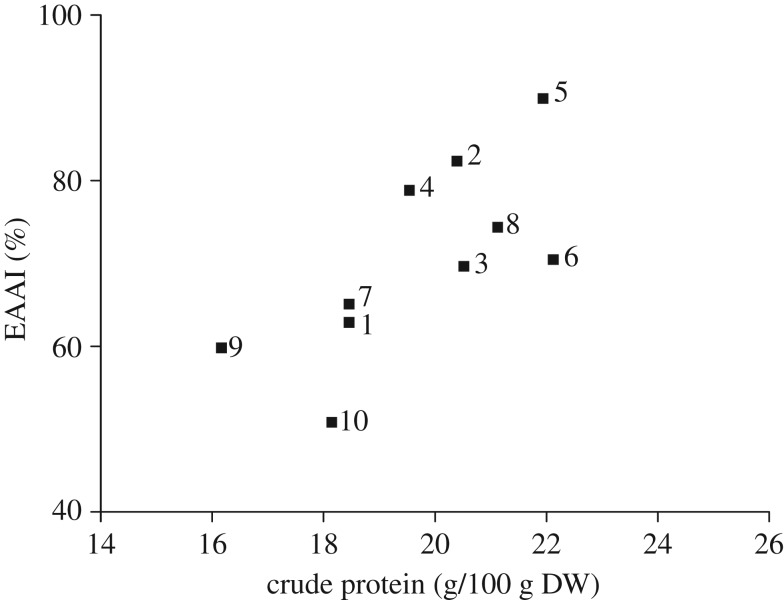
As a traditional food and medicine source, ginkgo ( L.) nut is popularly consumed in East Asia. The aim of this work is to characterize protein content and amino acids profile in 10 ginkgo nut cultivars, named successively as no. 1 to no. 10. There were observed differences among the cultivars with respect to the contents of protein and amino acids, except Cys. The no. 6 cultivar presented the highest protein content (22.1 g/100 g DW), while the no. 9 had the lowest (16.2 g/100 g DW). The contents of EAA and NEAA were revealed to vary in the range of 14.3-26.2 and 21.4-41.1 g/100 g protein, respectively. The most abundant EAA was Leu, and the first limiting amino acid was Lys. The level of Arg was attractive, especially in the no. 5 cultivar (1741 mg/100 g DW) where it is comparable to hazelnut and pistachio. As confirmed by AAS and EAAI, the no. 5 cultivar presented the best amino acids profile and protein quality among these cultivars. These results have relevance to the scientific development and application of ginkgo nuts in the food industry.
作为一种传统的食物和药物来源,银杏果在东亚地区广受欢迎。本研究旨在对10个银杏果品种(依次命名为1号至10号)的蛋白质含量和氨基酸谱进行表征。除半胱氨酸外,各品种在蛋白质和氨基酸含量方面存在差异。6号品种的蛋白质含量最高(22.1 g/100 g干重),而9号品种的蛋白质含量最低(16.2 g/100 g干重)。必需氨基酸和非必需氨基酸的含量分别在14.3 - 26.2 g/100 g蛋白质和21.4 - 41.1 g/100 g蛋白质范围内变化。含量最丰富的必需氨基酸是亮氨酸,第一限制氨基酸是赖氨酸。精氨酸的含量很可观,尤其是在5号品种中(1741 mg/100 g干重),与榛子和开心果相当。经氨基酸评分和必需氨基酸指数证实,5号品种在这些品种中呈现出最佳的氨基酸谱和蛋白质质量。这些结果与银杏果在食品工业中的科学开发和应用相关。