
通过综合生物信息学分析,HOTTIP作为头颈部鳞状细胞癌的关键候选生物标志物发挥作用。
HOTTIP Functions as a Key Candidate Biomarker in Head and Neck Squamous Cell Carcinoma by Integrated Bioinformatic Analysis.
作者信息
Yin Xiteng, Yang Weidong, Xie Junqi, Wei Zheng, Tang Chuanchao, Song Chuanhui, Wang Yufeng, Cai Yu, Xu Wenguang, Han Wei
机构信息
Department of Oral and Maxillofacial Surgery, Nanjing Stomatological Hospital, Medical School of Nanjing University, Nanjing, China.
Central Laboratory of Stomatology, Nanjing Stomatological Hospital, Medical School of Nanjing University, Nanjing, China.
出版信息
Biomed Res Int. 2019 Mar 26;2019:5450617. doi: 10.1155/2019/5450617. eCollection 2019.
BACKGROUND
Accumulating evidence has demonstrated the pivotal role of long noncoding RNAs (lncRNAs) in competing endogenous RNA (ceRNA) networks for predicting survival and evaluating prognosis in cancer patients. However, the pathogenesis of head and neck squamous cell carcinoma (HNSCC) remains unclear, and prognostic biomarkers for HNSCC are still lacking.
METHODS
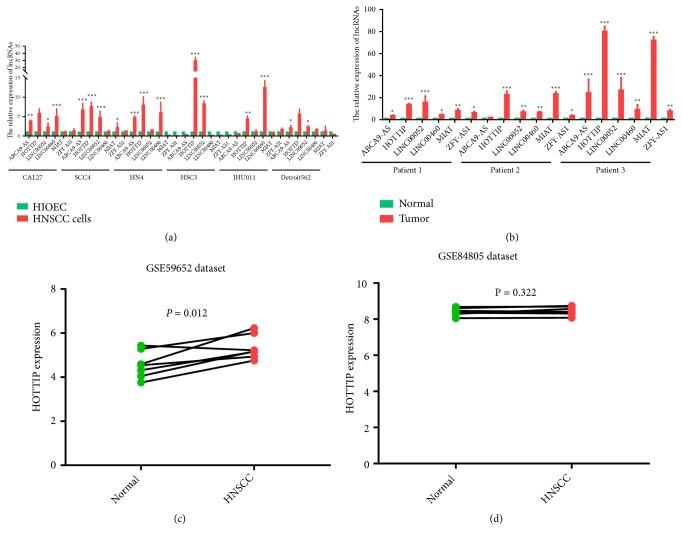
A total of 546 RNA sequencing profiles of HNSCC patients with clinical outcome data were obtained from the Cancer Genome Atlas (TCGA) database, providing a large sample of RNA sequencing data. From these, 71 Long noncoding RNAs lncRNAs, 8 microRNAs (miRNAs), and 16 messenger RNAs (mRNAs) were identified to construct a HNSCC-specific ceRNA network (fold change >2, P < 0.05). Univariate and multivariate Cox proportional regression models were used to assess independent indicators of prognosis. Then the expression of lncRNAs harboring prognostic value was validated in human HNSCC cell lines and tumor samples from our cohort and another two datasets from GEO (Gene Expression Omnibus) databases.
RESULTS
As a result, a 3-mRNA signature and 6-lncRNA signature were identified. The six-lncRNA signature exhibited the highest prognostic value. Notably, in the six lncRNAs, HOTTIP showed the greatest prognostic value and was significantly correlated with clinical stage and histological grade of HNSCC patients. Furthermore, it was proved that HOTTIP was upregulated in HNSCC cell lines and cancerous tissues compared with corresponding normal cell lines and normal tissues. Functional assessment analysis revealed that HOTTIP might play a key role in the oncogenesis and progression of HNSCC.
CONCLUSION
The present study deepened our understanding of the ceRNA-related regulatory mechanism in the pathogenesis of HNSCC and identified candidate prognostic biomarkers for clinical outcome prediction in HNSCC. HOTTIP may function as a key candidate biomarker in HNSCC and serve as a prognostic marker for HNSCC patients.
背景
越来越多的证据表明,长链非编码RNA(lncRNA)在竞争性内源RNA(ceRNA)网络中对于预测癌症患者的生存和评估预后起着关键作用。然而,头颈部鳞状细胞癌(HNSCC)的发病机制仍不清楚,且HNSCC的预后生物标志物仍然缺乏。
方法
从癌症基因组图谱(TCGA)数据库中获得了总共546例具有临床结局数据的HNSCC患者的RNA测序图谱,提供了大量的RNA测序数据样本。从中鉴定出71种长链非编码RNA(lncRNA)、8种微小RNA(miRNA)和16种信使RNA(mRNA),以构建HNSCC特异性ceRNA网络(倍数变化>2,P<0.05)。使用单变量和多变量Cox比例回归模型评估预后的独立指标。然后在我们队列中的人HNSCC细胞系和肿瘤样本以及来自基因表达综合数据库(GEO)的另外两个数据集中验证具有预后价值的lncRNA的表达。
结果
结果鉴定出一个由3种mRNA组成的特征和一个由6种lncRNA组成的特征。六种lncRNA特征显示出最高的预后价值。值得注意的是,在这六种lncRNA中,HOTTIP显示出最大的预后价值,并且与HNSCC患者的临床分期和组织学分级显著相关。此外,与相应的正常细胞系和正常组织相比,HOTTIP在HNSCC细胞系和癌组织中上调得到证实。功能评估分析表明,HOTTIP可能在HNSCC的肿瘤发生和进展中起关键作用。
结论
本研究加深了我们对HNSCC发病机制中ceRNA相关调控机制的理解,并鉴定出用于预测HNSCC临床结局的候选预后生物标志物。HOTTIP可能是HNSCC中的关键候选生物标志物,并可作为HNSCC患者的预后标志物。




 Zotero 插件