Chronobiology Unit, Groningen Institute for Evolutionary Life Sciences, University of Groningen, Groningen, The Netherlands.
Chrono@Work, Groningen, The Netherlands.
J Pineal Res. 2019 Aug;67(1):e12583. doi: 10.1111/jpi.12583. Epub 2019 May 9.
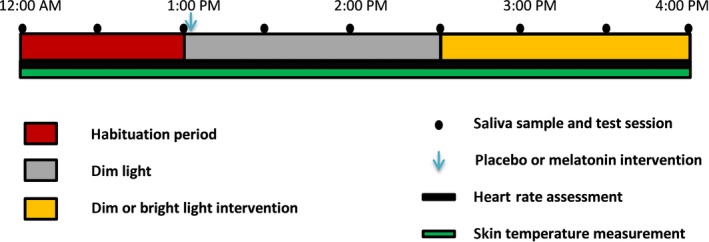
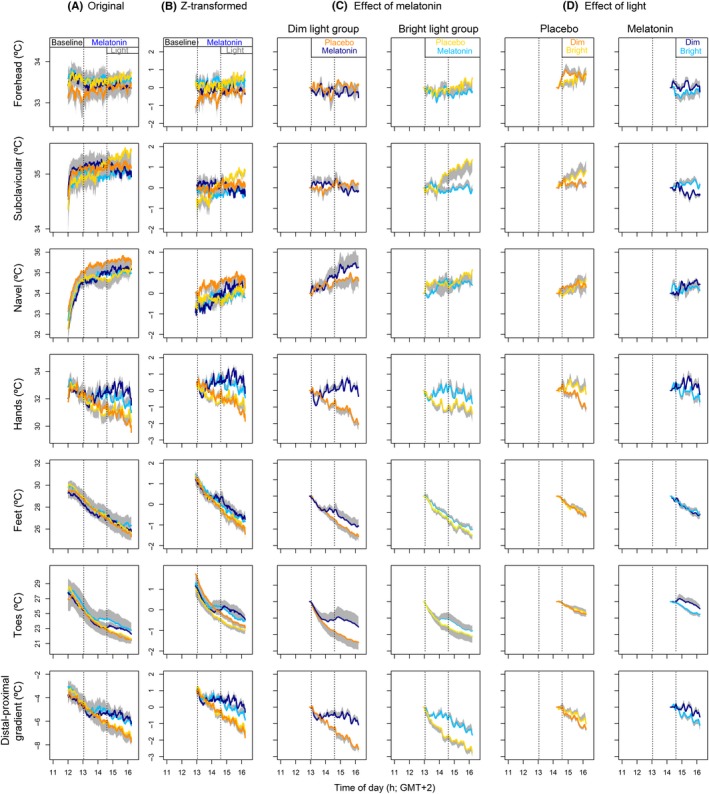
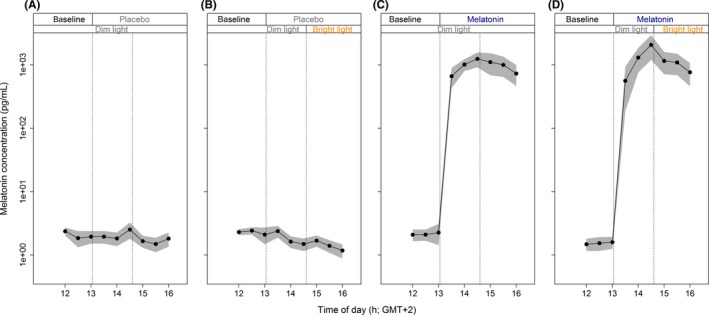
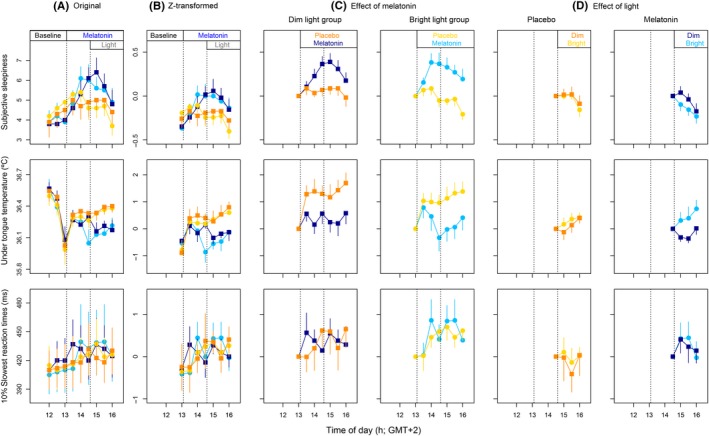
Light significantly improves alertness during the night (Cajochen, Sleep Med Rev, 11, 2007 and 453; Ruger et al., AJP Regul Integr Comp Physiol, 290, 2005 and R1413), but results are less conclusive at daytime (Lok et al., J Biol Rhythms, 33, 2018 and 589). Melatonin and core body temperature levels at those times of day may contribute to differences in alerting effects of light. In this experiment, the combined effect of daytime exogenous melatonin administration and light intensity on alertness, body temperature, and skin temperature was studied. The goal was to assess whether (a) alerting effects of light are melatonin dependent, (b) soporific effects of melatonin are mediated via the thermoregulatory system, and (c) light can improve alertness after melatonin-induced sleepiness during daytime. 10 subjects (5 females, 5 males) received melatonin (5 mg) in dim (10 lux) and, on a separate occasion, in bright polychromatic white light (2000 lux). In addition, they received placebo both under dim and bright light conditions. Subjects participated in all four conditions in a balanced order, yielding a balanced within-subject design, lasting from noon to 04:00 pm. Alertness and performance were assessed half hourly, while body temperature and skin temperature were measured continuously. Saliva samples to detect melatonin concentrations were collected half hourly. Melatonin administration increased melatonin concentrations in all subjects. Subjective sleepiness and distal skin temperature increased after melatonin ingestion. Bright light exposure after melatonin administration did not change subjective alertness scores, but body temperature and proximal skin temperature increased, while distal skin temperature decreased. Light exposure did not significantly affect these parameters in the placebo condition. These results indicate that (a) exogenous melatonin administration during daytime increases subjective sleepiness, confirming a role for melatonin in sleepiness regulation, (b) bright light exposure after melatonin ingestion significantly affected thermoregulatory parameters without altering subjective sleepiness, therefore temperature changes seem nonessential for melatonin-induced sleepiness, (c) subjective sleepiness was increased by melatonin ingestion, but bright light administration was not able to improve melatonin-induced sleepiness feelings nor performance. Other (physiological) factors may therefore contribute to differences in alerting effects of light during daytime and nighttime.
光在夜间显著提高警觉性(Cajochen,Sleep Med Rev,11,2007 和 453;Ruger 等人,AJP Regul Integr Comp Physiol,290,2005 和 R1413),但在白天的效果则不太确定(Lok 等人,J Biol Rhythms,33,2018 和 589)。在这些时候,褪黑素和核心体温水平可能会影响光的警觉作用的差异。在这项实验中,研究了白天外源性褪黑素给药和光照强度对警觉性、体温和皮肤温度的综合影响。目的是评估(a)光的警觉作用是否依赖于褪黑素,(b)褪黑素的催眠作用是否通过体温调节系统介导,以及(c)在白天褪黑素引起的困倦后,光是否可以改善警觉性。10 名受试者(5 名女性,5 名男性)在暗光(10 勒克斯)和明亮的多色白光(2000 勒克斯)下接受了褪黑素(5 毫克)。此外,他们在暗光和强光条件下都接受了安慰剂。受试者以平衡的顺序参加了所有四种条件,产生了平衡的个体内设计,从中午持续到下午 4 点。每半小时评估一次警觉性和表现,同时连续测量体温和皮肤温度。每半小时收集唾液样本以检测褪黑素浓度。褪黑素给药增加了所有受试者的褪黑素浓度。褪黑素摄入后,主观困倦和远端皮肤温度升高。褪黑素给药后暴露在明亮的光线下并没有改变主观警觉性评分,但体温和近端皮肤温度升高,而远端皮肤温度下降。在安慰剂条件下,光照对这些参数没有显著影响。这些结果表明:(a)白天外源性褪黑素给药会增加主观困倦,证实褪黑素在睡眠调节中的作用;(b)褪黑素摄入后暴露在明亮的光线下会显著影响体温调节参数,而不会改变主观困倦,因此体温变化对于褪黑素引起的困倦似乎不是必需的;(c)褪黑素摄入会增加主观困倦,但明亮的光照射不能改善褪黑素引起的困倦感或表现。因此,其他(生理)因素可能会导致白天和夜间光照警觉作用的差异。