Human-Technology Interaction, School of Innovation Sciences, Eindhoven University of Technology, Eindhoven, the Netherlands.
J Biol Rhythms. 2018 Dec;33(6):649-661. doi: 10.1177/0748730418796438. Epub 2018 Sep 10.
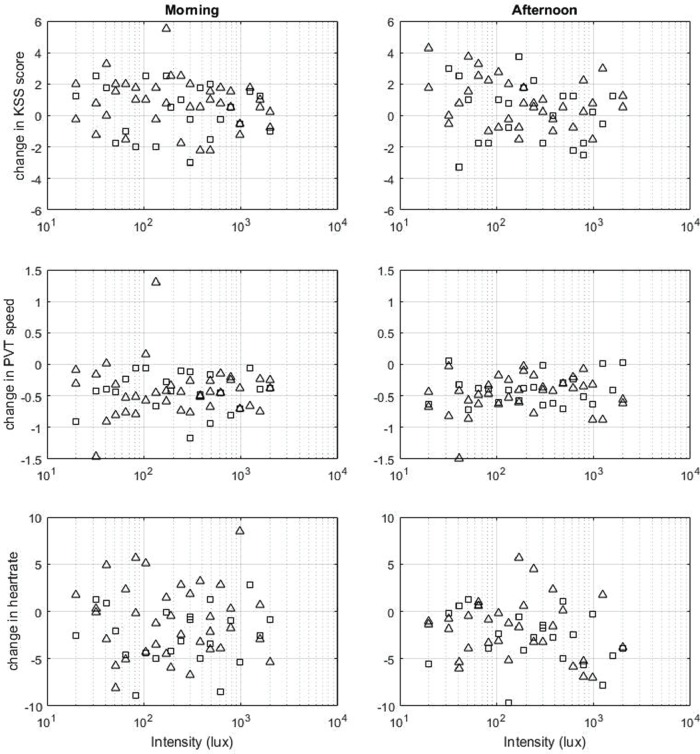
To date, it is largely unknown which light settings define the optimum to steer alertness and cognitive control during regular daytime working hours. In the current article, we used a multimeasure approach combined with a relatively large sample size ( N = 60) and a large range of intensity levels (20-2000 lux at eye level) to investigate the dose-dependent relationship between light and correlates of alertness and executive control during regular working hours in the morning and afternoon. Each participant was exposed to a single-intensity light level for 1 h after a 30-min baseline phase (100 lux at the eye) in the morning and afternoon (on separate days) during their daily routine. Results revealed no clear dose-dependent relationships between 1-h daytime light exposure and correlates of alertness or executive control. Subjective correlates showed only very modest linear relationships with the log-transformed illuminance, and we found no significant effects of light intensity on the behavioral and physiological indicators. Overall, these results suggest that daytime exposure to more intense light, at least for 1 h of exposure, may not systematically benefit alertness or executive functioning. However, future research is required to investigate effects of longer exposure durations and potential moderations by prior light exposure, personal characteristics, and spectrum.
迄今为止,人们对于在日常白天工作时间内,哪种光照设置最能促进警觉和认知控制,仍知之甚少。在当前的文章中,我们采用了多指标方法,结合了较大的样本量(N=60)和较大的强度范围(20-2000 勒克斯在眼睛水平),来研究在早晨和下午的常规工作时间内,光照与警觉和执行控制相关因素之间的剂量依赖性关系。在日常工作中,每个参与者在基线阶段(眼睛处 100 勒克斯)后 30 分钟,在上午和下午(在不同的日子)分别暴露于 1 小时的单一强度光线下。结果表明,在白天 1 小时的光照暴露与警觉或执行控制的相关因素之间没有明显的剂量依赖性关系。主观相关性仅与对数光照度显示出非常适度的线性关系,我们没有发现光照强度对行为和生理指标有显著影响。总体而言,这些结果表明,白天暴露于更高强度的光下,至少暴露 1 小时,可能不会系统地改善警觉或执行功能。然而,需要进一步的研究来调查更长的暴露时间的影响以及先前的光照暴露、个人特征和光谱的潜在调节作用。