NIHR Health Protection Research Unit in Emerging Zoonotic Infections, Institute of Infection and Global Health, NCZR, Neston, UK.
Epidemiology and Population Health, Institute of Global Health, NCZR, Neston, UK.
Zoonoses Public Health. 2019 Sep;66(6):686-694. doi: 10.1111/zph.12581. Epub 2019 Apr 29.
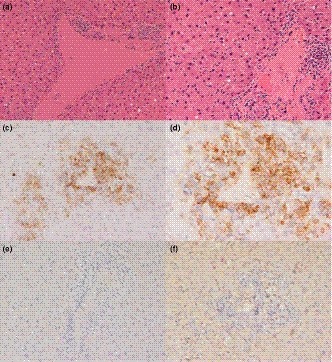
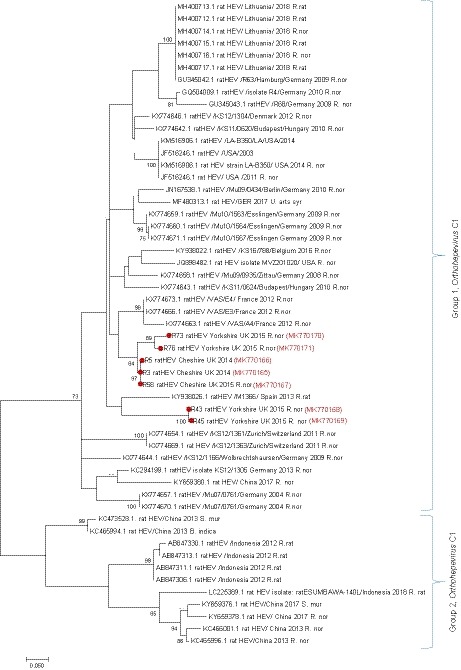
In the United Kingdom, there has been an increase in the number of hepatitis E virus (HEV) infections in people annually since 2010. Most of these are thought to be indigenously acquired Orthohepevirus A genotype 3 (HEV G3), which has been linked to pork production and consumption. However, the dominant subgroup circulating in British pigs differs from that which is found in people; therefore, an alternative, potentially zoonotic, source is suspected as a possible cause of these infections. Rodents, brown rats (Rattus norvegicus) in particular, have been shown to carry HEV, both the swine HEV G3 genotype and Orthohepevirus C, genotype C1 (rat HEV). To investigate the prevalence of HEV in British rodents, liver tissue was taken from 307 rodents collected from pig farms (n = 12) and other locations (n = 10). The RNA from these samples was extracted and tested using a pan-HEV nested RT-PCR. Limited histopathology was also performed. In this study, 8/61 (13%, 95% CI, 5-21) of brown rat livers were positive for HEV RNA. Sequencing of amplicons demonstrated all infections to be rat HEV with 87%-92% nucleotide identity to other rat HEV sequences circulating within Europe and China (224 nt ORF-1). Lesions and necrosis were observed histologically in 2/3 samples examined. No rat HEV RNA was detected in any other species, and no HEV G3 RNA was detected in any rodent in this study. This is the first reported detection of rat HEV in Great Britain. A human case of rat HEV infection has recently been reported in Asia, suggesting that rat HEV could pose a risk to public health.
自 2010 年以来,英国每年的戊型肝炎病毒(HEV)感染人数有所增加。这些感染大多被认为是本土获得的正肝病毒属 A 基因型 3(HEV G3),与猪肉生产和消费有关。然而,在英国猪中循环的主要亚群与在人群中发现的不同;因此,怀疑存在另一种可能的、可能的人畜共患病源,可能是这些感染的原因。啮齿动物,特别是褐家鼠(Rattus norvegicus),已被证明携带 HEV,包括猪 HEV G3 基因型和正肝病毒属 C,基因型 C1(鼠 HEV)。为了调查英国啮齿动物中 HEV 的流行情况,从猪养殖场(n=12)和其他地点(n=10)采集了 307 只啮齿动物的肝脏组织。这些样本的 RNA 用 pan-HEV 嵌套 RT-PCR 提取和检测。还进行了有限的组织病理学检查。在这项研究中,8/61(13%,95%置信区间,5-21)的褐家鼠肝脏 HEV RNA 阳性。扩增子测序表明所有感染均为鼠 HEV,与欧洲和中国(224 nt ORF-1)循环的其他鼠 HEV 序列具有 87%-92%的核苷酸同一性。在检查的 2/3 个样本中观察到组织学病变和坏死。在本研究中,未在任何其他物种中检测到鼠 HEV RNA,也未在任何啮齿动物中检测到 HEV G3 RNA。这是英国首次报道的鼠 HEV 检测。最近在亚洲报告了一例人类感染鼠 HEV 的病例,表明鼠 HEV 可能对公众健康构成威胁。