College of Science, Health, Engineering and Education, School of Veterinary and Life Sciences, Murdoch University, Western Australia, Australia.
Ausvet, Fremantle, Western Australia, Australia.
PLoS Negl Trop Dis. 2019 Apr 29;13(4):e0007384. doi: 10.1371/journal.pntd.0007384. eCollection 2019 Apr.
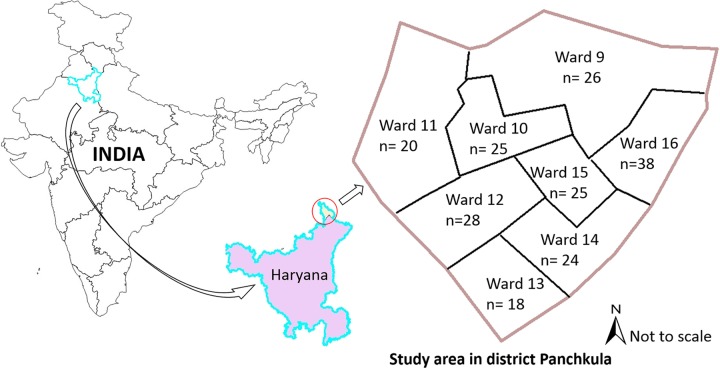
Canine rabies is endemic in urban India. A questionnaire was administered to 204 residents of the urbanised municipality of Panchkula in north India to assess the influence of gender, age, family size, social status and dog ownership, over the knowledge, attitudes and practices (KAP) towards rabies control and free-roaming dogs (FRD) in their locality. Bivariate analyses revealed significant knowledge gaps regarding crucial information on the control and transmission of rabies. Multivariable logistic regression models found that the respondents with a high/middle socio-economic status were likely to be more knowledgeable than those from low socio-economic levels (OR 3.03, 95%CI 1.5-6.0, p = 0.001). Households with children ≤14 years of age were likely to be lacking in knowledge about rabies compared to households with older or no children (OR 0.5, 95%CI 0.3-0.9, p = 0.04). The attitudes and practices of the respondents towards rabies control was positive in households with a high/middle socio-economic status (OR 3.4, 95%CI 1.7-7.2, p = 0.0008) but poor in older (≥ 35 years) participants (OR 0.4, 95%CI 0.2-0.7, p = 0.001). It is concluded that rabies awareness campaigns should be developed and conducted to target sectors of the urban community such as those belonging to lower socio-economic sections and schools to improve the residents' knowledge and practices towards rabies. Educating dog owners about sterilising their pets is also recommended to alter the attitudes of the residents towards FRD population control.
印度城市流行犬狂犬病。印度北部城市化的潘奇库拉市(Panchkula)有 204 名居民接受了问卷调查,以评估性别、年龄、家庭规模、社会地位和养狗等因素对狂犬病控制和当地流浪犬(FRD)的知识、态度和实践(KAP)的影响。双变量分析显示,关于狂犬病控制和传播的关键信息存在明显的知识差距。多变量逻辑回归模型发现,社会经济地位较高/中等的受访者比社会经济地位较低的受访者更有可能具有更多的知识(OR 3.03,95%CI 1.5-6.0,p = 0.001)。有≤14 岁儿童的家庭与有年龄较大或没有孩子的家庭相比,对狂犬病的了解可能较少(OR 0.5,95%CI 0.3-0.9,p = 0.04)。在社会经济地位较高/中等的家庭中,受访者对狂犬病控制的态度和做法是积极的(OR 3.4,95%CI 1.7-7.2,p = 0.0008),但在年龄较大(≥35 岁)的参与者中则较差(OR 0.4,95%CI 0.2-0.7,p = 0.001)。结论是,应制定和开展狂犬病宣传活动,以针对城市社区的某些部门,如社会经济地位较低的部门和学校,以提高居民对狂犬病的认识和实践。还建议教育狗主人对其宠物进行绝育,以改变居民对 FRD 人口控制的态度。