Ministry of Health and Child Care, Seke, Zimbabwe.
National University of Science and Technology, Faculty of Applied Science, Department of Environmental Science and Health, Bulawayo, Zimbabwe.
PLoS Negl Trop Dis. 2021 Mar 31;15(3):e0009305. doi: 10.1371/journal.pntd.0009305. eCollection 2021 Mar.
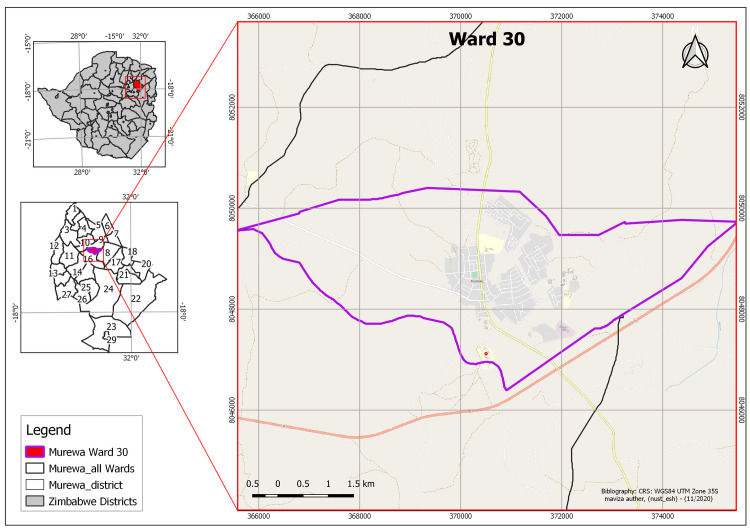
Zoonoses are a major threat to human health. Worldwide, rabies is responsible for approximately 59 000 deaths annually. In Zimbabwe, rabies is one of the top 5 priority diseases and it is notifiable. It is estimated that rabies causes 410 human deaths per year in the country. Murewa district recorded 938 dog bite cases and 4suspected rabies deaths between January 2017 and July 2018, overshooting the threshold of zero rabies cases. Of the 938dog bite cases reported in the district, 263 were reported in Ward 30 and these included all the 4suspected rabies deaths reported in the district. This necessitated a study to assess risk factors for contracting rabies in Ward 30, Murewa.
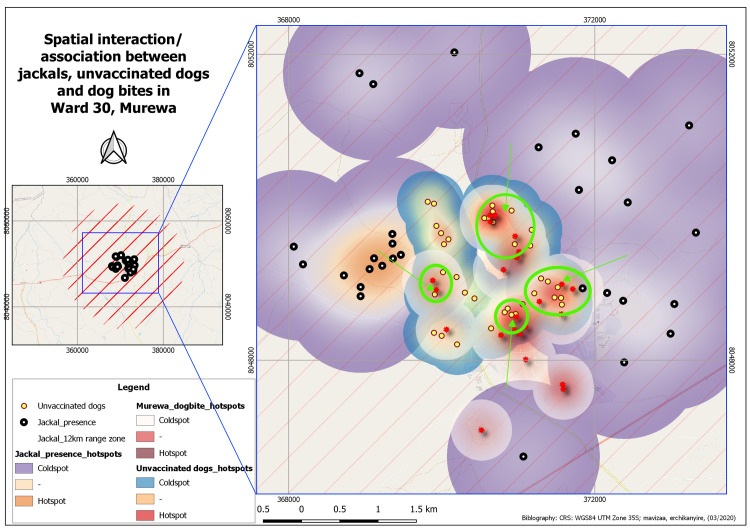
METHODOLOGY/ PRINCIPAL FINDINGS: A descriptive cross sectional survey was used for a retrospective analysis of a group of dog bite cases reported at Murewa Hospital, in Ward 30. Purposive sampling was used to select dog bite cases and snowball sampling was used to locate unvaccinated dogs and areas with jackal presence. The dog bite cases and relatives of rabies cases were interviewed using a piloted interviewer-administered questionnaire. Geographical Positioning System (GPS) coordinates of dog bite cases, vaccinated and unvaccinated dogs and jackal presence were collected using handheld GPS device. QGIS software was used to spatially analyse and map them. Dog owners were 10 times more likely to contract rabies compared to non-dog owners (RR = 10, 95% CI 1.06-93.7). Owners of unvaccinated dogs were 5 times more likely to contract rabies compared to owners of vaccinated dogs (RR = 5.01, 95% CI 0.53-47.31). Residents of the high density cluster (area with low cost houses and stand size of 300 square meters and below) were 64 times more likely to contract rabies compared to non-high density cluster residents (RR = 64.87, 95% CI 3.6039-1167.82). Participants who were not knowledgeable were 0.07 times more likely to contract rabies, compared to those who had knowledge about rabies. (RR = 0.07, 95% CI 0.004-1.25). Our study shows that the risk factors for contacting rabies included; low knowledge levels regarding rabies, dog ownership residing in the high density cluster, owning unvaccinated dogs and spatial overlap of jackal presence with unvaccinated dogs.
人畜共患病对人类健康构成重大威胁。在全球范围内,狂犬病每年导致约 59000 人死亡。在津巴布韦,狂犬病是前 5 大优先疾病之一,需要报告。据估计,该国每年有 410 人死于狂犬病。穆雷瓦区在 2017 年 1 月至 2018 年 7 月期间记录了 938 起狗咬伤病例和 4 例疑似狂犬病死亡病例,超过了零狂犬病病例的阈值。在该地区报告的 938 例狗咬伤病例中,30 区报告了 263 例,其中包括该地区报告的 4 例疑似狂犬病死亡病例。这就需要对穆雷瓦 30 区的狂犬病发病风险因素进行研究。
方法/主要发现:采用描述性横断面调查对穆雷瓦医院报告的一组狗咬伤病例进行回顾性分析。采用目的抽样选择狗咬伤病例,采用雪球抽样选择未接种疫苗的狗和有豺狼存在的区域。用经过试验的调查员管理问卷对狗咬伤病例及其狂犬病病例的亲属进行访谈。使用手持 GPS 设备收集狗咬伤病例、接种疫苗和未接种疫苗的狗以及豺狼存在的地理定位系统 (GPS) 坐标。使用 QGIS 软件对其进行空间分析和制图。与非狗主人相比,狗主人患狂犬病的风险高 10 倍(RR = 10,95%CI 1.06-93.7)。与接种疫苗的狗主人相比,未接种疫苗的狗主人患狂犬病的风险高 5 倍(RR = 5.01,95%CI 0.53-47.31)。居住在高密度聚居区(低成本房屋区,占地面积 300 平方米及以下)的居民患狂犬病的风险比非高密度聚居区居民高 64 倍(RR = 64.87,95%CI 3.6039-1167.82)。与狂犬病知识较高的参与者相比,知识水平较低的参与者患狂犬病的风险高 0.07 倍(RR = 0.07,95%CI 0.004-1.25)。我们的研究表明,接触狂犬病的危险因素包括:狂犬病知识水平低、居住在高密度聚居区的狗主人、拥有未接种疫苗的狗以及豺狼与未接种疫苗的狗在空间上重叠。