Centre for Research in Ageing and Cognitive Health, School of Psychology, University of Exeter Medical School and College of Life and Environmental Sciences, St Luke's Campus, Exeter, UK.
Centre of Applied Dementia Studies, University of Bradford, Bradford, UK.
Int J Geriatr Psychiatry. 2019 Aug;34(8):1251-1261. doi: 10.1002/gps.5128. Epub 2019 May 20.
The objectives of the study are to investigate how different levels of functional ability relate to quality of life, well-being, and satisfaction with life, conceptualised as reflecting capability to "live well" in people with dementia.
METHODS/DESIGN: Participants were 1496 people with mild-to-moderate dementia and 1188 informants who completed baseline assessments in the Improving the experience of Dementia and Enhancing Active Life (IDEAL) cohort study. Total self-rated and informant-rated scores on the Functional Activities Questionnaire were split into six ability levels to monitor how poorer functioning impacts the ability to live well. We also investigated the potential influence of sociodemographic and diagnostic variables, depression, cognition, and carer stress.
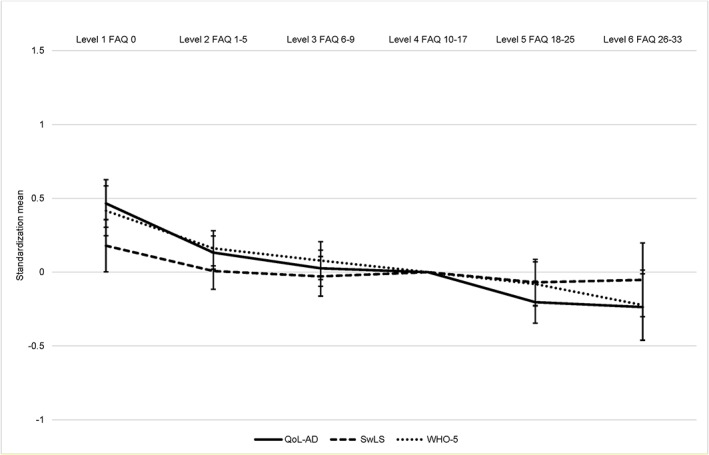
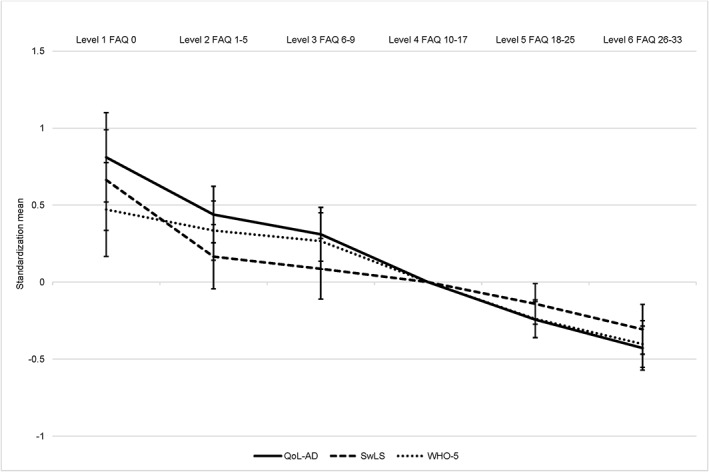
Multivariate multiple regression models found that people with dementia who had the greatest functional impairment according to self-ratings and informant ratings had poorer living well scores than those with the least functional impairment. Sociodemographic and diagnostic factors and cognition had little impact on effect sizes. For self-ratings, depression attenuated the relationship between functional ability and living well, whereas carer stress attenuated informant ratings.
People with dementia with the least functional impairments had greater capability to live well than those with the most functional impairment. Even subtle perceived difficulties in functional ability had a detrimental effect on the ability of people with dementia to live well. Depression in people with dementia and carer stress in informants influenced these associations, and therefore, these factors should be routinely included in future research studies and clinical assessments.
本研究旨在探讨不同功能能力水平与生活质量、幸福感和生活满意度的关系,这些概念被视为反映痴呆患者“生活良好”的能力。
方法/设计:参与者为 1496 名轻度至中度痴呆患者和 1188 名在改善痴呆体验和增强积极生活(IDEAL)队列研究中完成基线评估的知情者。全自评分和知情者评分的功能活动问卷总得分分为六个能力水平,以监测功能障碍程度对“生活良好”能力的影响。我们还调查了社会人口学和诊断变量、抑郁、认知和照顾者压力的潜在影响。
多变量多元回归模型发现,根据自我评估和知情者评估,功能障碍最严重的痴呆患者的生活良好评分比功能障碍最轻微的患者差。社会人口学和诊断因素以及认知对效应大小的影响较小。对于自我评估,抑郁减弱了功能能力与生活良好之间的关系,而照顾者压力减弱了知情者的评估。
功能障碍最轻微的痴呆患者比功能障碍最严重的患者具有更大的生活能力。即使是功能能力上的细微感知困难,也会对痴呆患者的生活能力产生不利影响。痴呆患者的抑郁和知情者的照顾者压力影响了这些关联,因此,这些因素应在未来的研究和临床评估中常规纳入。