Hayashi Masaru, Matsuo Koji, Tanabe Kazuhiro, Ikeda Masae, Miyazawa Mariko, Yasaka Miwa, Machida Hiroko, Shida Masako, Imanishi Tadashi, Grubbs Brendan H, Hirasawa Takeshi, Mikami Mikio
Department of Obstetrics and Gynecology, Tokai University School of Medicine, Kanagawa 2591193, Japan.
Division of Gynecologic Oncology, Department of Obstetrics and Gynecology, University of Southern California, Los Angeles, CA 90033, USA.
Cancers (Basel). 2019 Apr 27;11(5):591. doi: 10.3390/cancers11050591.
To conduct a comprehensive glycopeptide spectra analysis of serum between cancer and non-cancer patients to identify early biomarkers of epithelial ovarian cancer (EOC).
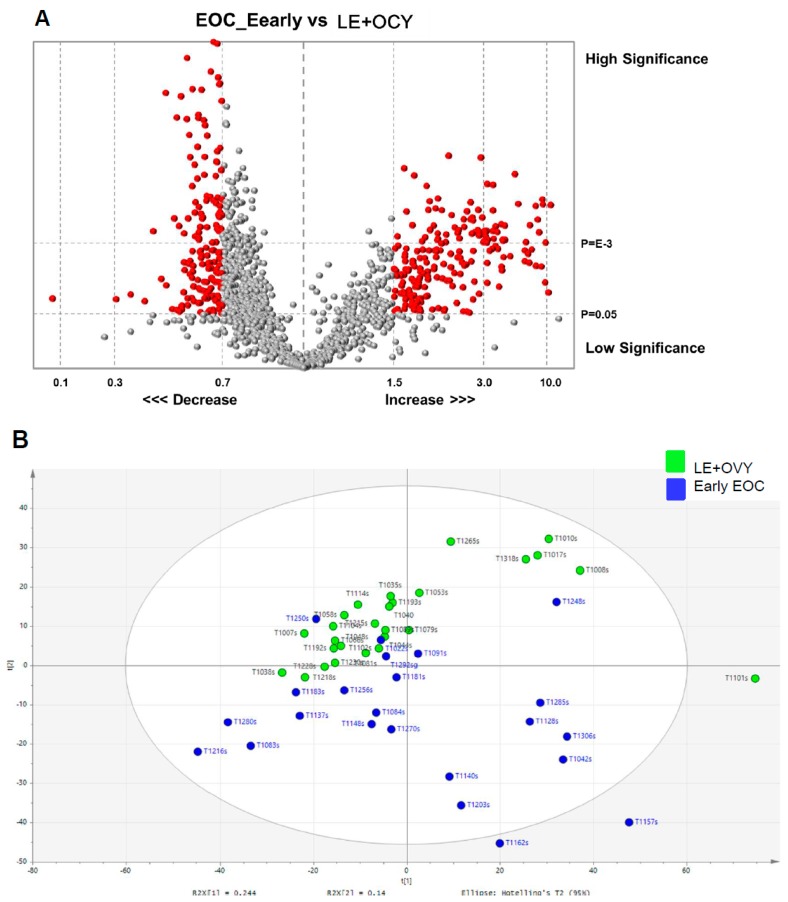
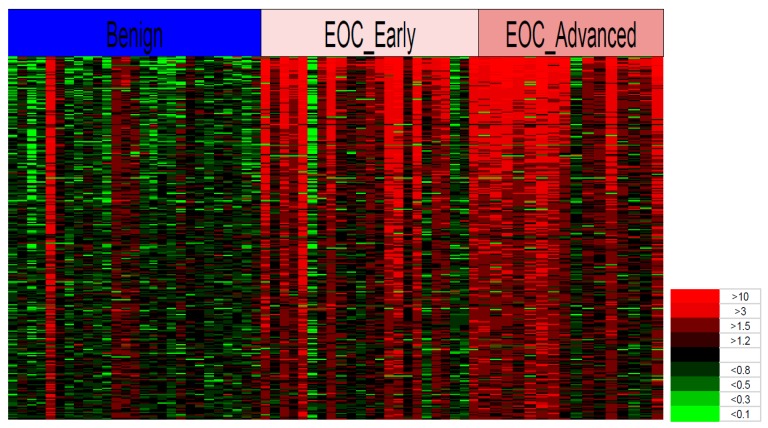
Approximately 30,000 glycopeptide peaks were detected from the digested serum glycoproteins of 39 EOC patients (23 early-stage, 16 advanced-stage) and 45 non-cancer patients (27 leiomyoma and ovarian cyst cases, 18 endometrioma cases) by liquid chromatography mass spectrometry (LC-MS). The differential glycopeptide peak spectra were analyzed to distinguish between cancer and non-cancer groups by employing multivariate analysis including principal component analysis (PCA), orthogonal partial least squares discriminant analysis (OPLS-DA) and heat maps.
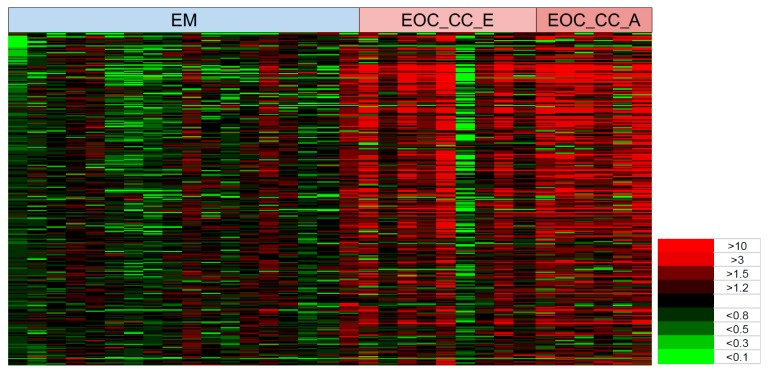
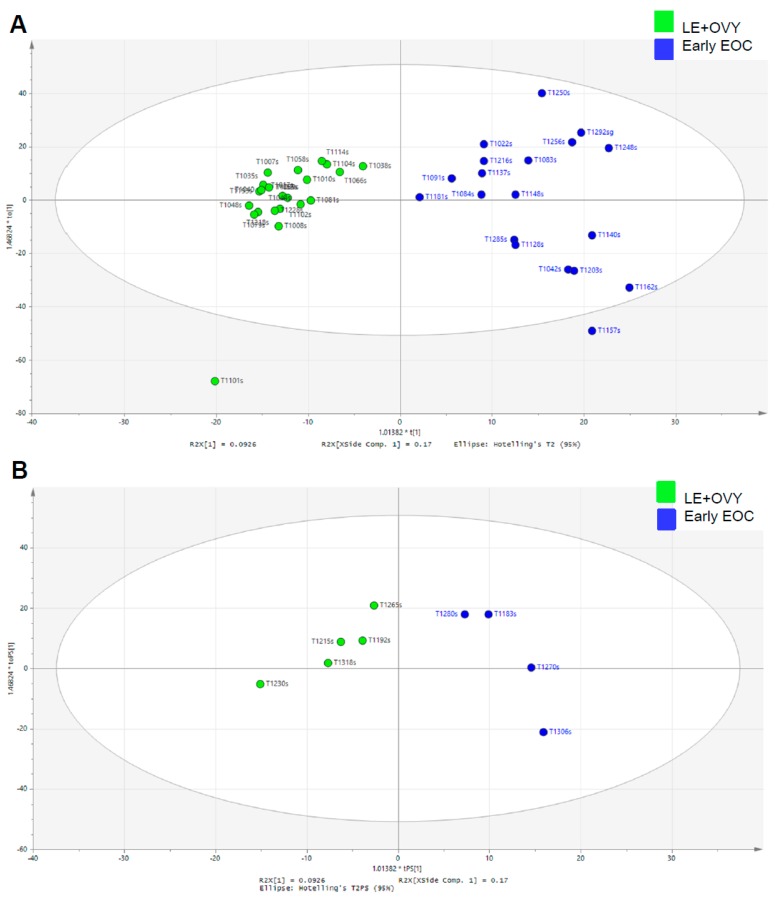
Examined spectral peaks were filtered down to 2281 serum quantitative glycopeptide signatures for differentiation between ovarian cancer and controls using multivariate analysis. The OPLS-DA model using cross-validation parameters R2 and Q2 and score plots of the serum samples significantly differentiated the EOC group from the non-cancer control group. In addition, women with early-stage clear cell carcinoma and endometriomas were clearly distinguished from each other by OPLS-DA as well as by PCA and heat maps.
Our study demonstrates the potential of comprehensive serum glycoprotein analysis as a useful tool for ovarian cancer detection.
对癌症患者和非癌症患者的血清进行全面的糖肽谱分析,以确定上皮性卵巢癌(EOC)的早期生物标志物。
通过液相色谱质谱联用仪(LC-MS)从39例EOC患者(23例早期、16例晚期)和45例非癌症患者(27例平滑肌瘤和卵巢囊肿病例、18例子宫内膜异位症病例)的消化后血清糖蛋白中检测到约30,000个糖肽峰。采用包括主成分分析(PCA)、正交偏最小二乘判别分析(OPLS-DA)和热图在内的多变量分析,对差异糖肽峰谱进行分析,以区分癌症组和非癌症组。
使用多变量分析将检测到的谱峰筛选至2281个血清定量糖肽特征,用于区分卵巢癌和对照组。使用交叉验证参数R2和Q2的OPLS-DA模型以及血清样本的得分图显著区分了EOC组和非癌症对照组。此外,早期透明细胞癌患者和子宫内膜异位症患者通过OPLS-DA以及PCA和热图也能清楚地相互区分。
我们的研究表明,全面的血清糖蛋白分析作为卵巢癌检测的有用工具具有潜力。