Groen K, van de Donk Nwcj, Stege Cam, Zweegman S, Nijhof I S
Department of Hematology, VU University Medical Center, Amsterdam, Netherlands,
Cancer Manag Res. 2019 Apr 2;11:2663-2675. doi: 10.2147/CMAR.S150653. eCollection 2019.
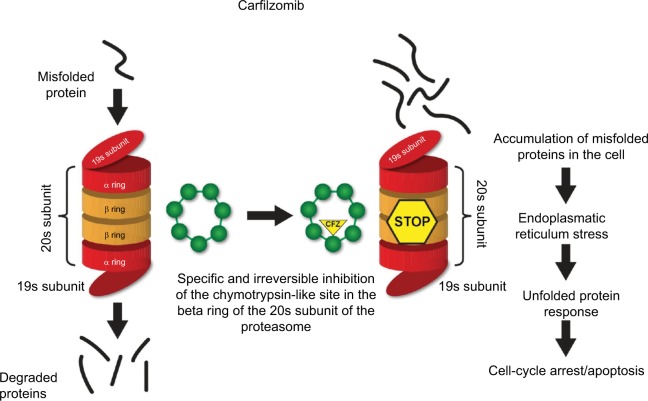
Although the prognosis of multiple myeloma (MM) patients has dramatically improved during recent years, virtually all patients eventually develop relapsed refractory disease. Several new therapeutics have been developed in the last few years, including carfilzomib, a second-generation proteasome inhibitor (PI) that has been approved by the US Food and Drug Administration (FDA) in the setting of relapsed and/or refractory MM, as a single agent with or without dexamethasone, and in combination with lenalidomide in 2012 and 2015, respectively. Other promising combinations with carfilzomib are being investigated. Carfilzomib has shown superiority over the first-generation PI bortezomib on both efficacy and toxicity. In particular, profoundly lower incidence in polyneuropathy compared to bortezomib has been described. However, carfilzomib has a different toxicity profile, with more cardiovascular adverse events. Therefore, caution should be taken with the use of carfilzomib for elderly and cardiovascularly compromised patients. The once-weekly administration of carfilzomib, recently approved by the FDA in combination with dexamethasone, will lead to a lower burden for the patient and caregivers compared to the twice-weekly schemes that were routinely used until recently. This review has a focus on clinical trial data that has led to drug approval, as well as new promising combination studies, and provides advice for treating physicians who are now prescribing this drug to patients.
尽管近年来多发性骨髓瘤(MM)患者的预后有了显著改善,但几乎所有患者最终都会发展为复发难治性疾病。在过去几年中,已经开发了几种新的治疗方法,包括卡非佐米,这是一种第二代蛋白酶体抑制剂(PI),已被美国食品药品监督管理局(FDA)批准用于复发和/或难治性MM,可单药使用,加或不加地塞米松,分别于2012年和2015年与来那度胺联合使用。其他与卡非佐米的有前景的联合用药正在研究中。卡非佐米在疗效和毒性方面均显示出优于第一代PI硼替佐米。特别是,与硼替佐米相比,其周围神经病变的发生率显著更低。然而,卡非佐米有不同的毒性特征,心血管不良事件更多。因此,对于老年患者和有心血管问题的患者,使用卡非佐米时应谨慎。FDA最近批准的卡非佐米与地塞米松联合使用的每周一次给药方案,与直到最近还常规使用的每周两次给药方案相比,将减轻患者和护理人员的负担。本综述重点关注导致该药物获批的临床试验数据以及新的有前景的联合研究,并为目前正在给患者开此药的治疗医生提供建议。