The Clinical Hospital of Chengdu Brain Science Institute, MOE Key Lab for NeuroInformation, University of Electronic Science and Technology of China, No. 2006, Xiyuan Ave., West Hi-Tech Zone, Chengdu, 611731, China.
School of Life Science and Technology, Center for Information in Medicine, University of Electronic Science and Technology of China, Chengdu, China.
Brain Topogr. 2019 Jul;32(4):530-549. doi: 10.1007/s10548-019-00707-x. Epub 2019 Apr 29.
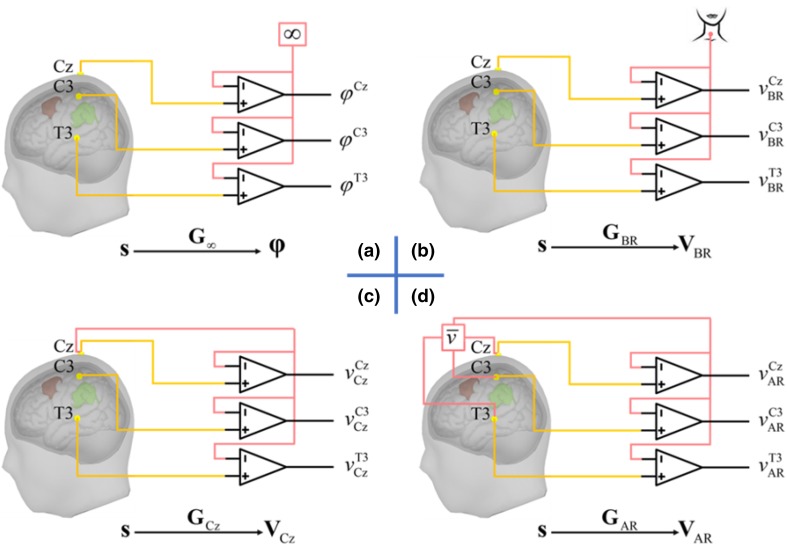
Which reference is appropriate for the scalp ERP and EEG studies? This unsettled problem still inspires unceasing debate. The ideal reference should be the one with zero or constant potential but unfortunately it is well known that no point on the body fulfills this condition. Consequently, more than ten references are used in the present EEG-ERP studies. This diversity seriously undermines the reproducibility and comparability of results across laboratories. A comprehensive review accompanied by a brief communication with rigorous derivations and notable properties (Hu et al. Brain Topogr, 2019. https://doi.org/10.1007/s10548-019-00706-y ) is thus necessary to provide application-oriented principled recommendations. In this paper current popular references are classified into two categories: (1) unipolar references that construct a neutral reference, including both online unipolar references and offline re-references. Examples of unipolar references are the reference electrode standardization technique (REST), average reference (AR), and linked-mastoids/ears reference (LM); (2) non-unipolar references that include the bipolar reference and the Laplacian reference. We show that each reference is derived with a different assumption and serves different aims. We also note from (Hu et al. 2019) that there is a general form for the reference problem, the 'no memory' property of the unipolar references, and a unified estimator for the potentials at infinity termed as the regularized REST (rREST) which has more advantageous statistical evidence than AR. A thorough discussion of the advantages and limitations of references is provided with recommendations in the hope to clarify the role of each reference in the ERP and EEG practice.
头皮 ERP 和 EEG 研究应采用哪种参考电极?这个悬而未决的问题仍在引发持续不断的争论。理想的参考电极应该是零电位或恒电位的电极,但众所周知,人体没有任何部位符合这一条件。因此,目前的 EEG-ERP 研究中使用了十多种参考电极。这种多样性严重破坏了实验室之间结果的可重复性和可比性。因此,有必要进行全面的综述,并通过严格的推导和显著的特性进行简要的交流(Hu 等人,Brain Topogr. 2019,https://doi.org/10.1007/s10548-019-00706-y),为应用提供有原则的推荐。在本文中,当前流行的参考电极被分为两类:(1)单极参考电极,构建中性参考电极,包括在线单极参考电极和离线重参考电极。单极参考电极的例子有参考电极标准化技术(REST)、平均参考(AR)和链接乳突/耳电极参考(LM);(2)非单极参考电极,包括双极参考电极和拉普拉斯参考电极。我们表明,每种参考电极都是基于不同的假设推导出来的,适用于不同的目的。我们还注意到(Hu 等人,2019),参考电极问题有一个一般形式,即单极参考电极的“无记忆”特性,以及一个用于估计无穷远处电位的统一估计器,称为正则化 REST(rREST),它比 AR 具有更有利的统计证据。本文对参考电极的优缺点进行了全面的讨论,并提出了一些建议,希望能阐明每种参考电极在 ERP 和 EEG 实践中的作用。