CAS Key Laboratory of Infection and Immunity, CAS Centre for Excellence in Biomacromolecules, Institute of Biophysics, Chinese Academy of Sciences, Beijing, China.
State Key Laboratory of Biotherapy, West China Hospital, Sichuan University, Collaborative Innovation Center for Biotherapy, Chengdu, China.
PLoS Biol. 2019 Apr 30;17(4):e3000229. doi: 10.1371/journal.pbio.3000229. eCollection 2019 Apr.
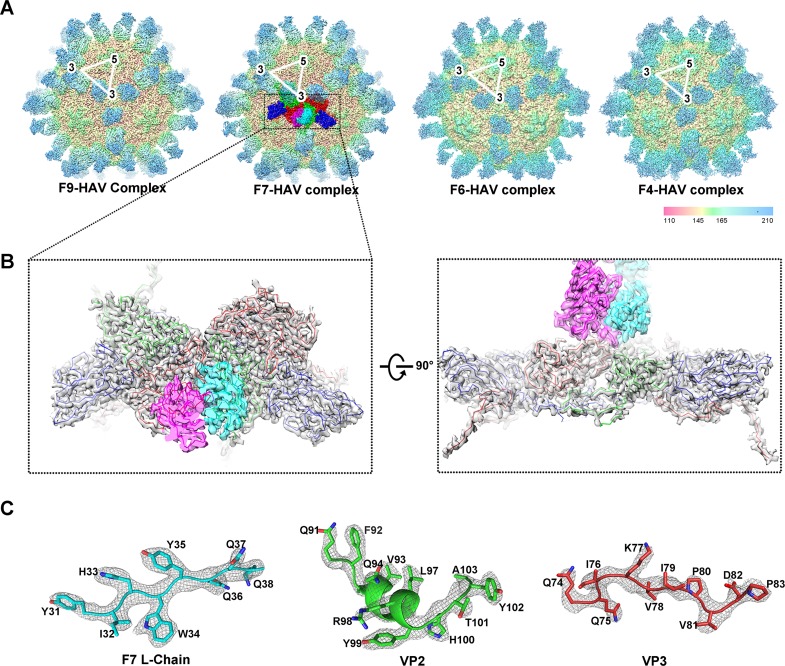
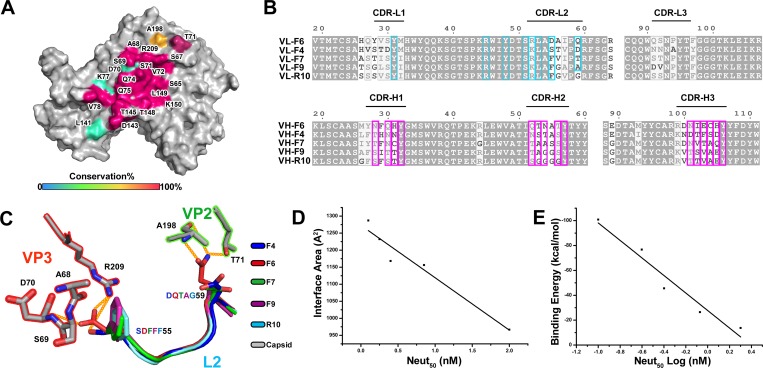
Hepatitis A virus (HAV), an enigmatic and ancient pathogen, is a major causative agent of acute viral hepatitis worldwide. Although there are effective vaccines, antivirals against HAV infection are still required, especially during fulminant hepatitis outbreaks. A more in-depth understanding of the antigenic characteristics of HAV and the mechanisms of neutralization could aid in the development of rationally designed antiviral drugs targeting HAV. In this paper, 4 new antibodies-F4, F6, F7, and F9-are reported that potently neutralize HAV at 50% neutralizing concentration values (neut50) ranging from 0.1 nM to 0.85 nM. High-resolution cryo-electron microscopy (cryo-EM) structures of HAV bound to F4, F6, F7, and F9, together with results of our previous studies on R10 fragment of antigen binding (Fab)-HAV complex, shed light on the locations and nature of the epitopes recognized by the 5 neutralizing monoclonal antibodies (NAbs). All the epitopes locate within the same patch and are highly conserved. The key structure-activity correlates based on the antigenic sites have been established. Based on the structural data of the single conserved antigenic site and key structure-activity correlates, one promising drug candidate named golvatinib was identified by in silico docking studies. Cell-based antiviral assays confirmed that golvatinib is capable of blocking HAV infection effectively with a 50% inhibitory concentration (IC50) of approximately 1 μM. These results suggest that the single conserved antigenic site from complete HAV capsid is a good antiviral target and that golvatinib could function as a lead compound for anti-HAV drug development.
甲型肝炎病毒(HAV)是一种神秘而古老的病原体,是全球急性病毒性肝炎的主要致病因子。虽然有有效的疫苗,但仍需要针对 HAV 感染的抗病毒药物,特别是在暴发性肝炎爆发期间。更深入地了解 HAV 的抗原特征和中和机制可以帮助开发针对 HAV 的合理设计的抗病毒药物。本文报道了 4 种新的抗体-F4、F6、F7 和 F9,它们在中和浓度为 50%时(neut50)对 HAV 的中和效力范围为 0.1 nM 至 0.85 nM。与我们之前关于抗原结合(Fab)-HAV 复合物的 R10 片段的研究结果一起,高分辨率冷冻电镜(cryo-EM)结构表明,HAV 与 F4、F6、F7 和 F9 结合,5 种中和单克隆抗体(NAb)识别的表位的位置和性质。所有表位都位于同一斑块内,高度保守。基于抗原表位的关键结构-活性相关性已经建立。基于单个保守抗原表位的结构数据和关键结构-活性相关性,通过计算机对接研究鉴定了一种有前途的候选药物 golvatinib。基于细胞的抗病毒测定证实,golvatinib 能够有效阻断 HAV 感染,其 50%抑制浓度(IC50)约为 1 μM。这些结果表明,完整 HAV 衣壳的单个保守抗原表位是一个很好的抗病毒靶标,golvatinib 可以作为抗 HAV 药物开发的先导化合物。