CLINURSID Research Group, University of Santiago de Compostela, Santiago de Compostela, Spain.
University College of Nursing, University of Vigo, Pontevedra, Spain.
PLoS One. 2019 Apr 30;14(4):e0212080. doi: 10.1371/journal.pone.0212080. eCollection 2019.
Decision-making in emergencies is a multifactorial process based on the rescuer, patient, setting and resources. The eye-tracking system is a proven method for assessing decision-making processes that have been used in different fields of science. Our aim was to evaluate the lifeguards' capacity to perform the ABCDE (Airway-Breathing-Circulation-Disability-Exposure) approach when facing a simulated critically ill-drowned victim.
A cross-sectional simulation study was designed to assess the skills and sequence of the ABCDE approach by 20 professional lifeguards. They had to assess a victim and act according to his/her clinical status by following the ABCDE primary assessment approach. The two kinds of variables were recorder: those related to the quality of each step of the ABCDE approach and the visual behaviour using a portable eye-movement system. The eye-tracking system was the Mobile Eye system (Bedford, USA).
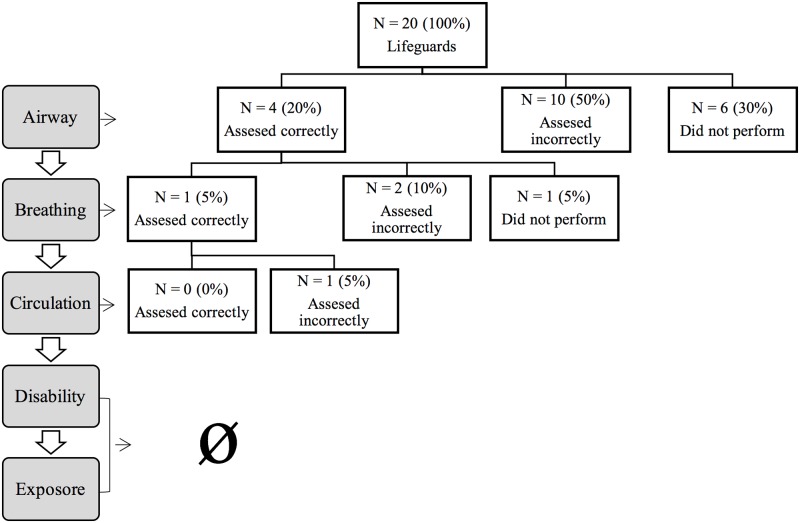
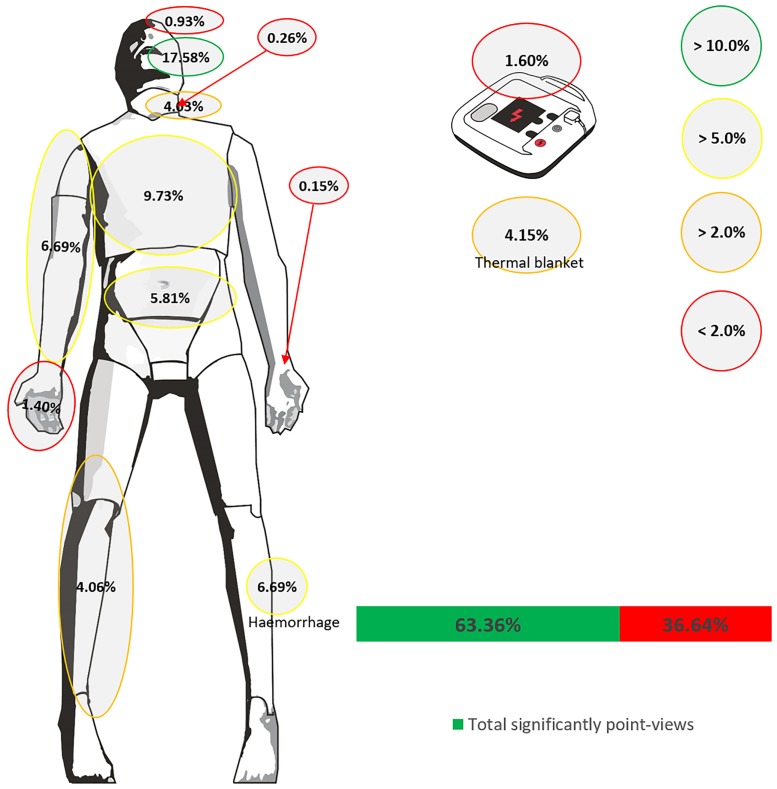
None of the study participants were able to complete correctly the ABCDE approach. Lifeguards spent more time in the Circulation step: Airway (15.5±11.1 s), Breathing (25.1±21.1 s), Circulation (44.6±29.5 s), Disability (38.5±0.7 s). Participants spent more time in viewpoints considered as important (65.5±17.4 s) compared with secondary ones (34.6±17.4 s, p = 0.008). This was also represented in the percentage of visual fixations (fixations in important viewpoints: 63.36±15.06; fixation in secondary viewpoints: 36.64±15.06; p = 0.008).
Professional lifeguards failed to fully perform the ABCDE sequence. Evaluation by experts with the help of eye-tracking technology detected the lifeguards' limitations in the assessment and treatment of an eventual critically ill victim. Such deficits should be considered in the design and implementation of lifeguards' training programmes.
紧急情况下的决策是一个多因素的过程,取决于救援者、患者、环境和资源。眼动追踪系统是一种经过验证的评估决策过程的方法,已被应用于不同的科学领域。我们的目的是评估救生员在面对模拟的危重溺水患者时执行 ABCDE(气道-呼吸-循环-残疾-暴露)方法的能力。
设计了一项横断面模拟研究,以评估 20 名专业救生员执行 ABCDE 方法的技能和顺序。他们必须根据患者的临床状况进行评估,并按照 ABCDE 初步评估方法进行操作。记录了两种类型的变量:与 ABCDE 方法的每个步骤的质量相关的变量和使用便携式眼动系统的视觉行为。眼动追踪系统是 Mobile Eye 系统(美国贝德福德)。
没有一个研究参与者能够正确地完成 ABCDE 方法。救生员在循环步骤上花费的时间更多:气道(15.5±11.1 秒)、呼吸(25.1±21.1 秒)、循环(44.6±29.5 秒)、残疾(38.5±0.7 秒)。参与者在被认为重要的视点上花费的时间更多(65.5±17.4 秒),而在次要视点上花费的时间更少(34.6±17.4 秒,p=0.008)。这也反映在视觉注视的百分比上(重要视点的注视:63.36±15.06;次要视点的注视:36.64±15.06;p=0.008)。
专业救生员未能完全执行 ABCDE 序列。专家借助眼动追踪技术进行评估,发现救生员在评估和治疗潜在危重患者方面存在局限性。这些缺陷应在救生员培训计划的设计和实施中加以考虑。