Emergency Department, University Medical Center Groningen, Groningen, The Netherlands
Department of Internal Medicine, University Medical Center Groningen, Groningen, The Netherlands.
BMJ Open. 2020 Jul 6;10(7):e032023. doi: 10.1136/bmjopen-2019-032023.
To investigate short-term and long-term effectiveness of simulation training to acquire a structured Airway Breathing Circulation Disability Exposure (ABCDE) approach for medical emergencies; and to examine which skills were learnt and maintained best.
An observational study with a 3-4 months follow-up.
Skills center of the University Medical Center Groningen.
Thirty voluntary participants (21 females and 9 males; 27±2.77 years) of a simulation-based course.
A 2-day ABCDE-teaching course for residents and non-residents. The course encompasses 24 simulations in which participants perform primary assessments of acute ill patients. Video recordings were taken of each participant performing a primary assessment, before (T1), directly after (T2) and 3-4 months after the intervention (T3).
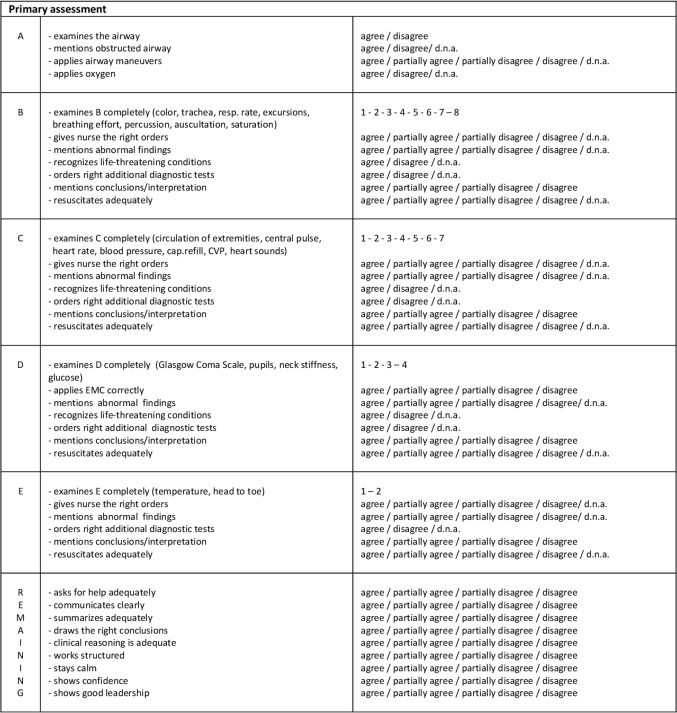
Physicians' performance in the ABCDE primary assessment at T1, T2 and T3. Two observers scored the primary assessments, blinded to measurement moment, using an assessment form to evaluate the performance with regard to skills essential for a structured ABCDE approach. The Friedman and Wilcoxon signed-rank test were used to compare physicians' performances on the subsequent measurement moments.
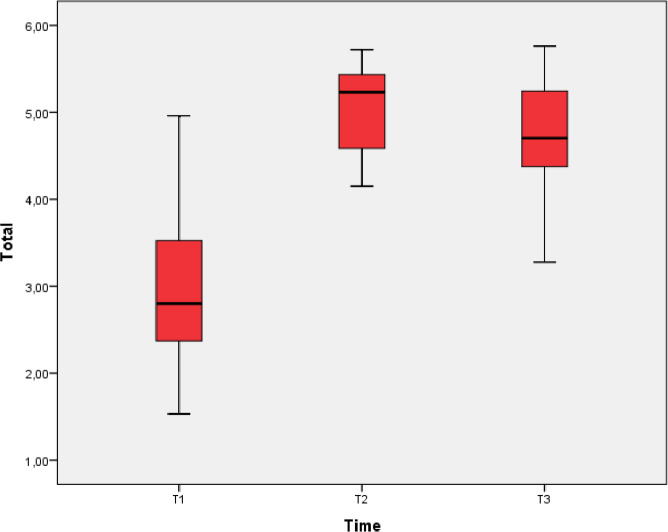
The mean ranks on the total primary assessment at T1, T2 and T3 were 1.14, 2.62 and 2.24, respectively, and were significantly different, (p<0.001).The mean ranks on the total primary assessment directly after the course (T2 vs T1 p<0.001) and 3-4 months after the course (T3 vs T1 p<0.001) were significantly better than before the course. Certain skills deteriorated during the follow-up. Strikingly, most skills that decrease over time are Crew Resources Management (CRM) skills.
A course using simulation training is an effective educational tool to teach physicians the ABCDE primary assessment. Certain CRM skills decrease over time, so we recommend organising refresher courses, simulation team training or another kind of simulation training with a focus on CRM skills.
调查模拟训练在获得结构化的 ABCDE(气道-呼吸-循环-意识-残疾暴露)急救方法方面的短期和长期效果;并研究哪些技能学得最好,保持得最好。
一项具有 3-4 个月随访的观察性研究。
格罗宁根大学医学中心技能中心。
参加模拟课程的 30 名志愿参与者(21 名女性和 9 名男性;27±2.77 岁)。
针对住院医师和非住院医师的 2 天 ABCDE 教学课程。该课程包括 24 次模拟,参与者对急性疾病患者进行初步评估。在 T1(干预前)、T2(干预后立即)和 T3(干预后 3-4 个月),对每位参与者进行初步评估时,均拍摄视频记录。
T1、T2 和 T3 时医生在 ABCDE 初步评估中的表现。两名观察者使用评估表对初步评估进行评分,评分时不了解测量时刻,以评估技能在结构化 ABCDE 方法中的表现。采用 Friedman 和 Wilcoxon 符号秩检验比较医生在随后测量时刻的表现。
T1、T2 和 T3 时的总初步评估平均秩分别为 1.14、2.62 和 2.24,差异有统计学意义(p<0.001)。课程结束后(T2 与 T1 比较,p<0.001)和课程结束后 3-4 个月(T3 与 T1 比较,p<0.001)的总初步评估平均秩明显优于课程开始前。某些技能在随访期间恶化。引人注目的是,随着时间的推移而下降的大多数技能都是团队资源管理(CRM)技能。
使用模拟训练的课程是教授医生 ABCDE 初步评估的有效教育工具。随着时间的推移,某些 CRM 技能会下降,因此我们建议组织复习课程、模拟团队培训或其他重点关注 CRM 技能的模拟培训。