Centro de Investigaciones sobre Porfirinas y Porfirias (CIPYP), Hospital de Clínicas José de San Martin, Universidad de Buenos Aires and CONICET, Av. Córdoba 2351, 1er subsuelo, Ciudad Autónoma de Buenos Aires, 1120AAF, Argentina.
CIHIDECAR- CONICET - Departamento de Química Orgánica, Facultad de Ciencias Exactas y Naturales, Universidad de Buenos Aires, Ciudad Universitaria, Pab. 2, Ciudad de Buenos Aires, 1428, Argentina.
Sci Rep. 2019 Apr 30;9(1):6654. doi: 10.1038/s41598-019-43238-y.
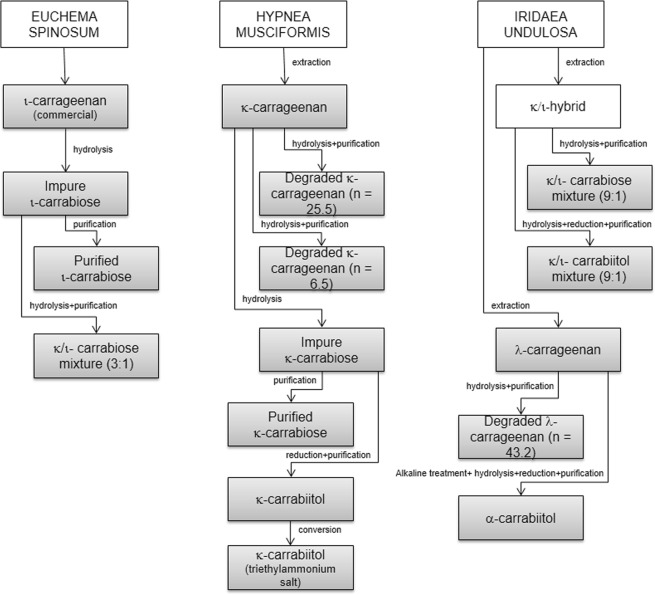
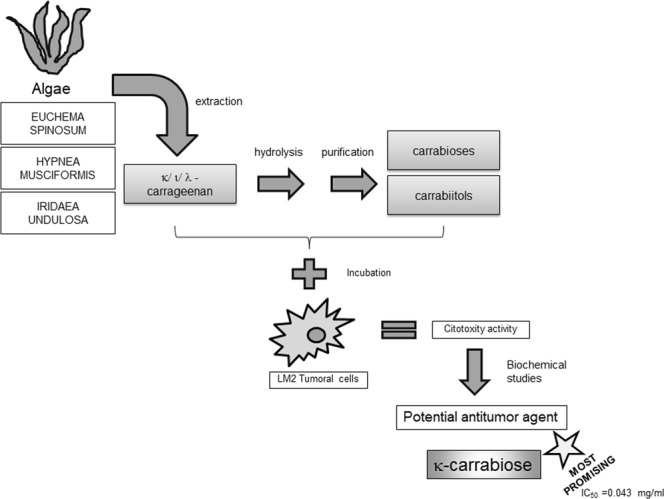
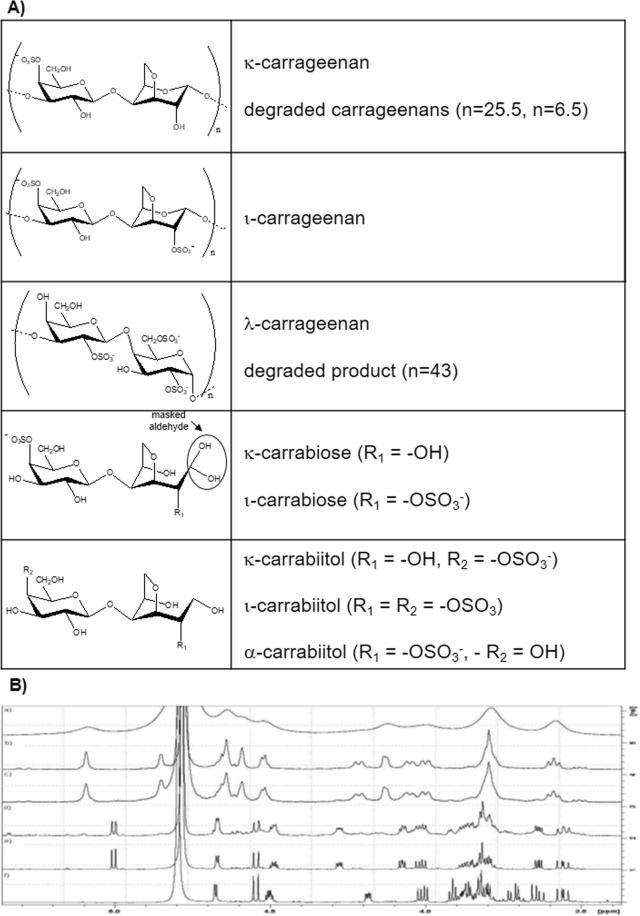
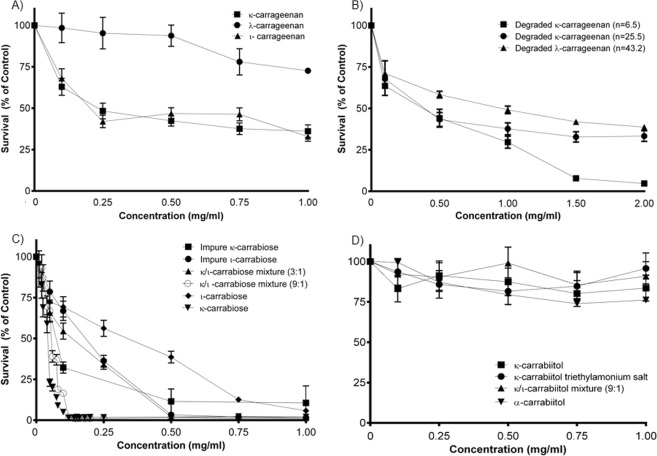
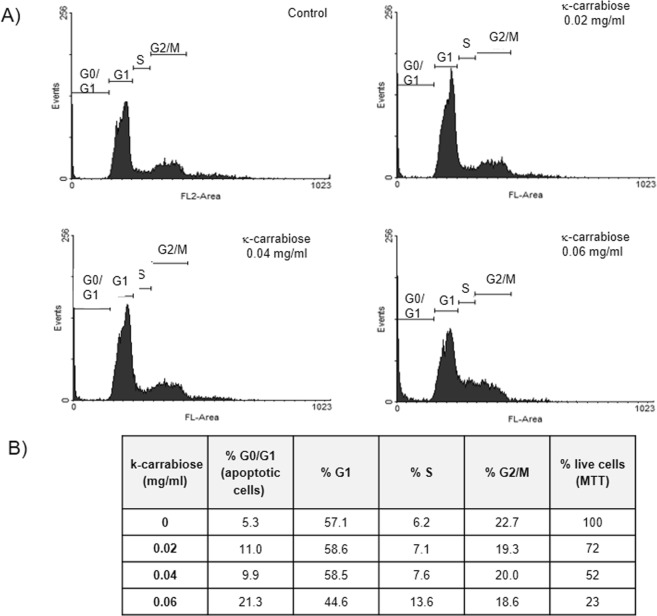
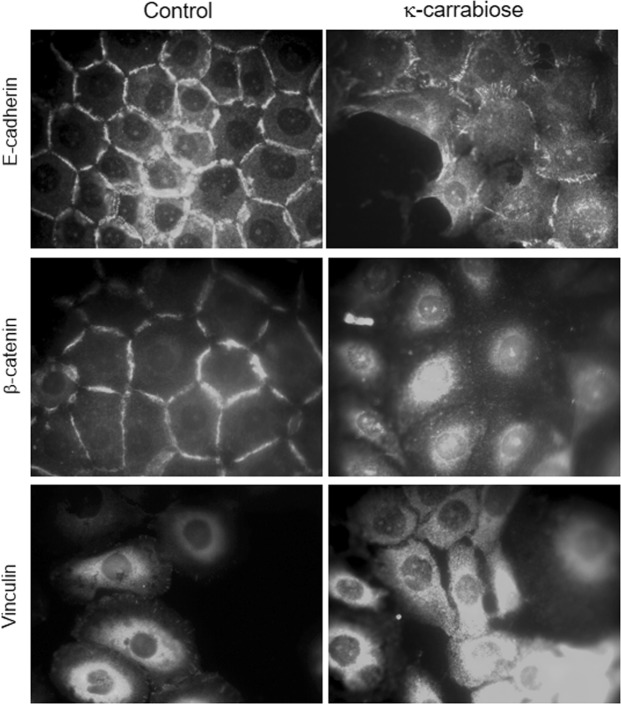
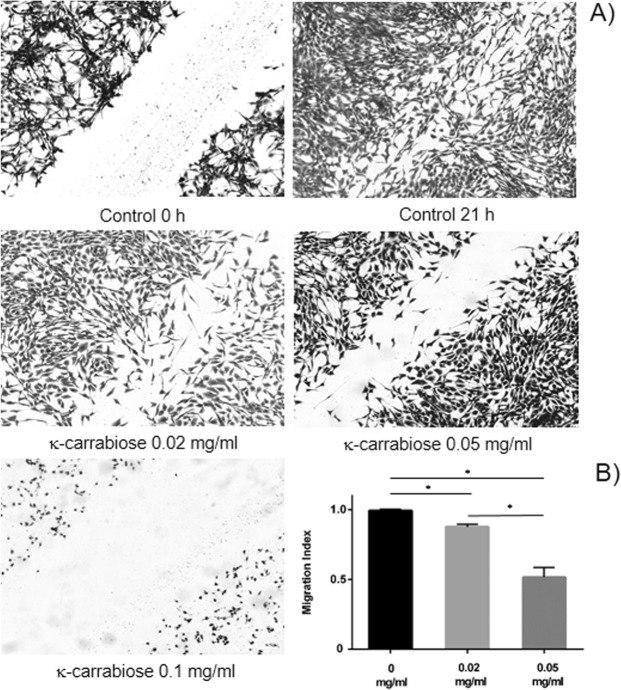
Carrageenans are sulfated galactans found in certain red seaweeds with proven biological activities. In this work, we have prepared purified native and degraded κ-, ι-; and λ-carrageenans, including the disaccharides (carrabioses) and disaccharide-alditols (carrabiitols) from seaweed extracts as potential antitumor compounds and identified the active principle of the cytotoxic and potential antitumor properties of these compounds. Both κ and ι-carrageenan, as well as carrageenan oligosaccharides showed cytotoxic effect over LM2 tumor cells. Characterized disaccharides (carrabioses) and the reduced product carrabiitols, were also tested. Only carrabioses were cytotoxic, and among them, κ-carrabiose was the most effective, showing high cytotoxic properties, killing the cells through an apoptotic pathway. In addition, the cells surviving treatment with κ-carrabiose, showed a decreased metastatic ability in vitro, together with a decreased cell-cell and cell-matrix interactions, thus suggesting possible antitumor potential. Overall, our results indicate that most cytotoxic compounds derived from carrageenans have lower molecular weights and sulfate content. Potential applications of the results emerging from the present work include the use of disaccharide units such as carrabioses coupled to antineoplasics in order to improve its cytotoxicity and antimetastatic properties, and the use of ι-carrageenan as adjuvant or carrier in anticancer treatments.
卡拉胶是从某些红海藻中提取的硫酸化半乳糖,具有已证实的生物活性。在这项工作中,我们制备了纯化的天然和降解的κ-、ι-和 λ-卡拉胶,包括从海藻提取物中分离出来的二糖(卡拉胶糖)和二糖-醛糖醇(卡拉比糖醇),作为潜在的抗肿瘤化合物,并确定了这些化合物的细胞毒性和潜在抗肿瘤特性的活性原理。κ-和 ι-卡拉胶以及卡拉胶低聚糖对 LM2 肿瘤细胞均显示出细胞毒性作用。还对特征性二糖(卡拉胶糖)和还原产物卡拉比糖醇进行了测试。只有卡拉胶糖具有细胞毒性,其中κ-卡拉胶糖的活性最高,具有很高的细胞毒性,通过凋亡途径杀死细胞。此外,用κ-卡拉胶糖处理后存活的细胞在体外表现出降低的转移能力,以及降低的细胞-细胞和细胞-基质相互作用,因此提示可能具有抗肿瘤潜力。总的来说,我们的结果表明,大多数来源于卡拉胶的细胞毒性化合物具有较低的分子量和硫酸根含量。本工作所产生的结果的潜在应用包括将二糖单元(如卡拉胶糖)与抗肿瘤药物偶联,以提高其细胞毒性和抗转移特性,以及将 ι-卡拉胶作为抗癌治疗的佐剂或载体。