Department of Pharmaceutics and Industrial pharmacy, College of Pharmacy, Taif University, Taif 21974, Saudi Arabia,
Department of Pharmaceutics and Industrial Pharmacy, Faculty of Pharmacy, Beni-Suef University, Beni-Suef 62521, Egypt,
Int J Nanomedicine. 2019 Apr 8;14:2515-2531. doi: 10.2147/IJN.S190502. eCollection 2019.
Fungal keratitis (FK) is a serious pathogenic condition usually associated with significant ocular morbidity. Natamycin (NAT) is the first-line and only medication approved by the Food and Drug Administration for the treatment of FK. However, NAT suffers from poor corneal penetration, which limits its efficacy for treating deep keratitis.
The objective of this work was to prepare NAT solid lipid nanoparticles (NAT-SLNs) to achieve sustained drug release and increased corneal penetration.
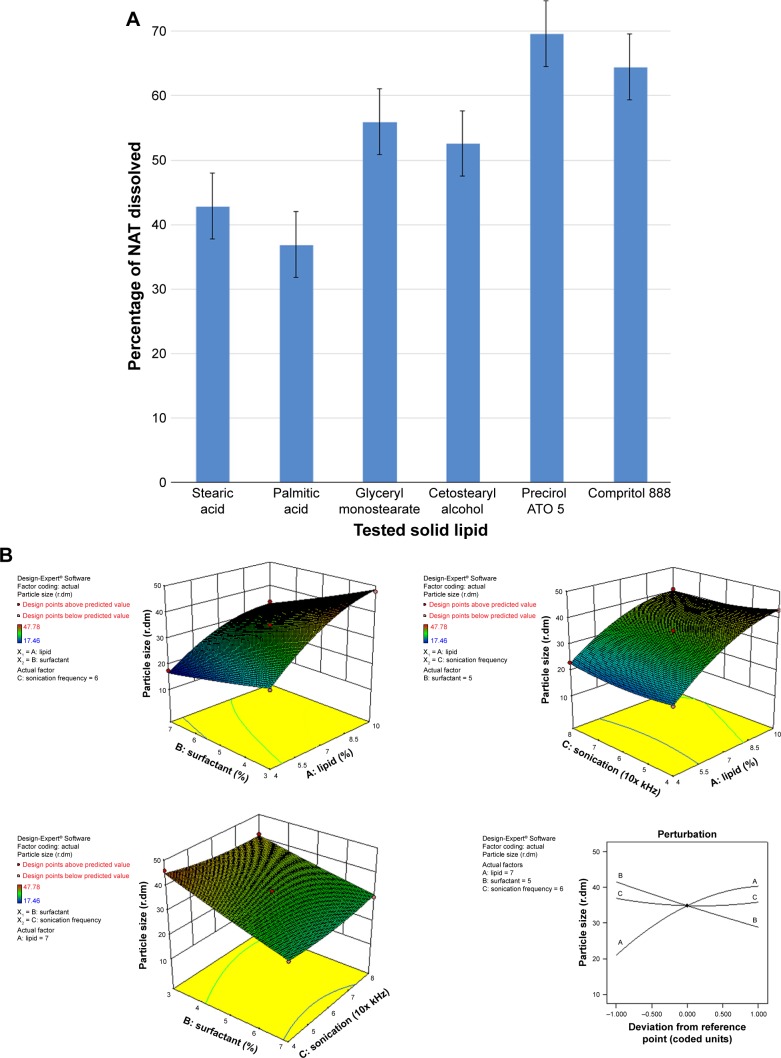
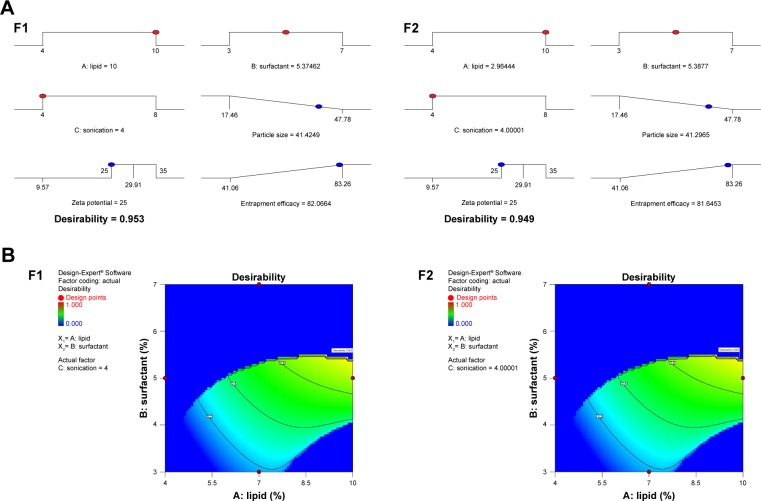
NAT-SLNs were prepared using the emulsification-ultrasonication technique. Box- Behnken experimental design was applied to optimize the effects of independent processing variables (lipid concentration [X], surfactant concentration [X], and sonication frequency [X]) on particle size (R), zeta potential (ZP; R), and drug entrapment efficiency (EE%) (R) as responses. Drug release profile, ex vivo corneal permeation, antifungal susceptibility, and cytotoxicity of the optimized formula were evaluated.
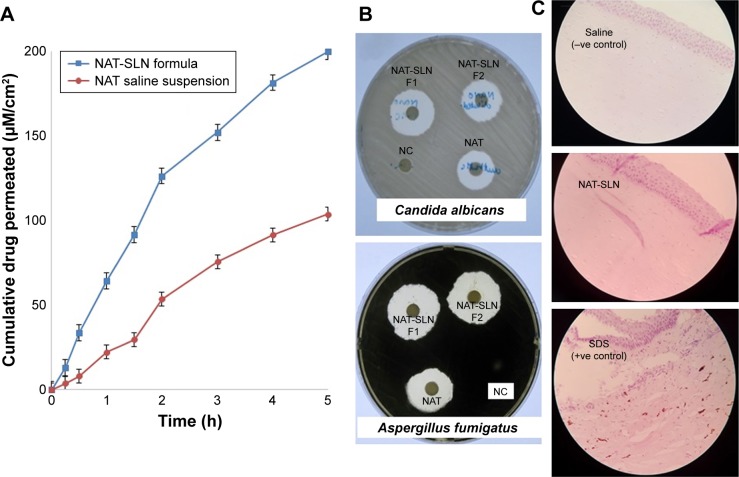
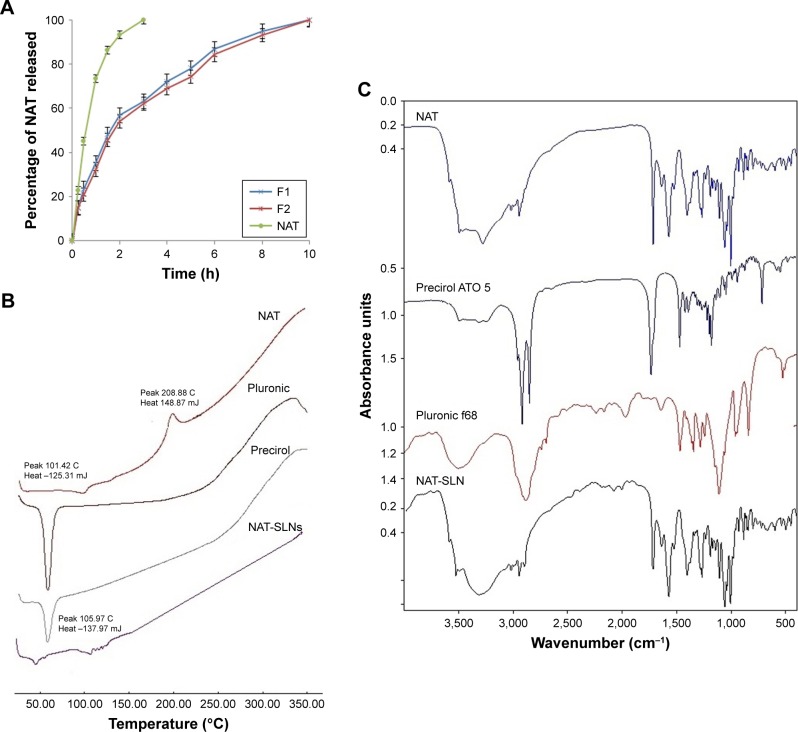
The optimized formula had a mean particle size of 42 r.nm (radius in nanometers), ZP of 26 mV, and EE% reached ~85%. NAT-SLNs showed an extended drug release profile of 10 hours, with enhanced corneal permeation in which the apparent permeability coefficient (P) and steady-state flux (J) reached 11.59×10 cm h and 3.94 mol h, respectively, in comparison with 7.28×10 cm h and 2.48 mol h for the unformulated drug, respectively. Antifungal activity was significantly improved, as indicated by increases in the inhibition zone of 8 and 6 mm against ATCC 1022 and a clinical isolate, respectively, and minimum inhibitory concentration values that were decreased 2.5-times against both of these pathogenic strains. NAT-SLNs were found to be non-irritating to corneal tissue. NAT-SLNs had a prolonged drug release rate that improved corneal penetration, and increased antifungal activity without cytotoxic effects on corneal tissues.
Thus, NAT-SLNs represent a promising ocular delivery system for treatment of deep corneal keratitis.
真菌性角膜炎(FK)是一种严重的致病情况,通常与严重的眼部发病率有关。那他霉素(NAT)是治疗 FK 的一线药物,也是唯一经美国食品和药物管理局批准的药物。然而,NAT 的角膜穿透性较差,限制了其治疗深层角膜炎的疗效。
本研究旨在制备 NAT 固体脂质纳米粒(NAT-SLNs)以实现药物的持续释放和增加角膜穿透性。
采用乳化-超声技术制备 NAT-SLNs。采用 Box-Behnken 实验设计考察独立工艺变量(脂质浓度[X]、表面活性剂浓度[X]和超声频率[X])对粒径(R)、Zeta 电位(ZP;R)和药物包封率(EE%)(R)的影响。评价优化配方的药物释放曲线、体外角膜渗透、抗真菌药敏性和细胞毒性。
优化配方的平均粒径为 42nm(纳米),ZP 为 26mV,EE%达到~85%。NAT-SLNs 显示出 10 小时的延长药物释放曲线,增强了角膜渗透,其中表观渗透系数(P)和稳态通量(J)分别达到 11.59×10cmh 和 3.94molh,而未形成配方的药物分别为 7.28×10cmh 和 2.48molh。抗真菌活性显著提高,对 ATCC1022 和临床分离株的抑菌圈分别增加了 8mm 和 6mm,对两种致病株的最小抑菌浓度值降低了 2.5 倍。NAT-SLNs 对角膜组织无刺激性。NAT-SLNs 具有延长的药物释放率,可改善角膜穿透性,并提高抗真菌活性,同时对角膜组织无细胞毒性作用。
因此,NAT-SLNs 是一种有前途的眼部给药系统,可用于治疗深层角膜角膜炎。