Lu Yajie, Chen Guojing, Long Zuoyao, Li Minghui, Ji Chuanlei, Wang Fengwei, Li Huanzhang, Lu Jianxi, Wang Zhen, Li Jing
Department of Orthopedics, Xijing Hospital, The Air Force Medical University, No. 127 Changle West Road, Xi'an, Shaanxi 710032, PR China.
Department of Orthopedics, Shaanxi Zheng He Hospital, Xi'an, Shaanxi 710043, PR China.
J Bone Oncol. 2019 Jan 25;16:100220. doi: 10.1016/j.jbo.2019.100220. eCollection 2019 Jun.
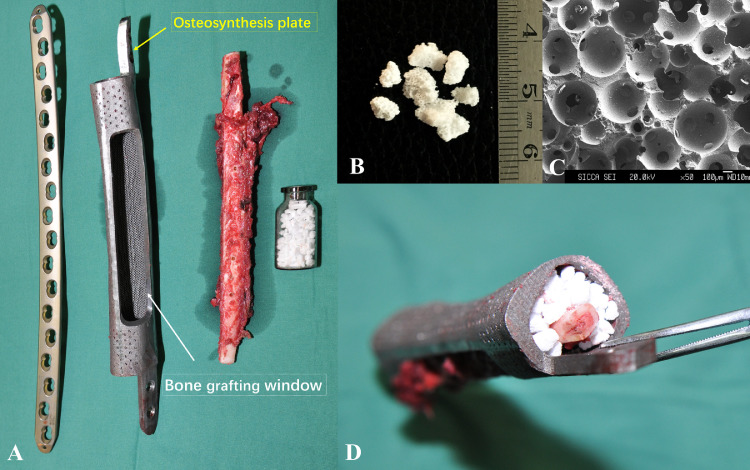
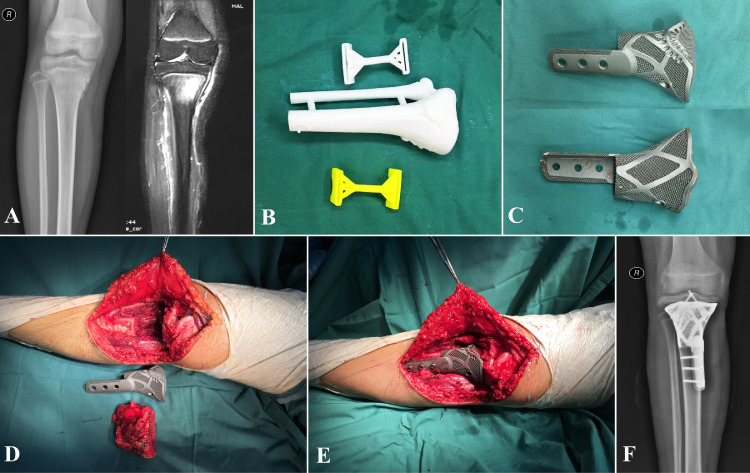
To introduce a novel 3D-printed prosthetic composite for reconstruction of massive bone defects after resection for bone malignancy of lower extremities. The design concept, surgical technique, and the preliminary outcomes were elaborated.
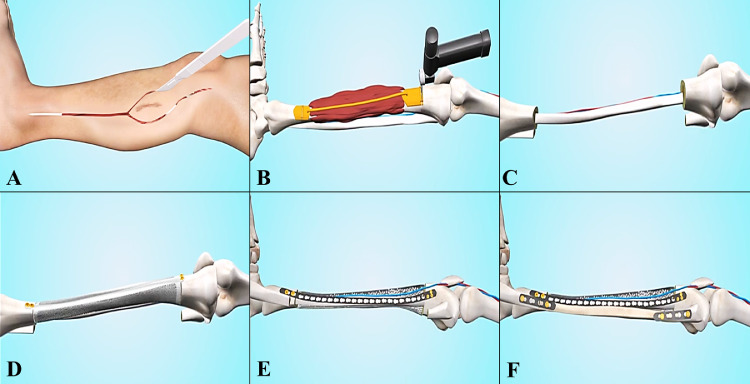
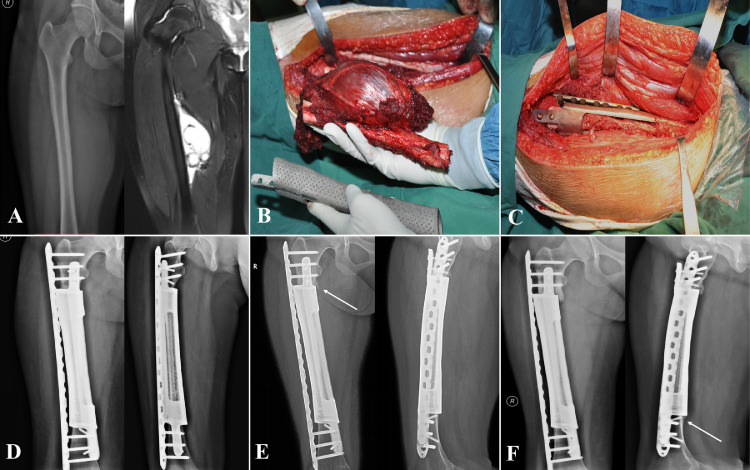
Patients with primary malignant tumors of lower extremities requiring tumor resection and reconstruction were recruited between Jun 2015 and Nov 2018. Patient-specific 3D-printed prostheses were designed according to preoperative imaging data. After tumor resection, reconstruction was performed with composites consisting of 3D- printed prosthesis, beta-tricalcium phosphate (-TCP) bioceramics and/or vascularized fibula. All patients underwent regular follow-up postoperatively. The functional outcomes were assessed by the Musculoskeletal Tumor Society score (MSTS). Oncological outcomes, imaging results, and complications were recorded and analyzed.
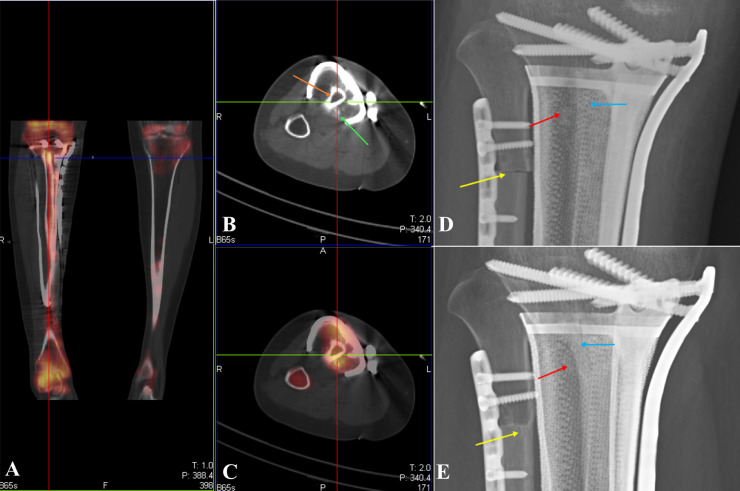
Ten cases averaging 12.90 years of age participated in this study. There were five femur and five tibia reconstructions. The mean follow-up period was 16.90 months. At last follow-up, all patients were alive without tumor recurrence. Average MSTS functional score was 80.33 ± 11.05%. All prostheses were intact and stable without failure or systemic breakage. No serious complications occurred after the operation. Postoperative X-ray, computed tomography (CT) and single-photon emission computed tomography (SPECT) showed an ideal integration between the bone and the prosthetic composite. Moreover, vascularized fibula and implanted -TCP bioceramics indicated relatively high metabolic activity .
Patient-specific 3D-printed prostheses combined with -TCP bioceramics and/or vascularized fibula provide an excellent option for reconstruction of massive bone defects after lower extremity malignant tumor extirpation. Short-term follow up showed promising clinical results in recovering lower limb function, promoting osseointegration and reducing complications.
介绍一种新型3D打印假体复合材料,用于下肢骨恶性肿瘤切除术后大块骨缺损的重建。阐述其设计理念、手术技术及初步结果。
招募2015年6月至2018年11月期间需要进行肿瘤切除和重建的下肢原发性恶性肿瘤患者。根据术前影像数据设计个性化的3D打印假体。肿瘤切除后,采用由3D打印假体、β-磷酸三钙(β-TCP)生物陶瓷和/或带血管腓骨组成的复合材料进行重建。所有患者术后均接受定期随访。通过肌肉骨骼肿瘤学会评分(MSTS)评估功能结果。记录并分析肿瘤学结果、影像学结果及并发症。
10例平均年龄12.90岁的患者参与本研究。其中5例为股骨重建,5例为胫骨重建。平均随访期为16.90个月。末次随访时,所有患者均存活,无肿瘤复发。平均MSTS功能评分为80.33 ± 11.05%。所有假体均完整且稳定,无故障或整体破损。术后未发生严重并发症。术后X线、计算机断层扫描(CT)和单光子发射计算机断层扫描(SPECT)显示骨与假体复合材料之间融合理想。此外,带血管腓骨和植入的β-TCP生物陶瓷显示出相对较高的代谢活性。
个性化3D打印假体联合β-TCP生物陶瓷和/或带血管腓骨为下肢恶性肿瘤切除术后大块骨缺损的重建提供了一个极佳的选择。短期随访显示,在恢复下肢功能、促进骨整合及减少并发症方面取得了令人满意的临床效果。