Department of Psychology, Colorado State University, Fort Collins, Colorado.
Department of Psychiatry, University of California San Diego, La Jolla, California.
Brain Behav. 2019 Jun;9(6):e01302. doi: 10.1002/brb3.1302. Epub 2019 May 1.
Wisdom is reportedly associated with better health and quality of life. However, our knowledge of the neurobiology of wisdom is still in the early stages of development. We aimed to improve our understanding by correlating a psychometric measure of the trait with patterns of brain activation produced by a cognitive task theorized to be relevant to wisdom: moral decision-making. In particular, we aimed to determine whether individual differences in wisdom interact with moral task complexity in relation to brain activation.
Participants were 39 community-dwelling men and women aged 27-76 years, who completed moral and nonmoral decision-making tasks while undergoing functional magnetic resonance imaging. Brain activation in select regions of interest was correlated with participants' scores on the San Diego Wisdom Scale (SD-WISE).
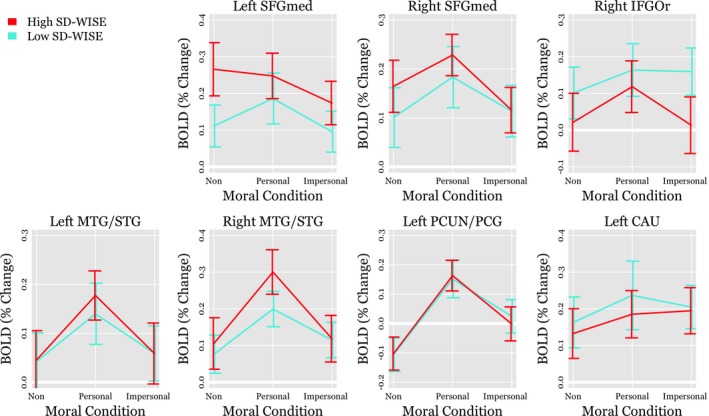
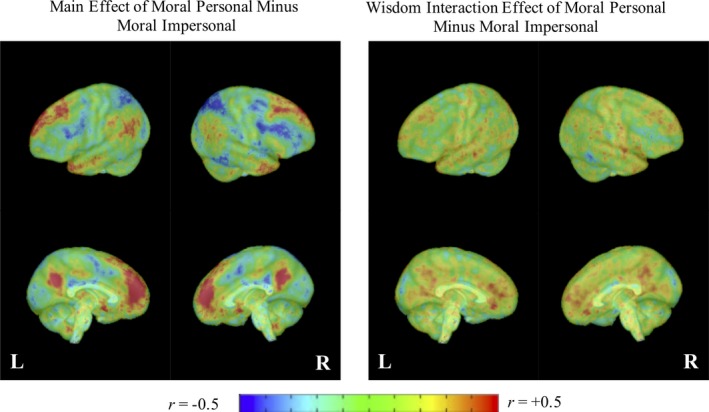
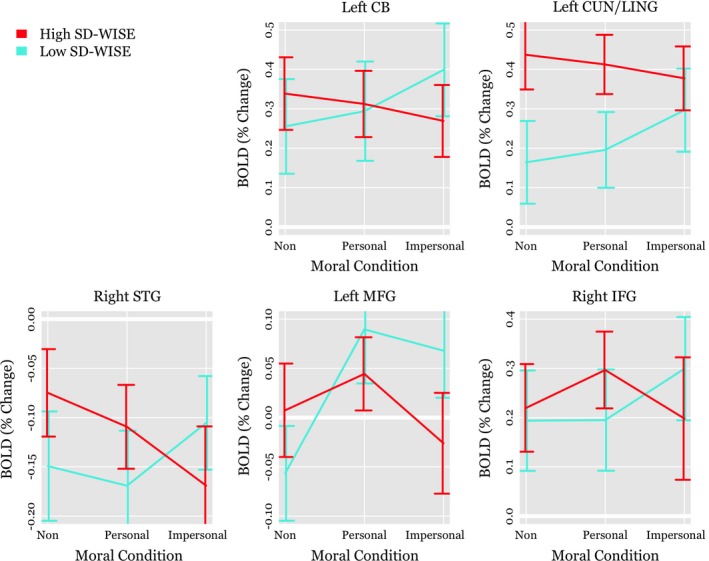
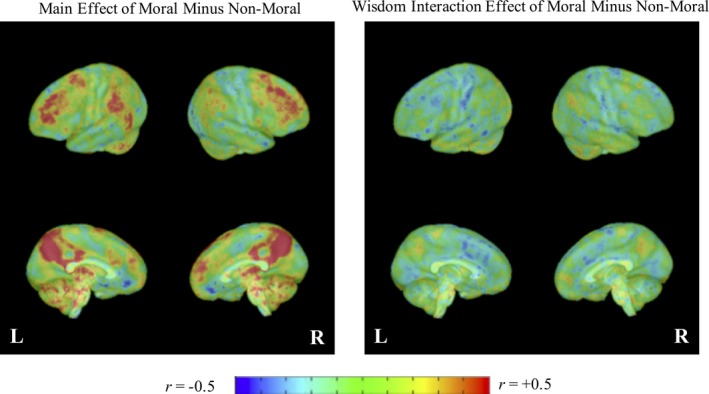
Individual differences in wisdom were found to interact with brain response to moral versus nonmoral and moral personal versus impersonal dilemmas, particularly in regions in or near the default mode network. Persons with higher scores on the SD-WISE had less contrast between moral and nonmoral dilemmas and greater contrast between moral-personal and moral-impersonal dilemmas than individuals with lower SD-WISE scores.
Results confirmed our hypothesis that individual differences in level of wisdom would interact with moral condition in relation to brain activation, and may underscore the relevance of considering one's own and others' actions and experiences in the context of wise thinking. Future studies are needed to replicate these findings and to examine specific neurocircuits.
据报道,智慧与更好的健康和生活质量有关。然而,我们对智慧的神经生物学的了解仍处于早期阶段。我们旨在通过将特质的心理测量与认知任务产生的大脑激活模式相关联来提高我们的理解,该认知任务被认为与智慧有关:道德决策。特别是,我们旨在确定个体的智慧差异是否与道德任务的复杂性相互作用,以与大脑激活有关。
参与者是 39 名年龄在 27-76 岁之间的社区居住的男性和女性,他们在进行功能磁共振成像的同时完成了道德和非道德决策任务。选择的兴趣区域的大脑激活与参与者在圣地亚哥智慧量表(SD-WISE)上的得分相关联。
发现智慧的个体差异与道德与非道德以及道德个人与道德非个人困境的大脑反应相互作用,特别是在默认模式网络内或附近的区域。在 SD-WISE 上得分较高的人在道德和非道德困境之间的对比度较小,而在道德个人和道德非个人困境之间的对比度大于 SD-WISE 得分较低的人。
结果证实了我们的假设,即个体的智慧水平差异将与大脑激活的道德条件相互作用,并且可能强调在智慧思维中考虑自己和他人的行为和经验的相关性。需要进一步的研究来复制这些发现并检查特定的神经回路。