Li Jing-Ping, Zhang Xiang-Mei, Zhang Zhenzhen, Zheng Li-Hua, Jindal Sonali, Liu Yun-Jiang
Department of Breast Surgery, the Fourth Hospital of Hebei Medical University.
Research Center, the Fourth Hospital of Hebei Medical University.
Medicine (Baltimore). 2019 May;98(18):e15449. doi: 10.1097/MD.0000000000015449.
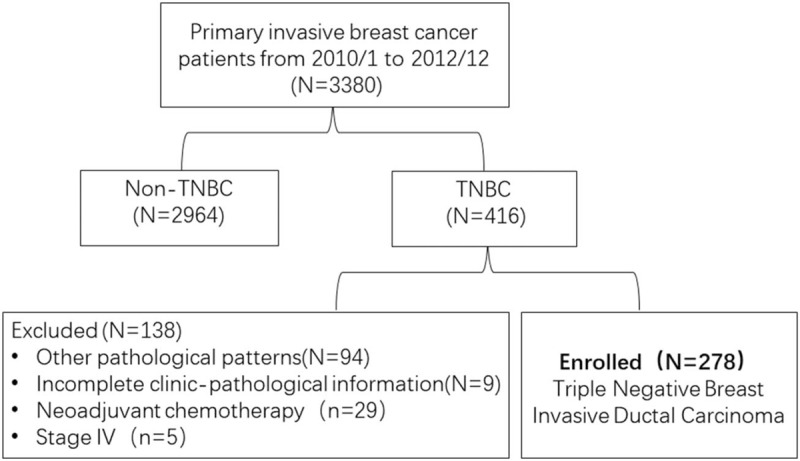
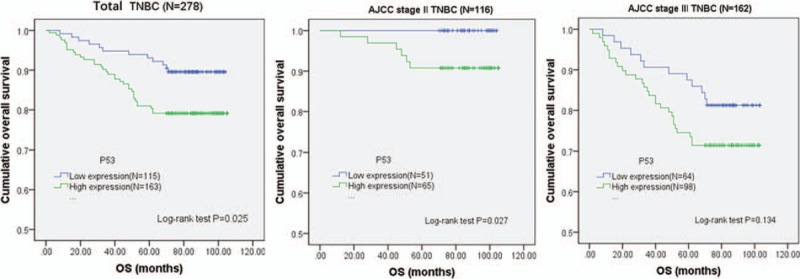
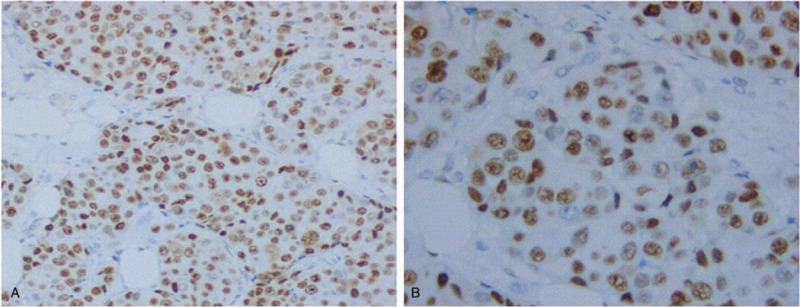
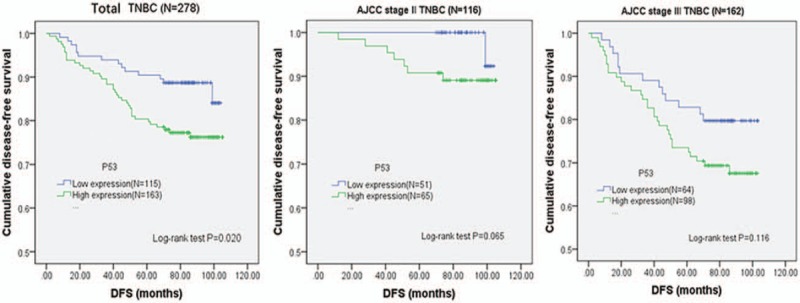
TP53 gene is mutated in approximately 80% of triple-negative breast cancer (TNBC). However, the prognostic significance of immunohistochemical (IHC)-detected p53 protein expression remains controversial in TNBC. In this study, we retrospectively analyzed the association between IHC-detected p53 expression and the prognosis in a cohort of 278 patients with stage I-III triple-negative breast invasive ductal carcinoma (IDC), who received surgery at the department of breast surgery in the Fourth Hospital of Hebei Medical University from 2010-01 to 2012-12. We found a positive expression ratio of IHC-detected p53 in triple-negative breast IDC of 58.6% (163/278). Furthermore, levels of expression were significantly associated with vessel tumor emboli and higher histologic grade (P = .038, P = .043, respectively), with the highest expression level observed in G3 breast cancer (64.7%). Additionally, Kaplan-Meier analysis showed that p53 expression indicated worse overall survival (OS) in the whole cohort (79.6% vs 89.6%, Log-rank test P = .025) as well as in stratified prognostic stage II patients (90.8% vs 100%, Log-rank test P = .027). The mortality risk of p53 expression patients was 2.22 times higher than that of p53 negative patients (HR: 2.222; 95%CI: 1.147-4.308). In addition, p53 expression was also associated with poor disease-free survival (DFS) (76.7% vs 86.8%, P = .020). Cox proportional hazard ratio model showed p53 expression was an independent risk factor for OS (P = .018) and DFS (P = .018) after controlling for tumor size, lymph node status, and vessel tumor emboli. Altogether, our data showed that IHC-detected p53 expression is a promising prognostic candidate for poor survival in triple-negative breast IDC patients. However, more studies are needed to determine if p53 may be applied to clinical practice as a biomarker and/or novel therapeutic target for TNBC.
在大约80%的三阴性乳腺癌(TNBC)中,TP53基因发生突变。然而,免疫组织化学(IHC)检测到的p53蛋白表达的预后意义在TNBC中仍存在争议。在本研究中,我们回顾性分析了2010年1月至2012年12月在河北医科大学第四医院乳腺外科接受手术的278例I-III期三阴性乳腺浸润性导管癌(IDC)患者中,IHC检测到的p53表达与预后之间的关联。我们发现三阴性乳腺IDC中IHC检测到的p53阳性表达率为58.6%(163/278)。此外,表达水平与血管肿瘤栓子和更高的组织学分级显著相关(分别为P = 0.038,P = 0.043),在G3级乳腺癌中观察到最高表达水平(64.7%)。此外,Kaplan-Meier分析显示,p53表达表明整个队列的总生存期(OS)较差(79.6%对89.6%,对数秩检验P = 0.025)以及分层预后II期患者(90.8%对100%,对数秩检验P = 0.027)。p53表达患者的死亡风险比p53阴性患者高2.22倍(HR:2.222;95%CI:1.147 - 4.308)。此外,p53表达也与无病生存期(DFS)差相关(76.7%对86.8%,P = 0.020)。Cox比例风险模型显示,在控制肿瘤大小、淋巴结状态和血管肿瘤栓子后,p53表达是OS(P = 0.018)和DFS(P = 0.018)的独立危险因素。总之,我们的数据表明,IHC检测到的p53表达是三阴性乳腺IDC患者生存不良的一个有前景的预后指标。然而,需要更多的研究来确定p53是否可以作为TNBC的生物标志物和/或新的治疗靶点应用于临床实践。