Department of Animal Science, Universidade Federal de Viçosa, Viçosa, Minas Gerais, Brazil.
Department of Veterinary, Universidade Federal de Viçosa, Viçosa, Minas Gerais, Brazil.
PLoS One. 2019 May 3;14(5):e0216066. doi: 10.1371/journal.pone.0216066. eCollection 2019.
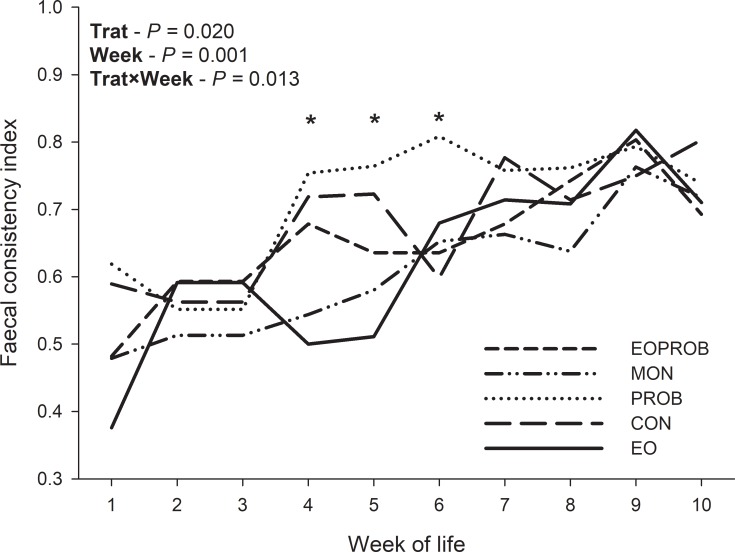
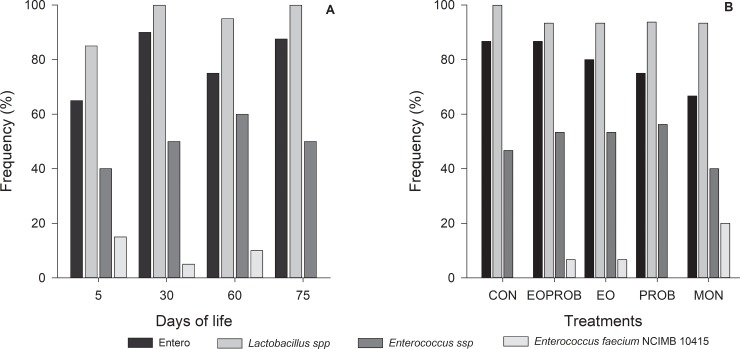
The aim was to evaluate the effect of different feed additives on intake, performance, and fecal consistency index (FCI) of dairy calves from 6-60 d of age and its residual effect 15 d after weaning. Fifty Holstein calves (38 ± 1.0 kg BW) were fed 5 L/d of milk plus starter feed until weaning, and corn silage and concentrate after weaning. The treatments were: control (CON), monensin (MON; 30 mg/kg of starter), probiotic E. faecium (PROB; 70 mg/kg of starter), essential oils (EO; 300 mg/kg of starter), or PROB + EO (EOPROB). Fecal score and dry matter intake (DMI) were measured daily, and animals were weighed every 15 d. A DNA extraction from feces was performed to identify the presence of microorganisms (E. coli, Hafnia, Shiguella, Lactobacillus spp, Enterococcus spp, and Enterococcus faecium NCIMB 10415) by PCR. Two 72-h digestibility trials were performed at days 20-28 and 50-56, by total fecal collection. The DMI before weaning was greater for EO (903.0 g/d) compared with MON (794.3 g/d) and EOPROB (783.1 g/d). The FCI decreased during pre-weaning for EO and MON. Average daily gain (ADG) and feed efficiency (FE) did not differ among treatments before weaning. After weaning, DMI and FCI did not differ among treatments. The EO had greater ADG (917.5 g/d) compared with CON (615.8 g/d) and PROB (592.6 g/d). The FE improved with EO (0.72 g/g) over CON (0.36 g/g), MON (0.49 g/g), and PROB (0.36 g/g). The PCR results showed absence of E. faecium NCIMB 10415 in animals fed PROB and CON. Animals fed PROB had greater intake of CP and NDF than animals fed EOPROB. The EO can be added to the dairy calf ration to improve fecal score and increase DMI. The pre-weaning FCI decrease with MON and increase with PROB.
本研究旨在评估不同饲料添加剂对 6-60 日龄奶牛犊牛采食量、生产性能和粪便硬度指数(FCI)的影响及其断奶后 15 天的残留效应。50 头荷斯坦奶牛(38±1.0kgBW)在断奶前每天饲喂 5L 牛奶和开食料,断奶后饲喂青贮玉米和精料。处理组分别为:对照组(CON)、莫能菌素(MON;30mg/kg 开食料)、粪肠球菌(PROB;70mg/kg 开食料)、精油(EO;300mg/kg 开食料)或 PROB+EO(EOPROB)。每天记录粪便评分和干物质采食量(DMI),每 15d 称重一次。通过聚合酶链反应(PCR)从粪便中提取 DNA,以鉴定微生物(大肠杆菌、哈夫尼亚菌、志贺氏菌、乳酸杆菌属、肠球菌属和粪肠球菌 NCIMB 10415)的存在。在第 20-28 天和第 50-56 天进行了两次为期 72h 的全粪消化试验。断奶前,EO 组(903.0g/d)的 DMI 大于 MON 组(794.3g/d)和 EOPROB 组(783.1g/d)。断奶前,EO 和 MON 组的 FCI 下降。断奶前,各处理组间的平均日增重(ADG)和饲料效率(FE)无差异。断奶后,各处理组间 DMI 和 FCI 无差异。与 CON(615.8g/d)和 PROB(592.6g/d)相比,EO 组的 ADG(917.5g/d)更高。与 CON(0.36g/g)、MON(0.49g/g)和 PROB(0.36g/g)相比,EO 组的 FE(0.72g/g)提高。PCR 结果显示,饲喂 PROB 和 CON 的动物中不存在粪肠球菌 NCIMB 10415。饲喂 PROB 的动物比饲喂 EOPROB 的动物摄入更多的 CP 和 NDF。EO 可添加到奶牛犊牛日粮中,以改善粪便评分并增加 DMI。断奶前 FCI 随着 MON 的添加而降低,随着 PROB 的添加而升高。