Vashishta Aruna, Jimenez-Flores Emeri, Klaes Christopher K, Tian Shifu, Miralda Irina, Lamont Richard J, Uriarte Silvia M
Department of Medicine, School of Medicine, University of Louisville, 570 S. Preston St., Louisville, KY 40202, USA.
Department of Oral Immunology and Infectious Diseases, School of Dentistry, University of Louisville, 570 S. Preston St., Louisville, KY 40202, USA.
Pathogens. 2019 May 1;8(2):59. doi: 10.3390/pathogens8020059.
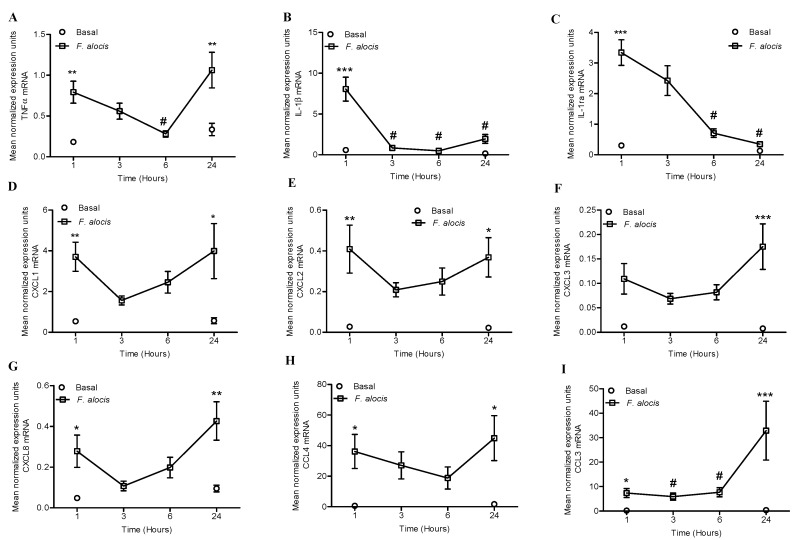
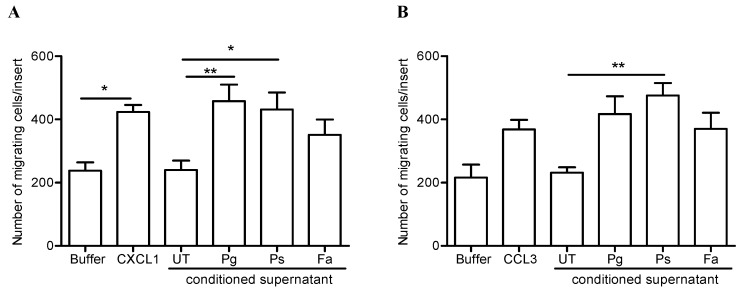
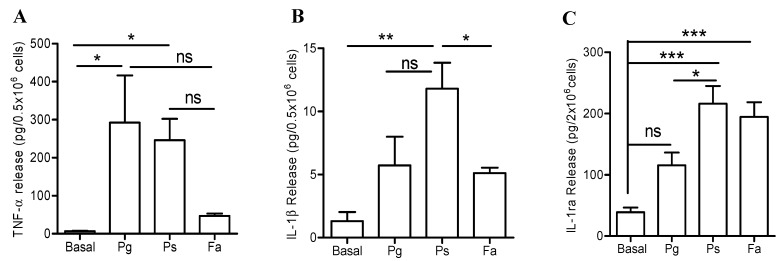
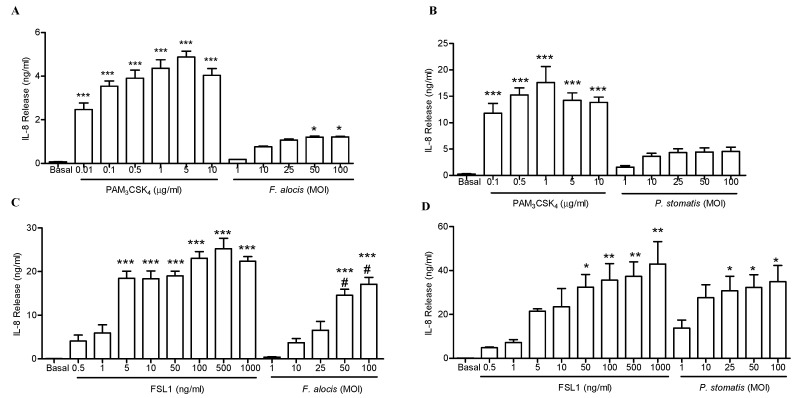
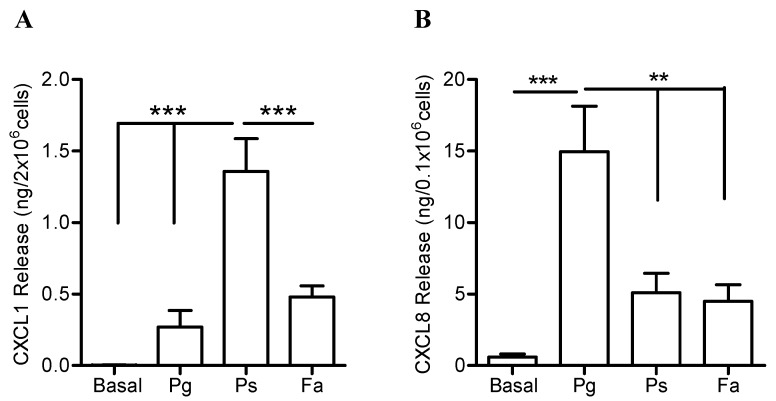
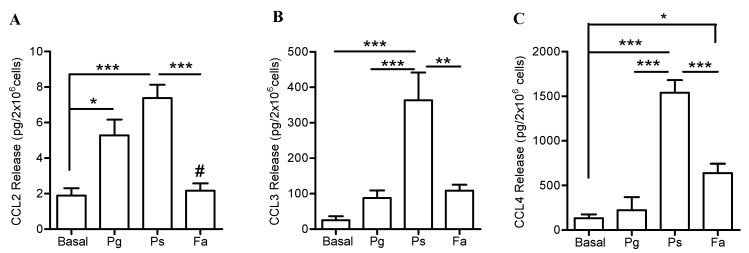
Periodontitis is a highly prevalent infectious disease that affects ~ 50% of the adults in the USA alone. Two Gram-positive anaerobic oral bacteria, and , have emerged as important periodontal pathogens. Neutrophils are a major component of the innate host response in the gingival tissue, and the contribution of neutrophil-derived cytokines and chemokines plays a central role in disease progression. The pattern of cytokines and chemokines released by human neutrophils upon stimulation with newly appreciated periodontal bacteria compared to the keystone oral pathogen was investigated. Our results showed that both and triggered TLR2/6 activation. F. alocis induced significant changes in gene expression of cytokines and chemokines in human neutrophils compared to unstimulated cells. However, except for IL-1ra, neutrophils released lower levels of cytokines and chemokines in response to F. alocis compared to P. stomatis. Furthermore, bacteria-free conditioned supernatant collected from neutrophils challenged with P. stomatis, but not from P. gingivalis or F. alocis, was chemotactic towards both neutrophils and monocytes. Elucidating stimuli-specific modulation of human neutrophil effector functions in the context of dysbiotic microbial community constituents provides valuable information for understanding the pathogenesis of periodontal diseases.
牙周炎是一种高度流行的传染病,仅在美国就影响了约50%的成年人。两种革兰氏阳性厌氧口腔细菌,即[具体细菌名称1]和[具体细菌名称2],已成为重要的牙周病原体。中性粒细胞是牙龈组织中固有宿主反应的主要组成部分,中性粒细胞衍生的细胞因子和趋化因子的作用在疾病进展中起着核心作用。研究了与关键口腔病原体[具体病原体名称]相比,新发现的牙周细菌刺激后人中性粒细胞释放的细胞因子和趋化因子模式。我们的结果表明,[具体细菌名称1]和[具体细菌名称2]均触发了TLR2/6激活。与未刺激的细胞相比,牙龈纤毛菌诱导人中性粒细胞中细胞因子和趋化因子的基因表达发生显著变化。然而,除白细胞介素-1受体拮抗剂(IL-1ra)外,与口腔扁平苔藓相比,中性粒细胞对牙龈纤毛菌刺激释放的细胞因子和趋化因子水平较低。此外,从受口腔扁平苔藓攻击的中性粒细胞中收集的无菌条件上清液对中性粒细胞和单核细胞都有趋化作用,但从牙龈卟啉单胞菌或牙龈纤毛菌攻击的中性粒细胞中收集的上清液则没有。在生态失调的微生物群落成分背景下阐明人中性粒细胞效应功能的刺激特异性调节,为理解牙周疾病的发病机制提供了有价值的信息。