Cvetkovic Caroline, Rich Max H, Raman Ritu, Kong Hyunjoon, Bashir Rashid
Department of Bioengineering, University of Illinois at Urbana-Champaign, Urbana, IL 61801, USA.
Micro and Nanotechnology Laboratory, University of Illinois at Urbana-Champaign, Urbana, IL 61801, USA.
Microsyst Nanoeng. 2017 Jun 19;3:17015. doi: 10.1038/micronano.2017.15. eCollection 2017.
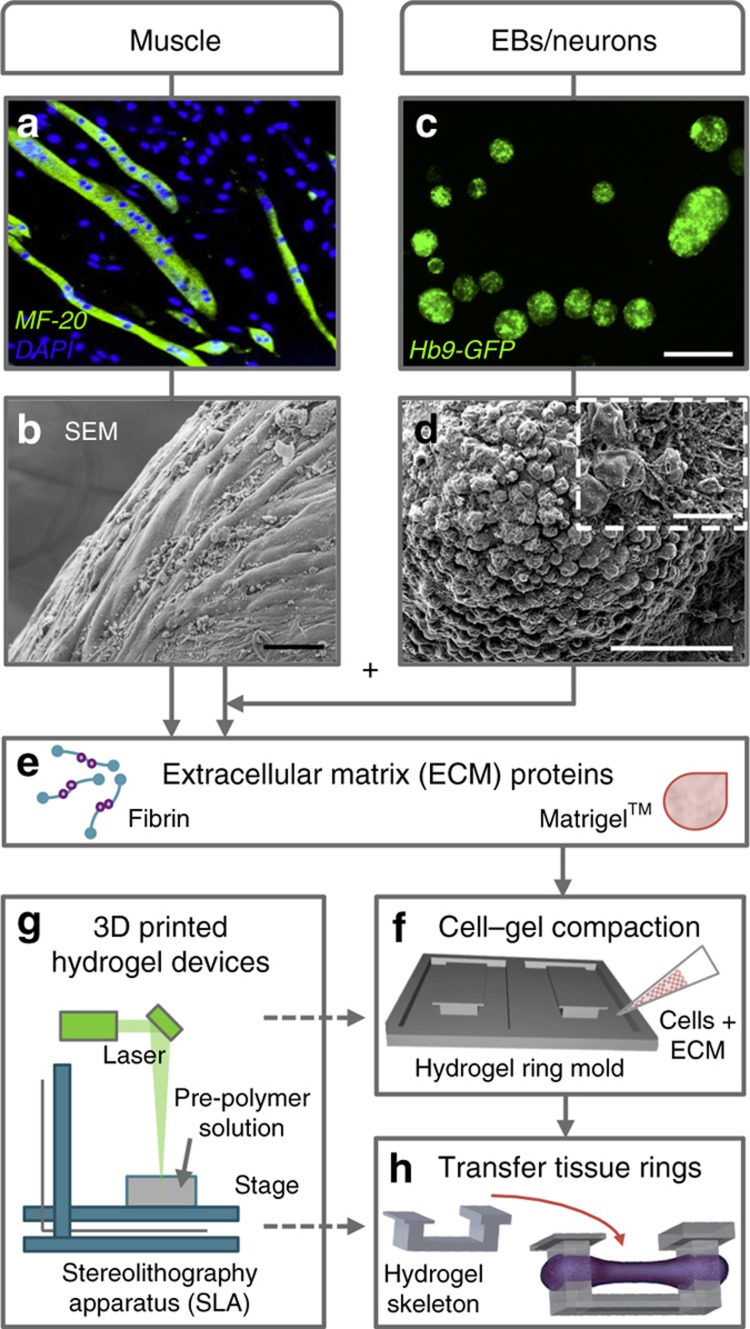
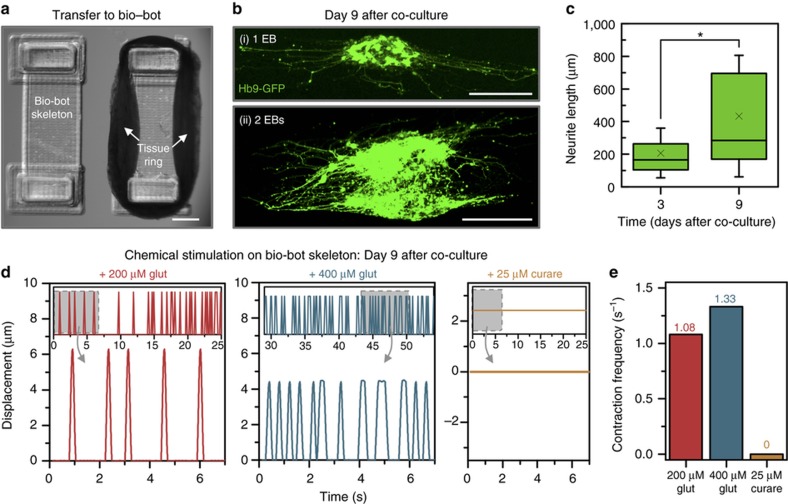
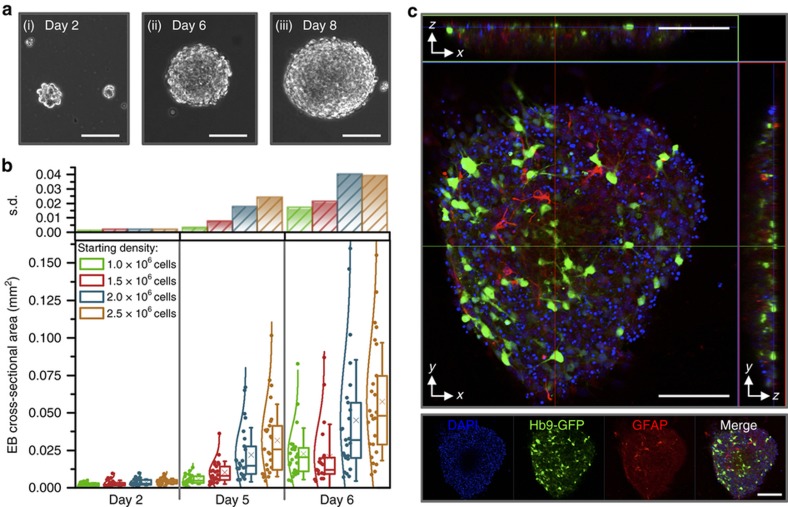
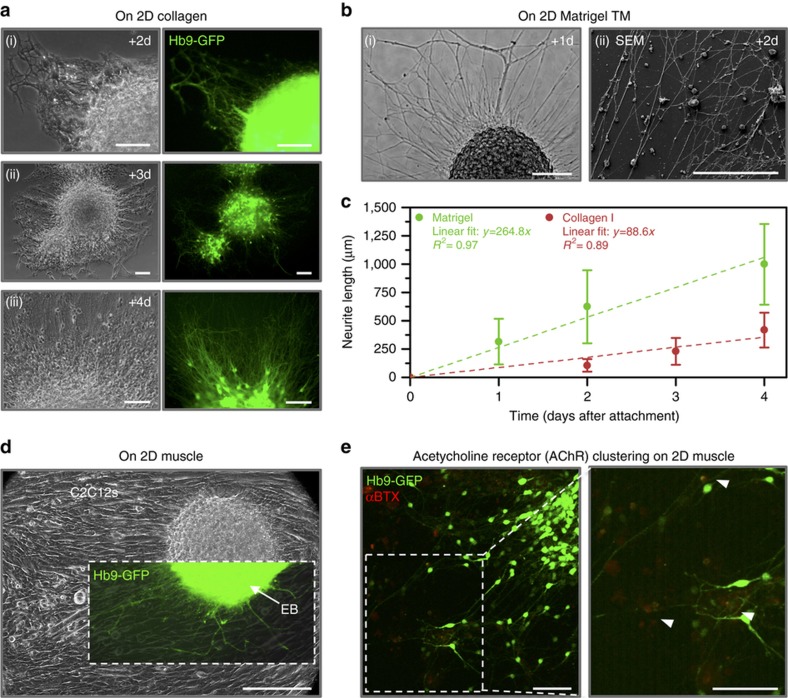
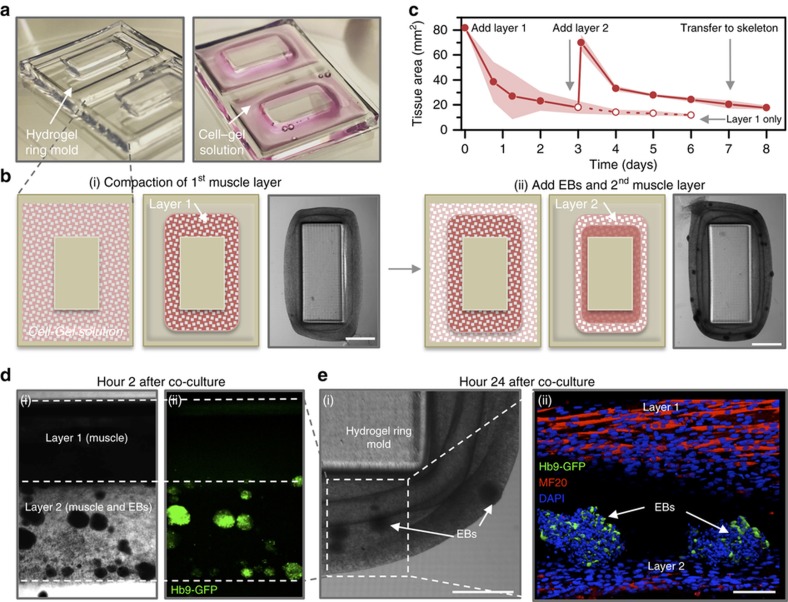
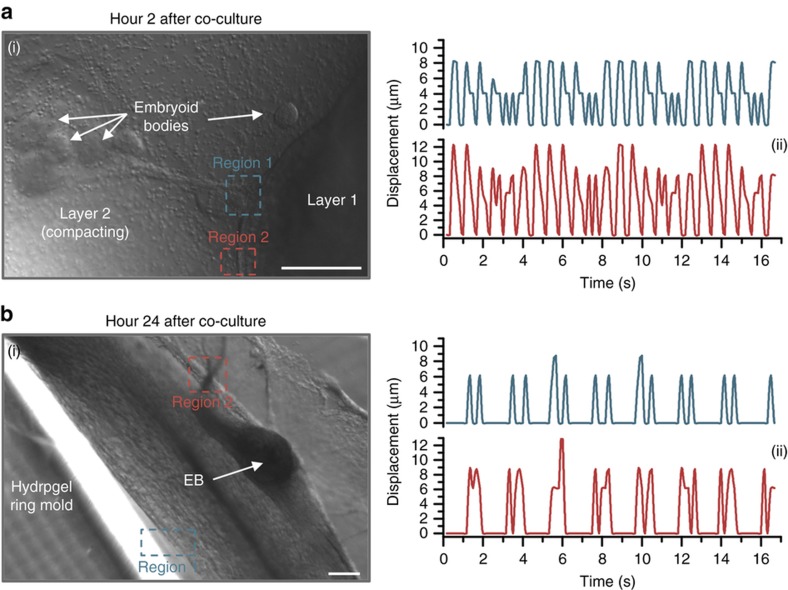
A complex and functional living cellular system requires the interaction of one or more cell types to perform specific tasks, such as sensing, processing, or force production. Modular and flexible platforms for fabrication of such multi-cellular modules and their characterization have been lacking. Here, we present a modular cellular system, made up of multi-layered tissue rings containing integrated skeletal muscle and motor neurons (MNs) embedded in an extracellular matrix. The MNs were differentiated from mouse embryonic stem cells through the formation of embryoid bodies (EBs), which are spherical aggregations of cells grown in a suspension culture. The EBs were integrated into a tissue ring with skeletal muscle, which was differentiated in parallel, to create a co-culture amenable to both cell types. The multi-layered rings were then sequentially placed on a stationary three-dimensional-printed hydrogel structure resembling an anatomical muscle-tendon-bone organization. We demonstrate that the site-specific innervation of a group of muscle fibers in the multi-layered tissue rings allows for muscle contraction via chemical stimulation of MNs with glutamate, a major excitatory neurotransmitter in the mammalian nervous system, with the frequency of contraction increasing with glutamate concentration. The addition of tubocurarine chloride (a nicotinic receptor antagonist) halted the contractions, indicating that muscle contraction was MN induced. With a bio-fabricated system permitting controllable mechanical and geometric attributes in a range of length scales, our novel engineered cellular system can be utilized for easier integration of other modular "building blocks" in living cellular and biological machines.
一个复杂且功能完备的活细胞系统需要一种或多种细胞类型相互作用以执行特定任务,比如感知、处理或产生力。用于制造此类多细胞模块及其特性表征的模块化且灵活的平台一直缺失。在此,我们展示了一种模块化细胞系统,它由多层组织环组成,这些组织环包含嵌入细胞外基质中的整合骨骼肌和运动神经元(MNs)。MNs 是从小鼠胚胎干细胞通过形成胚状体(EBs)分化而来的,胚状体是在悬浮培养中生长的细胞球形聚集体。将 EBs 与平行分化的骨骼肌整合到一个组织环中,以创建一种适合两种细胞类型的共培养体系。然后将多层环依次放置在一个类似解剖学上肌肉 - 肌腱 - 骨组织的固定三维打印水凝胶结构上。我们证明,多层组织环中一组肌肉纤维的位点特异性神经支配使得通过用谷氨酸(哺乳动物神经系统中的一种主要兴奋性神经递质)对 MNs 进行化学刺激来实现肌肉收缩,收缩频率随谷氨酸浓度增加而升高。添加氯化筒箭毒碱(一种烟碱受体拮抗剂)可使收缩停止,这表明肌肉收缩是由 MNs 诱导的。借助一个在一系列长度尺度上允许可控机械和几何属性的生物制造系统,我们的新型工程细胞系统可用于更轻松地将其他模块化“构建块”整合到活细胞和生物机器中。