Soft Robotics Laboratory, Department of Mechanical Engineering, Eidgenossische Technische Hochschule Zurich, 8092 Zurich, Switzerland.
Department of Biological Engineering, Massachusetts Institute of Technology, Cambridge, MA 02139.
Proc Natl Acad Sci U S A. 2022 Aug 30;119(35):e2200741119. doi: 10.1073/pnas.2200741119. Epub 2022 Aug 24.
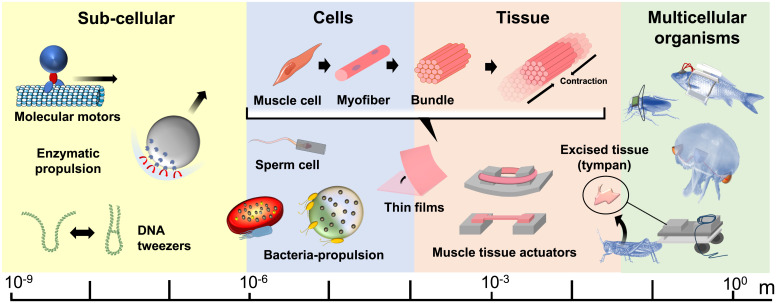
The next robotics frontier will be led by biohybrids. Capable biohybrid robots require microfluidics to sustain, improve, and scale the architectural complexity of their core ingredient: biological tissues. Advances in microfluidics have already revolutionized disease modeling and drug development, and are positioned to impact regenerative medicine but have yet to apply to biohybrids. Fusing microfluidics with living materials will improve tissue perfusion and maturation, and enable precise patterning of sensing, processing, and control elements. This perspective suggests future developments in advanced biohybrids.
下一个机器人技术前沿将由生物杂交体引领。能够实现生物杂交的机器人需要微流控技术来维持、改进和扩展其核心成分——生物组织的结构复杂性。微流控技术的进步已经彻底改变了疾病建模和药物开发,并且有望对再生医学产生影响,但尚未应用于生物杂交体。将微流控技术与活体材料融合将改善组织灌注和成熟度,并能够精确设计感应、处理和控制元件。本观点对先进生物杂交体的未来发展提出了建议。