Wolfson Wellcome Biomedical Laboratories, Department of Life Sciences, Natural History Museum, Cromwell Road, London, SW7 5BD, UK.
BMC Public Health. 2012 Oct 30;12:930. doi: 10.1186/1471-2458-12-930.
Schistosomiasis is a parasitic infection that continues to be a major public health problem in many developing countries being responsible for an estimated burden of at least 1.4 million disability-adjusted life years (DALYs) in Africa alone. Importantly, morbidity due to schistosomiasis has been greatly reduced in some parts of the world, including Zanzibar. The Zanzibar government is now committed to eliminate urogenital schistosomiasis. Over the next 3-5 years, the whole at-risk population will be administered praziquantel (40 mg/kg) biannually. Additionally, snail control and behaviour change interventions will be implemented in selected communities and the outcomes and impact measured in a randomized intervention trial.
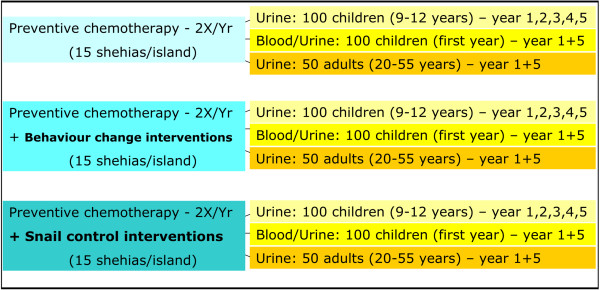
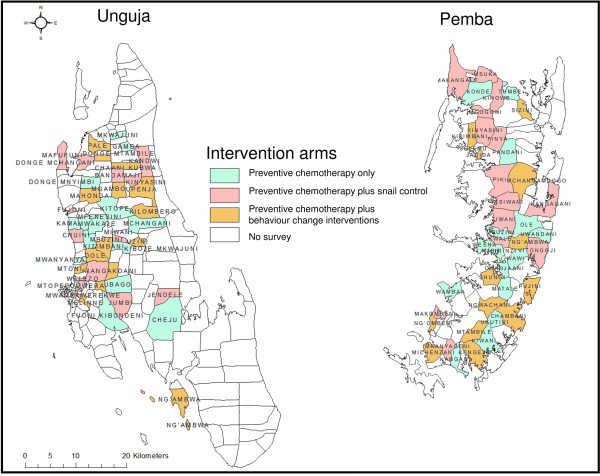
METHODS/DESIGN: In this 5-year research study, on both Unguja and Pemba islands, urogenital schistosomiasis will be assessed in 45 communities with urine filtration and reagent strips in 4,500 schoolchildren aged 9-12 years annually, and in 4,500 first-year schoolchildren and 2,250 adults in years 1 and 5. Additionally, from first-year schoolchildren, a finger-prick blood sample will be collected and examined for Schistosoma haematobium infection biomarkers. Changes in prevalence and infection intensity will be assessed annually. Among the 45 communities, 15 were randomized for biannual snail control with niclosamide, in concordance with preventive chemotherapy campaigns. The reduction of Bulinus globosus snail populations and S. haematobium-infected snails will be investigated. In 15 other communities, interventions triggering behaviour change have been designed and will be implemented in collaboration with the community. A change in knowledge, attitudes and practices will be assessed annually through focus group discussions and in-depth interviews with schoolchildren, teachers, parents and community leaders. In all 45 communities, changes in the health system, water and sanitation infrastructure will be annually tracked by standardized questionnaire-interviews with community leaders. Additional issues potentially impacting on study outcomes and all incurring costs will be recordedand monitored longitudinally.
Elimination of schistosomiasis has become a priority on the agenda of the Zanzibar government and the international community. Our study will contribute to identifying what, in addition to preventive chemotherapy, needs to be done to prevent, control, and ultimately eliminate schistosomiasis, and to draw lessons for current and future schistosomiasis elimination programmes in Africa and elsewhere.
ISRCTN48837681.
血吸虫病是一种寄生虫感染,在许多发展中国家仍然是一个主要的公共卫生问题,仅在非洲,它就造成了至少 140 万残疾调整生命年(DALYs)的负担。重要的是,在世界上的一些地区,包括桑给巴尔,血吸虫病的发病率已经大大降低。桑给巴尔政府现在致力于消除尿路血吸虫病。在接下来的 3-5 年内,将对所有高危人群每两年进行一次吡喹酮(40mg/kg)治疗。此外,将在选定的社区实施钉螺控制和行为改变干预措施,并在随机干预试验中测量结果和影响。
方法/设计:在这项为期 5 年的研究中,在 Unguja 和 Pemba 两个岛屿上,每年将对 45 个社区的 4000 名 9-12 岁的在校儿童和第 1 年和第 5 年的 4000 名一年级学生和 2250 名成年人进行尿过滤和试剂条检测,评估尿路血吸虫病。每年将评估患病率和感染强度的变化。在这 45 个社区中,有 15 个社区随机进行了为期两年的尼氯硝唑螺控制,与预防性化疗运动相吻合。将调查减少 Bulinus globosus 钉螺种群和感染血吸虫的钉螺的情况。在其他 15 个社区中,设计了触发行为改变的干预措施,并将与社区合作实施。每年将通过焦点小组讨论和对小学生、教师、家长和社区领导的深入访谈评估知识、态度和实践的变化。在所有 45 个社区中,每年通过对社区领导进行标准化问卷调查访谈来跟踪卫生系统、水和卫生基础设施的变化。还将记录和监测所有潜在影响研究结果和产生的费用的问题,并进行纵向监测。
消除血吸虫病已成为桑给巴尔政府和国际社会的优先事项。我们的研究将有助于确定除了预防性化疗之外,还需要做些什么来预防、控制和最终消除血吸虫病,并为非洲和其他地区当前和未来的血吸虫病消除规划提供经验教训。
ISRCTN48837681。