Department of Metabolism Research, Lexicon Pharmaceuticals, 8800 Technology Forest Place, The Woodlands, TX 77381, USA
Department of Metabolism Research, Lexicon Pharmaceuticals, 8800 Technology Forest Place, The Woodlands, TX 77381, USA.
Dis Model Mech. 2019 May 7;12(5):dmm038224. doi: 10.1242/dmm.038224.
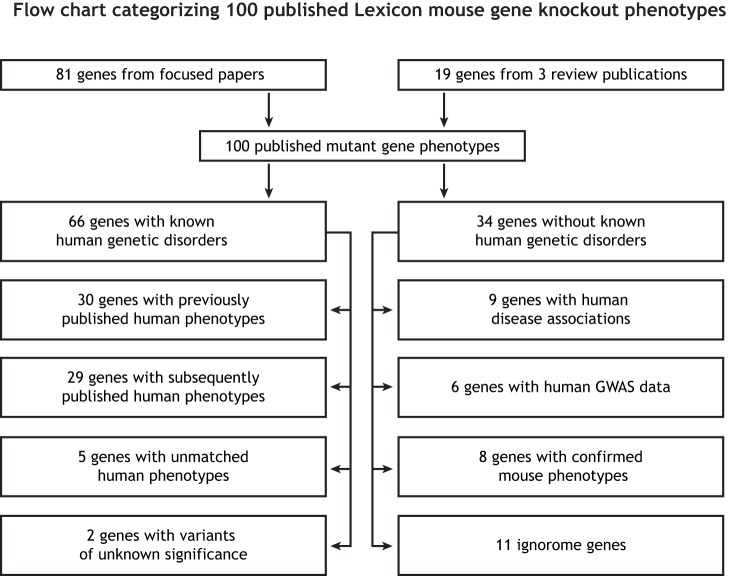
Two large-scale mouse gene knockout phenotyping campaigns have provided extensive data on the functions of thousands of mammalian genes. The ongoing International Mouse Phenotyping Consortium (IMPC), with the goal of examining all ∼20,000 mouse genes, has examined 5115 genes since 2011, and phenotypic data from several analyses are available on the IMPC website (www.mousephenotype.org). Mutant mice having at least one human genetic disease-associated phenotype are available for 185 IMPC genes. Lexicon Pharmaceuticals' Genome5000™ campaign performed similar analyses between 2000 and the end of 2008 focusing on the druggable genome, including enzymes, receptors, transporters, channels and secreted proteins. Mutants (4654 genes, with 3762 viable adult homozygous lines) with therapeutically interesting phenotypes were studied extensively. Importantly, phenotypes for 29 Lexicon mouse gene knockouts were published prior to observations of similar phenotypes resulting from homologous mutations in human genetic disorders. Knockout mouse phenotypes for an additional 30 genes mimicked previously published human genetic disorders. Several of these models have helped develop effective treatments for human diseases. For example, studying knockout mice (lacking peripheral serotonin) aided the development of telotristat ethyl, an approved treatment for carcinoid syndrome. (also known as ) and (also known as ) knockout mice were employed to develop sotagliflozin, a dual SGLT1/SGLT2 inhibitor having success in clinical trials for diabetes. Clinical trials evaluating inhibitors of AAK1 (neuropathic pain) and SGLT1 (diabetes) are underway. The research community can take advantage of these unbiased analyses of gene function in mice, including the minimally studied 'ignorome' genes.
两项大规模的小鼠基因敲除表型分析计划提供了大量关于数千个哺乳动物基因功能的广泛数据。正在进行的国际小鼠表型分析联盟(IMPC),其目标是研究所有约 20000 个小鼠基因,自 2011 年以来已经检查了 5115 个基因,并且 IMPC 网站(www.mousephenotype.org)上提供了来自几个分析的表型数据。具有至少一种人类遗传疾病相关表型的突变小鼠可用于 185 个 IMPC 基因。Lexicon Pharmaceuticals 的 Genome5000™ 计划在 2000 年至 2008 年底期间进行了类似的分析,重点是可用药基因组,包括酶、受体、转运蛋白、通道和分泌蛋白。具有治疗意义的表型的突变体(4654 个基因,有 3762 个可行的纯合成年线)进行了广泛研究。重要的是,29 个 Lexicon 小鼠基因敲除的表型在人类遗传疾病同源突变导致类似表型的观察之前就已经发表。另外 30 个基因的敲除小鼠表型模拟了先前发表的人类遗传疾病。这些模型中的一些有助于开发治疗人类疾病的有效疗法。例如,研究 敲除小鼠(缺乏外周血清素)有助于开发批准用于类癌综合征的治疗药物telotristat ethyl。 (也称为)和 (也称为)敲除小鼠被用于开发 sotagliflozin,一种用于糖尿病的双重 SGLT1/SGLT2 抑制剂,在临床试验中取得了成功。正在进行评估 AAK1(神经痛)和 SGLT1(糖尿病)抑制剂的临床试验。研究界可以利用这些对小鼠基因功能的无偏分析,包括研究最少的“ignorome”基因。