Harman Gary E, Uphoff Norman
Cornell University, Ithaca, NY, USA.
Scientifica (Cairo). 2019 Apr 2;2019:9106395. doi: 10.1155/2019/9106395. eCollection 2019.
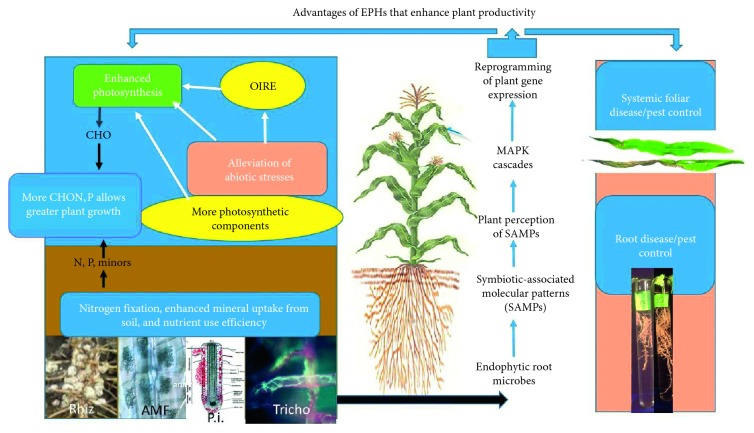
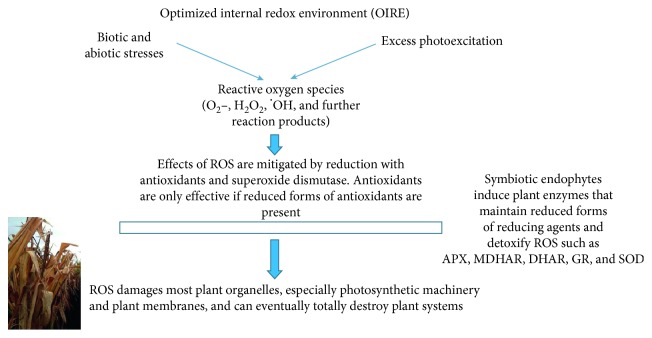
Plants should not be regarded as entities unto themselves, but as the visible part of plant-microbe complexes which are best understood as "holobiomes." Some microorganisms when given the opportunity to inhabit plant roots become root symbionts. Such root colonization by symbiotic microbes can raise crop yields by promoting the growth of both shoots and roots, by enhancing uptake, fixation, and/or more efficient use of nutrients, by improving plants' resistance to pests, diseases, and abiotic stresses that include drought, salt, and other environmental conditions, and by enhancing plants' capacity for photosynthesis. We refer plant-microbe associations with these capabilities that have been purposefully established as enhanced plant holobiomes (EPHs). Here, we consider four groups of phylogenetically distinct and distant symbiotic endophytes: (1) Rhizobiaceae bacteria; (2) plant-obligate arbuscular mycorrhizal fungi (AMF); (3) selected endophytic strains of fungi in the genus ; and (4) fungi in the Sebicales order, specifically . Although these exhibit quite different "lifestyles" when inhabiting plants, all induce beneficial systemic changes in plants' gene expression that are surprisingly similar. For example, all induce gene expression that produces proteins which detoxify reactive oxygen species (ROS). ROS are increased by environmental stresses on plants or by overexcitation of photosynthetic pigments. Gene overexpression results in a cellular environment where ROS levels are controlled and made more compatible with plants' metabolic processes. EPHs also frequently exhibit increased rates of photosynthesis that contribute to greater plant growth and other capabilities. Soil organic matter (SOM) is augmented when plant root growth is increased and roots remain in the soil. The combination of enhanced photosynthesis, increasing sequestration of CO from the air, and elevation of SOM removes C from the atmosphere and stores it in the soil. Reductions in global greenhouse gas levels can be accelerated by incentives for carbon farming and carbon cap-and-trade programs that reward such climate-friendly agriculture. The development and spread of EPHs as part of such initiatives has potential both to enhance farm productivity and incomes and to decelerate global warming.
植物不应被视为独立的个体,而应被视为植物-微生物复合体的可见部分,这种复合体最好被理解为“全生物群落”。一些微生物一旦有机会栖息在植物根部,就会成为根部共生体。共生微生物对根部的这种定殖可以通过促进地上部和根部的生长、增强养分的吸收、固定和/或更有效地利用养分、提高植物对包括干旱、盐害和其他环境条件在内的病虫害和非生物胁迫的抗性,以及增强植物的光合作用能力来提高作物产量。我们将具有这些功能且已被有意建立的植物-微生物联合体称为增强型植物全生物群落(EPHs)。在此,我们考虑四类系统发育上不同且亲缘关系较远的共生内生菌:(1)根瘤菌科细菌;(2)专性植物丛枝菌根真菌(AMF);(3)所选的 属内生真菌菌株;(4)Sebicales 目真菌,特别是 。尽管这些内生菌在栖息于植物时表现出截然不同的“生活方式”,但它们都会在植物基因表达中诱导出惊人相似的有益系统性变化。例如,它们都会诱导产生能够清除活性氧(ROS)的蛋白质的基因表达。植物受到环境胁迫或光合色素过度激发时,ROS 会增加。基因的过度表达会形成一个细胞环境,使 ROS 水平得到控制,并使其与植物的代谢过程更相适应。EPHs 还经常表现出光合作用速率的提高,这有助于植物生长得更好以及具备其他能力。当植物根系生长增加且根系留在土壤中时,土壤有机质(SOM)会增加。增强的光合作用、增加从空气中固定碳以及 SOM 的增加相结合,会将碳从大气中去除并储存在土壤中。通过鼓励碳农业和碳总量控制与交易计划来奖励这种气候友好型农业,可以加速全球温室气体水平的降低。作为此类举措的一部分,EPHs 的开发和推广有可能提高农场生产力和收入,并减缓全球变暖。