Ellis Libby, Belot Aurélien, Rachet Bernard, Coleman Michel P
London School of Hygiene and Tropical Medicine, London, United Kingdom.
J Glob Oncol. 2019 May;5:1-9. doi: 10.1200/JGO.19.00038.
The ratio of cancer mortality and cancer incidence rates in a population has conventionally been used as an indicator of the completeness of cancer registration. More recently, the complement of the mortality-to-incidence ratio (1-M/I) has increasingly been presented as a surrogate for cancer survival. We discuss why this is mistaken in principle and misleading in practice.
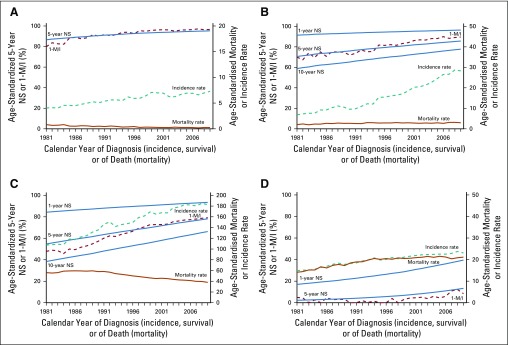
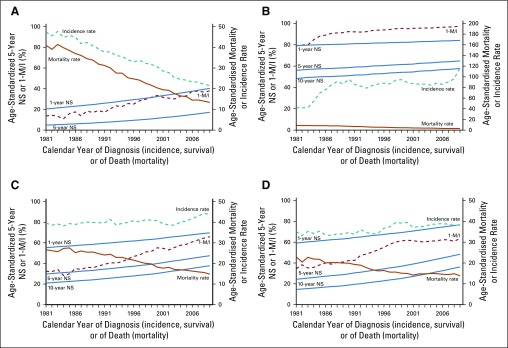
We provide an empirical assessment of the extent to which trends in the 1-M/I ratio reflect trends in cancer survival. We used national cancer incidence, mortality and survival data in England to compare trends in both the 1-M/I ratio and net survival at 1, 5, and 10 years for 19 cancers in men and 20 cancers in women over the 29-year period from 1981 to 2009.
The absolute difference between the 1-M/I ratio and 5-year net survival for 2009 was less than 5% for only 12 of the 39 cancer/sex combinations examined. For an additional 12, the 1-M/I ratio differed from 5-year net survival by at least 15%. The comparison is also unstable over time; thus, even when differences were small for 2009, the difference between 5-year net survival and the 1-M/I ratio had changed dramatically for most cancers between 1981 and 2009.
The 1-M/I ratio lacks any theoretical basis as a proxy for cancer survival. It is not a valid proxy for cancer survival in practice, either, whether at 5 years or at any other time interval since diagnosis. It has none of the useful properties of a population-based survival estimate. It should not be used as a surrogate for cancer survival.
人群中癌症死亡率与发病率之比传统上被用作癌症登记完整性的指标。最近,死亡率与发病率之比的倒数(1-M/I)越来越多地被用作癌症生存率的替代指标。我们讨论了为什么这在原则上是错误的,在实践中具有误导性。
我们对1-M/I比值趋势在多大程度上反映癌症生存趋势进行了实证评估。我们使用了英格兰的国家癌症发病率、死亡率和生存数据,比较了1981年至2009年这29年期间男性19种癌症和女性20种癌症在1年、5年和10年时1-M/I比值和净生存率的趋势。
在研究的39种癌症/性别组合中,2009年1-M/I比值与5年净生存率之间的绝对差异仅在12种组合中小于5%。另外12种组合中,1-M/I比值与5年净生存率的差异至少为15%。这种比较随时间也不稳定;因此,即使2009年差异很小,1981年至2009年期间大多数癌症的5年净生存率与1-M/I比值之间的差异也发生了巨大变化。
1-M/I比值作为癌症生存率的替代指标缺乏任何理论依据。在实践中,无论是在5年时还是在诊断后的任何其他时间间隔,它都不是癌症生存率的有效替代指标。它不具备基于人群的生存估计的任何有用特性。它不应被用作癌症生存率的替代指标。