Department of Medicine (DAME), University of Udine, Udine, UD, Italy.
Department of Oncology, ASUIUD University Hospital of Udine, Udine, UD, Italy.
J Cachexia Sarcopenia Muscle. 2019 Apr;10(2):368-377. doi: 10.1002/jcsm.12368. Epub 2019 Feb 4.
Pancreatic cancer (PC) patients have multiple risk factors for sarcopenia and loss of skeletal muscle mass (LSMM), which may cause greater treatment toxicities, reduced response to cancer therapy, prolonged hospitalization, impaired quality of life, and worse prognosis.
This is a retrospective study on advanced PC patients treated at the Department of Oncology of Udine, Italy, from January 2012 to November 2017. Among 162 patients who received chemotherapy, 94 consecutive patients with an available computed tomography (CT) scan were retrospectively analyzed. The primary objective of our study was to explore if an early LSMM ≥ 10% (measured at first radiological evaluation and compared with baseline) and/or baseline sarcopenia may impact prognosis. Baseline sarcopenia was defined according to Prado's criteria. Skeletal muscle area was measured as cross-sectional areas (cm ) using CT scan data through the Picture archiving and communication system (PACS) image system.
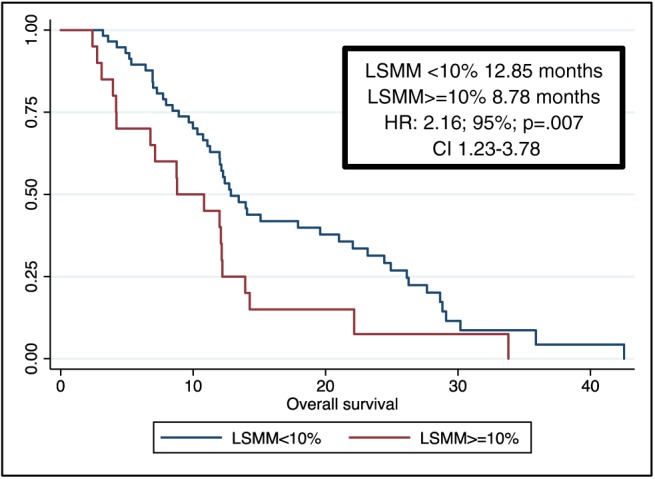
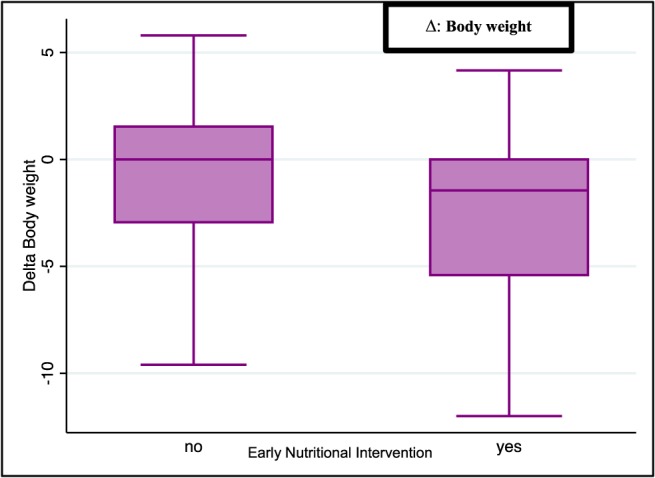
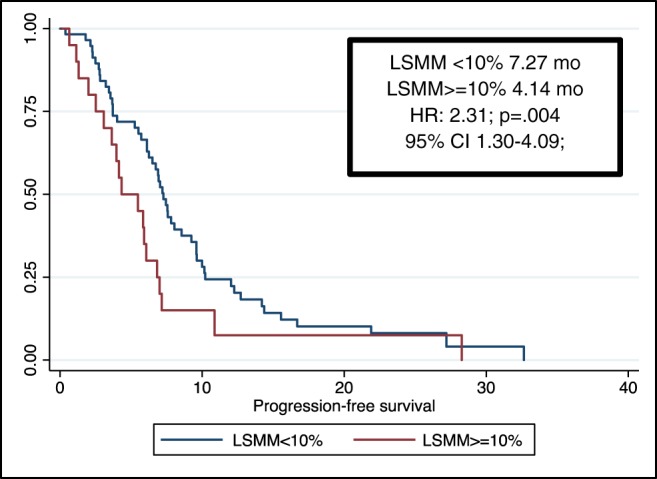
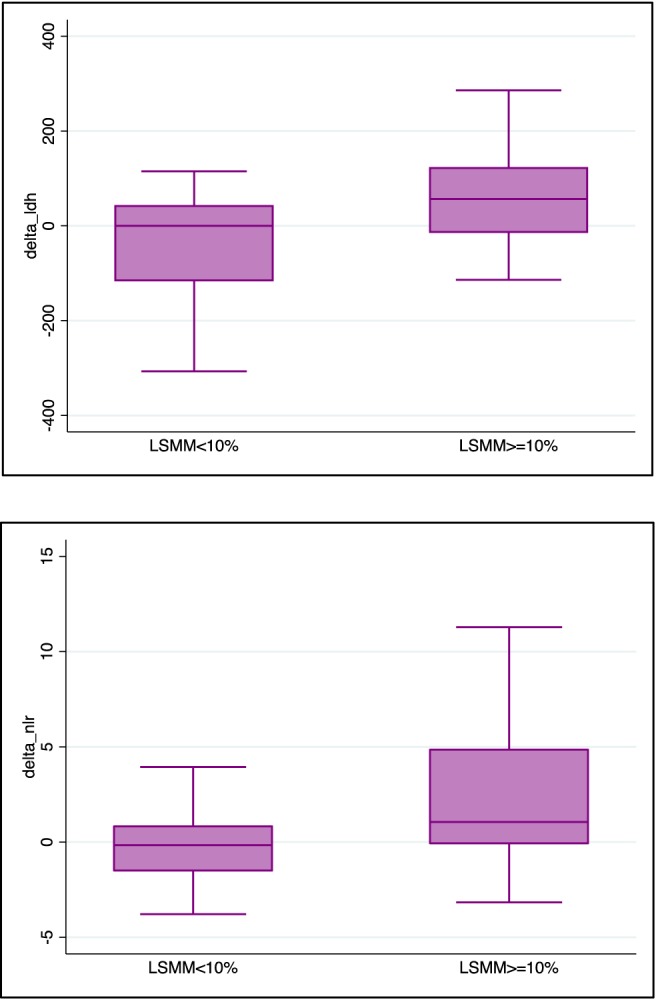
In the whole cohort, 48% of patients were ≤70 years old, and 50% had metastatic disease. At baseline, 73% of patients had sarcopenia, and 16% presented a visceral fat area ≥ 44 cm /m . Overall, 21% experienced an early LSMM ≥ 10%. Approximately 33% of sarcopenic patients at baseline and ~35% of patients with early LSMM ≥ 10% had a body mass index > 25 kg/m . Of note, 71% of patients were evaluated by a nutritionist, and 56% received a dietary supplementation (oral and/or parenteral). After a median follow-up of 30.44 months, median overall survival (OS) was 11.28 months, whereas median progression-free survival (PFS) was 5.72 months. By multivariate analysis, early LSMM ≥ 10% was significantly associated with worse OS [hazard ratio (HR): 2.16; 95% confidence interval (CI) 1.23-3.78; P = 0.007] and PFS (HR: 2.31; 95% CI 1.30-4.09; P = 0.004). Moreover, an exploratory analysis showed that inflammatory indexes, such as neutrophil-lymphocyte ratio variation, impact early LSMM ≥ 10% (odds ratio 1.31, 95% CI 1.06-1.61, P = 0.010).
Early LSMM ≥ 10% has a negative prognostic role in advanced PC patients. Further prospective investigations are needed to confirm these preliminary data.
胰腺癌(PC)患者存在多种发生肌肉减少症和骨骼肌量损失(LSMM)的风险因素,这可能导致更严重的治疗毒性、癌症治疗反应降低、住院时间延长、生活质量受损以及预后更差。
这是一项对意大利乌迪内肿瘤科 2012 年 1 月至 2017 年 11 月期间治疗的晚期 PC 患者进行的回顾性研究。在接受化疗的 162 名患者中,回顾性分析了 94 名连续接受 CT 扫描的患者。本研究的主要目的是探讨早期 LSMM≥10%(在第一次影像学评估时测量,并与基线相比)和/或基线时肌肉减少症是否会影响预后。基线时肌肉减少症按照 Prado 的标准定义。使用 CT 扫描数据通过图像存档与通讯系统(PACS)图像系统测量骨骼肌面积(cm²)。
在整个队列中,48%的患者年龄≤70 岁,50%的患者有转移病灶。基线时,73%的患者存在肌肉减少症,16%的患者内脏脂肪面积≥44cm²/m²。总体而言,21%的患者发生了早期 LSMM≥10%。大约 33%的基线时存在肌肉减少症的患者和~35%的早期 LSMM≥10%的患者体重指数(BMI)>25kg/m²。值得注意的是,71%的患者接受了营养师的评估,56%的患者接受了饮食补充(口服和/或肠外)。中位随访 30.44 个月后,中位总生存期(OS)为 11.28 个月,而中位无进展生存期(PFS)为 5.72 个月。多变量分析显示,早期 LSMM≥10%与更差的 OS 显著相关[风险比(HR):2.16;95%置信区间(CI)1.23-3.78;P=0.007]和 PFS(HR:2.31;95%CI 1.30-4.09;P=0.004)。此外,一项探索性分析表明,炎症指标(如中性粒细胞-淋巴细胞比值变化)与早期 LSMM≥10%有关(比值比 1.31,95%CI 1.06-1.61,P=0.010)。
早期 LSMM≥10%在晚期 PC 患者中具有负性预后作用。需要进一步的前瞻性研究来证实这些初步数据。