Department of Human Physiology, Medical University of Lublin, Radziwiłłowska 11, 20-080, Lublin, Poland.
Department of Oncology, Medical University of Lublin, Lublin, Poland.
Support Care Cancer. 2020 Feb;28(2):531-540. doi: 10.1007/s00520-019-04838-6. Epub 2019 May 10.
Radiotherapy (RTH) usually combined with chemotherapy (C-RTH) is the main method of treatment in head and neck cancer (HNC). The most common complication of RTH is oral mucositis (OM). At a certain stage of RTH, it occurs in almost all patients, often lead to discontinuation of treatment. Tumour necrosis factor alpha (TNF-α) is a cytokine secreted during inflammatory process accompanying RTH and the development of cancer itself. Single nucleotide polymorphism (SNP) of the TNF-α promoter region can potentially affect the function or expression of this cytokine, and thus modulate the risk of occurrence and intensity of OM and shortening of overall survival (OS).
The study group consisted of 62 patients with HNC in whom intensity-modulated radiation therapy (IMRT) technique was applied. The plasma TNF-α level was assessed using the ELISA Kit. Genotyping was performed using a real-time PCR method.
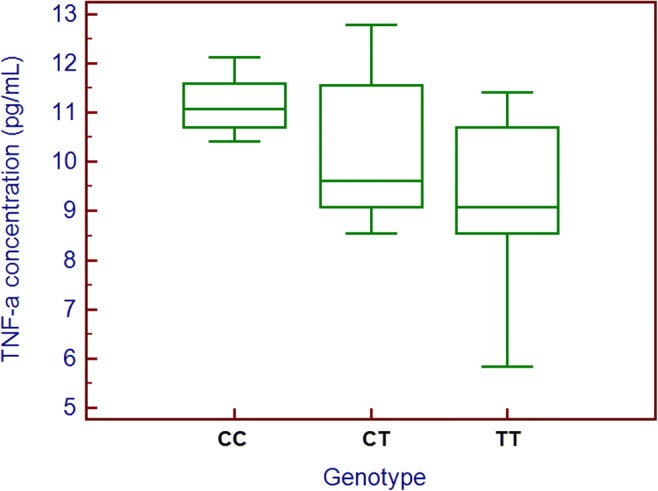
HNC patients with the CC genotype of TNF-α (- 1211 T > C) have higher TNF-α plasma concentrations than those with T allele (10.70 vs 9.62 ng/ml). Patients with the 3rd degree of OM have significantly higher TNF-α levels after 5th (10.40 vs 9.45 ng/ml) and 7th (10.32 vs 9.60 ng/ml) week of RTH. CC genotype was related to a higher risk of 3rd degree OM development in the last weeks of RTH (5th, OR = 7.33; 7th, OR = 23.15).
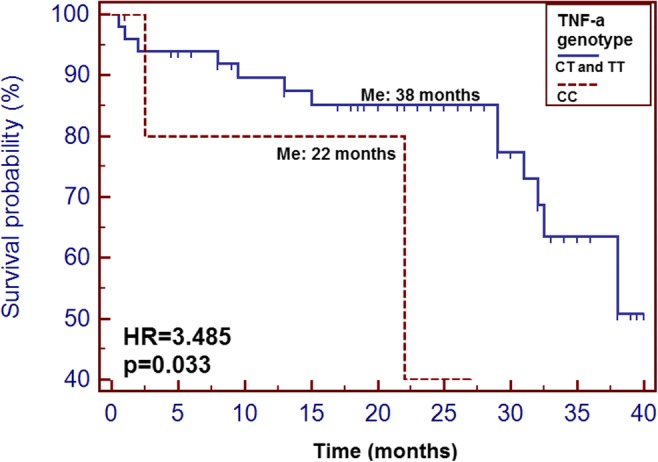
High TNF-α plasma concentration and CC genotype of TNF-α are related to the higher risk of more severe OM in patients irradiated due to HNC. High TNF-α plasma concentration and CC genotype of TNF-α are independent prognostic factors for patients subjected to RTH due to HNC.
放射治疗(RTH)通常与化疗(C-RTH)联合使用,是头颈部癌症(HNC)的主要治疗方法。RTH 的最常见并发症是口腔粘膜炎(OM)。在 RTH 的某个阶段,几乎所有患者都会发生这种情况,通常会导致治疗中断。肿瘤坏死因子-α(TNF-α)是 RTH 及癌症本身炎症过程中分泌的一种细胞因子。TNF-α 启动子区域的单核苷酸多态性(SNP)可能会影响这种细胞因子的功能或表达,从而调节 OM 的发生和严重程度以及总生存(OS)的缩短风险。
该研究组包括 62 例接受调强放疗(IMRT)技术治疗的 HNC 患者。采用 ELISA 试剂盒检测血浆 TNF-α 水平。采用实时 PCR 方法进行基因分型。
TNF-α(-1211T>C)CC 基因型的 HNC 患者的 TNF-α 血浆浓度高于 T 等位基因(10.70 比 9.62ng/ml)。OM 第 3 度患者在 RTH 第 5 天(10.40 比 9.45ng/ml)和第 7 天(10.32 比 9.60ng/ml)后 TNF-α 水平显著升高。CC 基因型与 RTH 最后几周 3 度 OM 发生的风险增加相关(第 5 天,OR=7.33;第 7 天,OR=23.15)。
高 TNF-α 血浆浓度和 TNF-α 的 CC 基因型与 HNC 放疗患者发生更严重 OM 的风险增加有关。高 TNF-α 血浆浓度和 TNF-α 的 CC 基因型是接受 HNC 放疗的患者的独立预后因素。