State Key Lab of Bioreactor Engineering, East China University of Science and Technology, P.O.B. 311, 130 Meilong Road, Shanghai, 200237, China.
Sunson Industry Group Co, Ltd, Beijing, China.
Microb Cell Fact. 2019 May 10;18(1):81. doi: 10.1186/s12934-019-1131-z.
Cellulolytic enzymes produced by the filamentous fungus Trichoderma reesei are commonly used in biomass conversion. The high cost of cellulase is still a significant challenge to commercial biofuel production. Improving cellulase production in T. reesei for application in the cellulosic biorefinery setting is an urgent priority.
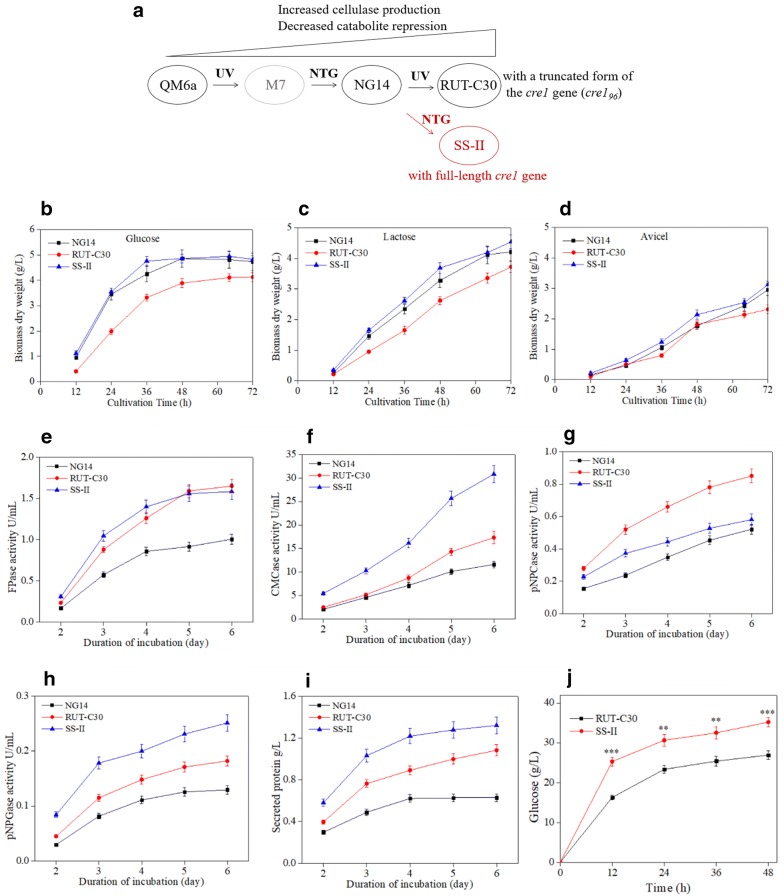
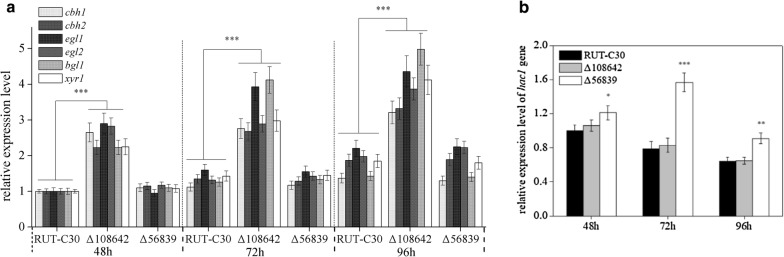
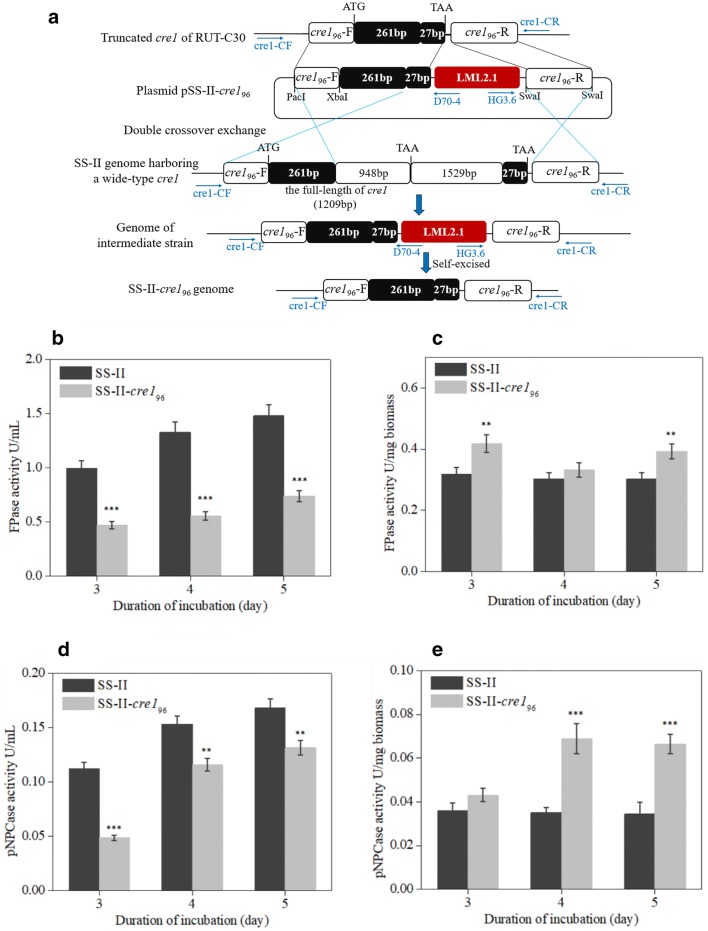
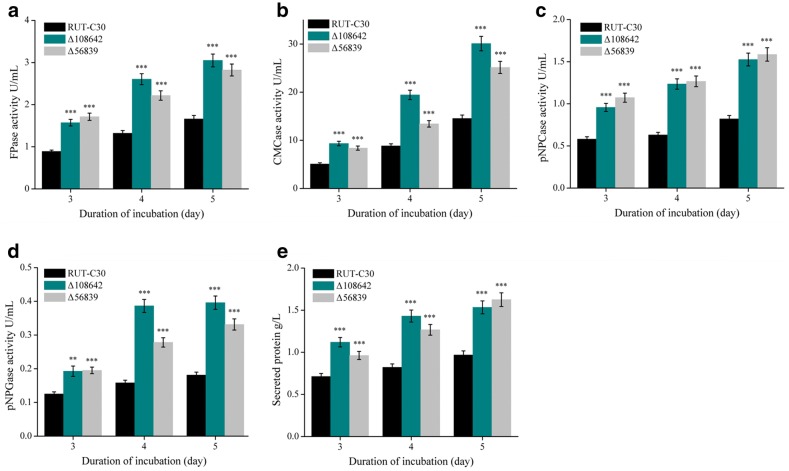
Trichoderma reesei hyper-cellulolytic mutant SS-II derived from the T. reesei NG14 strain exhibited faster growth rate and more efficient lignocellulosic biomass degradation than those of RUT-C30, another hyper-cellulolytic strain derived from NG14. To identify any genetic changes that occurred in SS-II, we sequenced its genome using Illumina MiSeq. In total, 184 single nucleotide polymorphisms and 40 insertions and deletions were identified. SS-II sequencing revealed 107 novel mutations and a full-length wild-type carbon catabolite repressor 1 gene (cre1). To combine the mutations of RUT-C30 and SS-II, the sequence of one confirmed beneficial mutation in RUT-C30, cre1, was introduced in SS-II to replace full-length cre1, forming the mutant SS-II-cre1. The total cellulase production of SS-II-cre1 was decreased owing to the limited growth of SS-II-cre1. In contrast, 57 genes mutated only in SS-II were selected and knocked out in RUT-C30. Of these, 31 were involved in T. reesei growth or cellulase production. Cellulase activity was significantly increased in five deletion strains compared with that in two starter strains, RUT-C30 and SS-II. Cellulase production of T. reesei Δ108642 and Δ56839 was significantly increased by 83.7% and 70.1%, respectively, compared with that of RUT-C30. The amount of glucose released from pretreated corn stover hydrolyzed by the crude enzyme from Δ108642 increased by 11.9%.
The positive attribute confirmed in one cellulase hyper-producing strain does not always work efficiently in another cellulase hyper-producing strain, owing to the differences in genetic background. Genome re-sequencing revealed novel mutations that might affect cellulase production and other pathways indirectly related to cellulase formation. Our strategy of combining the mutations of two strains successfully identified a number of interesting phenotypes associated with cellulase production. These findings will contribute to the creation of a gene library that can be used to investigate the involvement of various genes in the regulation of cellulase production.
丝状真菌里氏木霉产生的纤维素酶通常用于生物质转化。纤维素酶的高成本仍然是商业生物燃料生产的一个重大挑战。提高里氏木霉的纤维素酶产量,以应用于纤维素生物精炼厂,是当务之急。
源自里氏木霉 NG14 菌株的里氏木霉超纤维素酶突变体 SS-II 比另一个源自 NG14 的超纤维素酶突变体 RUT-C30 具有更快的生长速度和更高效的木质纤维素生物质降解。为了确定 SS-II 中发生的任何遗传变化,我们使用 Illumina MiSeq 对其基因组进行了测序。总共鉴定出 184 个单核苷酸多态性和 40 个插入和缺失。SS-II 测序揭示了 107 个新突变和全长野生型碳分解代谢物阻遏物 1 基因(cre1)。为了结合 RUT-C30 和 SS-II 的突变,将 RUT-C30 中一个已确认的有益突变的序列引入 SS-II 以替换全长 cre1,形成突变体 SS-II-cre1。由于 SS-II-cre1 的生长受限,其总纤维素酶产量降低。相比之下,在 RUT-C30 中敲除了仅在 SS-II 中突变的 57 个基因。其中,31 个基因参与里氏木霉的生长或纤维素酶的产生。与两个起始菌株 RUT-C30 和 SS-II 相比,五个缺失菌株的纤维素酶活性显著增加。与 RUT-C30 相比,T. reeseiΔ108642 和Δ56839 的纤维素酶产量分别显著增加了 83.7%和 70.1%。从预处理的玉米秸秆中释放的葡萄糖量用来自Δ108642 的粗酶水解增加了 11.9%。
在一个纤维素酶高产菌株中确认的阳性特征在另一个纤维素酶高产菌株中并不总是能有效地发挥作用,这是由于遗传背景的差异。全基因组重测序揭示了可能间接影响纤维素酶产生和其他与纤维素形成间接相关途径的新突变。我们结合两个菌株突变的策略成功地确定了一些与纤维素酶产生相关的有趣表型。这些发现将有助于创建一个基因文库,用于研究各种基因在纤维素酶产生调控中的作用。