Roy Utpal N, Camarda Giuseppe S, Cui Yonggang, Gul Rubi, Yang Ge, Zazvorka Jakub, Dedic Vaclav, Franc Jan, James Ralph B
Brookhaven National Laboratory, Upton, NY, 11973, USA.
North Carolina State University, Raleigh, NC, 27695-7909, USA.
Sci Rep. 2019 May 13;9(1):7303. doi: 10.1038/s41598-019-43778-3.
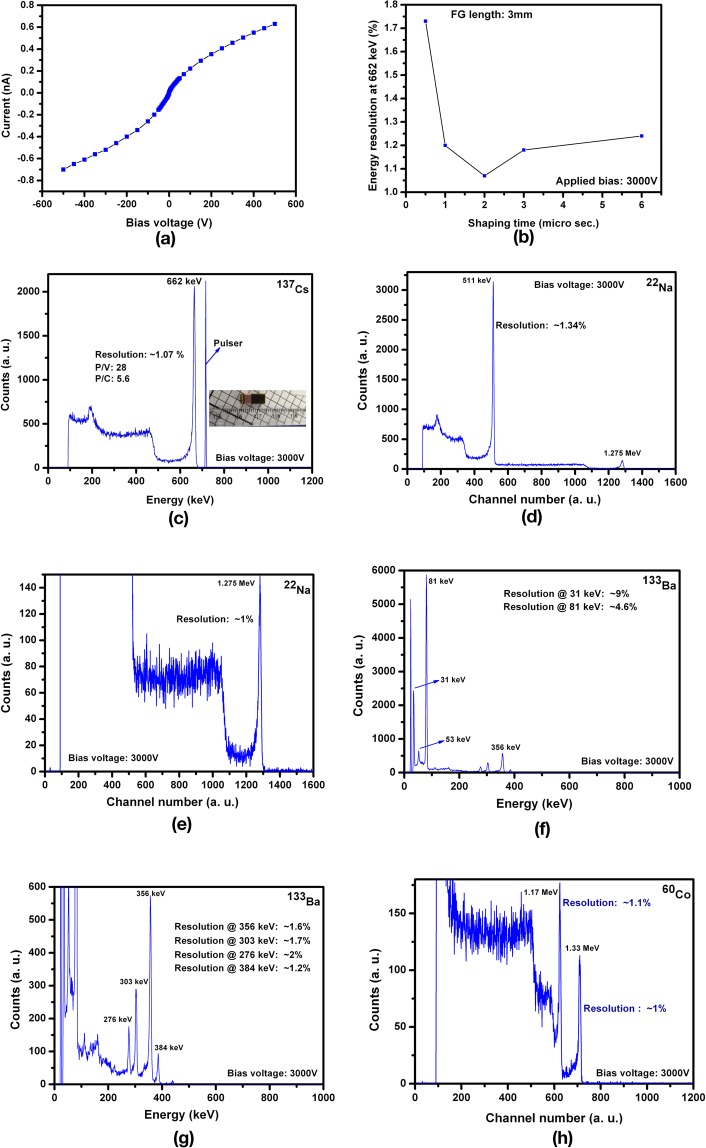
X- and gamma-ray detectors have broad applications ranging from medical imaging to security, non-proliferation, high-energy physics and astrophysics. Detectors with high energy resolution, e.g. less than 1.5% resolution at 662 keV at room temperature, are critically important in most uses. The efficacy of adding selenium to the cadmium zinc telluride (CdZnTe) matrix for radiation detector applications has been studied. In this paper, the growth of a new quaternary compound CdZnTeSe by the Traveling Heater Method (THM) is reported. The crystals possess a very high compositional homogeneity with less extended defects, such as secondary phases and sub-grain boundary networks. Virtual Frisch-grid detectors fabricated from as-grown ingots revealed ~0.87-1.5% energy resolution for 662-keV gamma rays. The superior material quality with a very low density of defects and very high compositional homogeneity heightens the likelihood that CdZnTeSe will be the next generation room-temperature detector material.
X射线和伽马射线探测器有着广泛的应用,涵盖从医学成像到安全、防扩散、高能物理和天体物理学等领域。具有高能量分辨率的探测器,例如在室温下对于662keV能量的分辨率小于1.5%,在大多数应用中至关重要。人们已经研究了在碲化镉锌(CdZnTe)基体中添加硒用于辐射探测器应用的效果。本文报道了采用移动加热器法(THM)生长一种新型四元化合物CdZnTeSe。这些晶体具有非常高的成分均匀性,且扩展缺陷较少,如第二相和亚晶界网络。由生长态晶体制备的虚拟弗里施栅探测器对于662keV伽马射线显示出约0.87 - 1.5%的能量分辨率。具有极低缺陷密度和非常高成分均匀性的优异材料质量增加了CdZnTeSe成为下一代室温探测器材料的可能性。