Division of Gastroenterology and Hepatology, Key Laboratory of Gastroenterology and Hepatology, Ministry of Health, Shanghai Institute of Digestive Disease, Renji Hospital, School of Medicine, Shanghai Jiao Tong University, Shanghai, China.
Department of Gastroenterology and Hepatology, Tongji Hospital, Tongji University School of Medicine, Shanghai, China.
J Dig Dis. 2019 Jun;20(6):278-287. doi: 10.1111/1751-2980.12783.
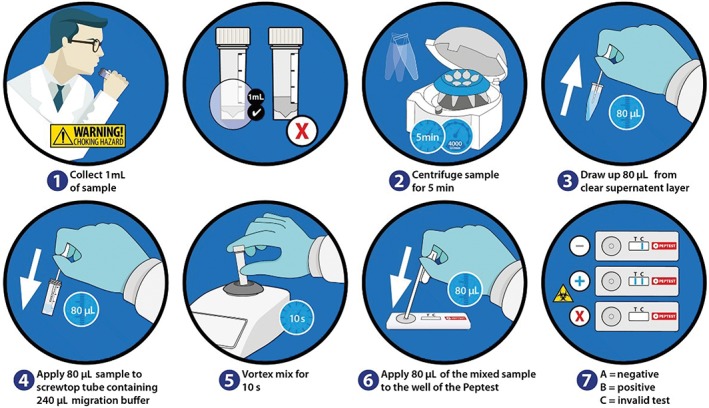
Peptest is a new non-invasive reflux diagnostic test based on lateral flow technology that containing two highly specific human pepsin monoclonal antibodies for detecting pepsin, a biomarker for reflux disease. The primary aim of this multicenter clinical study was to validate the efficacy of Peptest in patients diagnosed with gastroesophageal reflux and healthy controls in China.
Patients with suspected gastroesophageal reflux underwent an endoscopy and were classified into non-erosive reflux disease and erosive esophagitis subgroups. A healthy control group was also recruited. All participants were given a reflux disease questionnaire-patients scoring greater than 12 and controls scoring zero. All participants provided a postprandial saliva sample and most patients gave an additional post-symptom sample for pepsin analysis.
Altogether 1032 participants aged between 19 and 78 years were recruited. They consisted of 488 patients with non-erosive reflux disease, 221 with erosive esophagitis and 323 healthy controls. The number of postprandial and post-symptom samples analyzed totaled 1031 and 692, respectively. The results across all centers showed an overall pepsin-positive sensitivity of 85%, a specificity of 60%, a positive predictive value of 82%, a negative predictive value of 65% and a positive likelihood ratio of 2.12.
The sensitivity of Peptest was high, but the specificity achieved in some centers was low, resulting overall in only a moderate specificity. Further diagnostic investigative studies are warranted.
Peptest 是一种新的基于横向流动技术的非侵入性反流诊断测试,包含两种针对胃蛋白酶的高度特异性人胃蛋白酶单克隆抗体,用于检测胃蛋白酶,这是一种反流性疾病的生物标志物。本多中心临床研究的主要目的是验证 Peptest 在诊断为胃食管反流病的患者和中国健康对照中的疗效。
疑似胃食管反流病的患者接受内镜检查,并分为非糜烂性反流病和糜烂性食管炎亚组。还招募了健康对照组。所有参与者都接受了反流病问卷-患者评分大于 12 分,对照组评分零分。所有参与者都提供了餐后唾液样本,大多数患者还提供了额外的症状后样本进行胃蛋白酶分析。
共招募了 1032 名年龄在 19 至 78 岁之间的参与者。他们包括 488 名非糜烂性反流病患者、221 名糜烂性食管炎患者和 323 名健康对照组。共分析了 1031 份餐后和 692 份症状后样本。来自所有中心的结果显示,总体胃蛋白酶阳性敏感性为 85%,特异性为 60%,阳性预测值为 82%,阴性预测值为 65%,阳性似然比为 2.12。
Peptest 的敏感性较高,但某些中心的特异性较低,总体特异性仅为中等。需要进一步的诊断研究。