Institute of Applied Health Research, University of Birmingham, Edgbaston, UK.
Warwick Medical School, University of Warwick, Coventry, UK.
BMJ Open. 2019 May 15;9(5):e027982. doi: 10.1136/bmjopen-2018-027982.
To assess the prevalence of mild-to-moderate distress in patients with end-stage renal disease (ESRD) and determine the association between distress and patient characteristics.
Cross-sectional survey using emotion thermometer and distress thermometer problem list.
Renal units in four hospital Trusts in the West Midlands, UK.
Adult patients with stage 5 chronic kidney disease who were: (1) On prerenal replacement therapy. (2) On dialysis for less than 2 years. (3) On dialysis for 2 years or more (4) With a functioning transplant.
The prevalence of mild-to-moderate distress, and the incidence of distress thermometer problems and patient support needs.
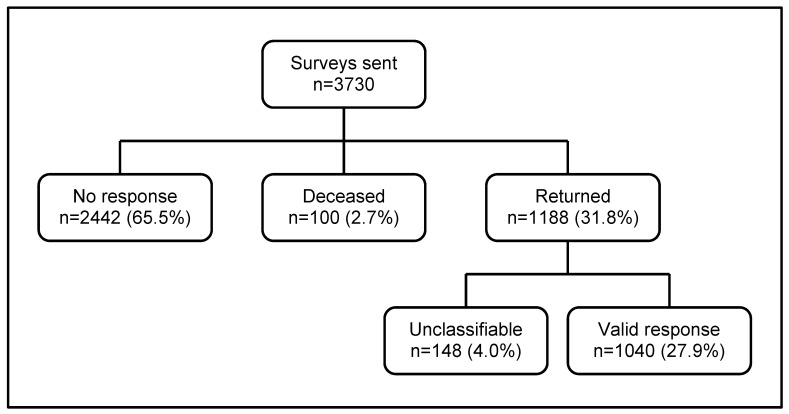
In total, 1040/3730 surveys were returned (27.9%). A third of survey respondents met the criteria for mild-to-moderate distress (n=346; 33.3%). Prevalence was highest in patients on dialysis for 2 years or more (n=109/300; 36.3%) and lowest in transplant patients (n=118/404; 29.2%). Prevalence was significantly higher in younger versus older patients (χ=14.33; p=0.0008), in women versus men (χ=6.63; p=0.01) and in black and minority ethnic patients versus patients of white ethnicity (χ=10.36; p=0.013). Over 40% of patients (n=141) reported needing support. More than 95% of patients reported physical problems and 91.9% reported at least one emotional problem.
Mild-to-moderate distress is common in patients with ESRD, and there may be substantial unmet support needs. Regular screening could help identify patients whose distress may otherwise remain undetected. Further research into differences in distress prevalence over time and at specific transitional points across the renal disease pathway is needed, as is work to determine how best to support patients requiring help.
评估终末期肾病(ESRD)患者轻度至中度痛苦的患病率,并确定痛苦与患者特征之间的关系。
使用情绪温度计和痛苦温度计问题清单进行横断面调查。
英国西米德兰兹郡四个医院信托的肾脏科。
处于以下阶段的成年慢性肾脏病 5 期患者:(1)在肾前替代治疗前。(2)透析时间不足 2 年。(3)透析时间 2 年或更长时间。(4)有功能的移植。
轻度至中度痛苦的患病率,痛苦温度计问题和患者支持需求的发生率。
共收回 3730 份调查中的 1040 份(27.9%)。三分之一的调查对象符合轻度至中度痛苦的标准(n=346;33.3%)。透析时间 2 年或更长时间的患者患病率最高(n=109/300;36.3%),而移植患者患病率最低(n=118/404;29.2%)。与年龄较大的患者相比,年轻患者(χ2=14.33;p=0.0008),女性与男性(χ2=6.63;p=0.01)以及黑人及少数民族患者与白种人患者(χ2=10.36;p=0.013)的患病率明显更高。超过 40%的患者(n=141)报告需要支持。超过 95%的患者报告有身体问题,91.9%的患者报告有至少一个情绪问题。
ESRD 患者中轻度至中度痛苦很常见,可能存在大量未满足的支持需求。定期筛查可以帮助识别那些痛苦可能未被发现的患者。需要进一步研究随着时间的推移和在肾脏疾病通路的特定过渡点上痛苦患病率的差异,以及如何最好地支持需要帮助的患者。