Emerg Infect Dis. 2019 Jun;25(6):1041-1049. doi: 10.3201/eid2506.180138.
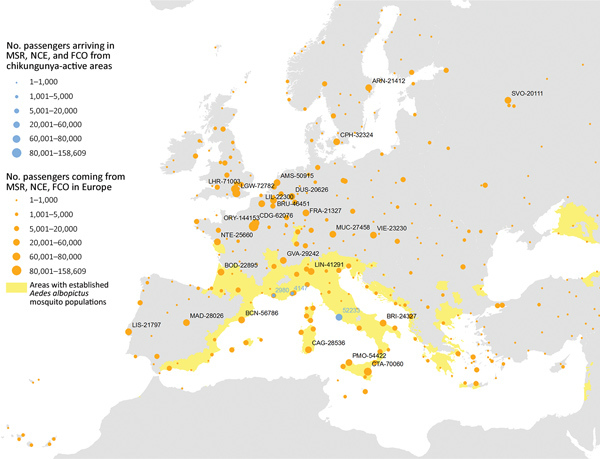
With regard to fully harvesting the potential of big data, public health lags behind other fields. To determine this potential, we applied big data (air passenger volume from international areas with active chikungunya transmission, Twitter data, and vectorial capacity estimates of Aedes albopictus mosquitoes) to the 2017 chikungunya outbreaks in Europe to assess the risks for virus transmission, virus importation, and short-range dispersion from the outbreak foci. We found that indicators based on voluminous and velocious data can help identify virus dispersion from outbreak foci and that vector abundance and vectorial capacity estimates can provide information on local climate suitability for mosquitoborne outbreaks. In contrast, more established indicators based on Wikipedia and Google Trends search strings were less timely. We found that a combination of novel and disparate datasets can be used in real time to prevent and control emerging and reemerging infectious diseases.
关于充分挖掘大数据的潜力,公共卫生领域落后于其他领域。为了确定这一潜力,我们将大数据(来自有基孔肯雅热传播活动的国际地区的航空旅客量、Twitter 数据以及白纹伊蚊的媒介能力估计值)应用于 2017 年欧洲的基孔肯雅热暴发,以评估病毒传播、病毒输入以及从暴发中心短距离扩散的风险。我们发现,基于大量和快速的数据的指标有助于识别病毒从暴发中心的扩散,而媒介丰度和媒介能力估计值可以提供有关本地气候是否适合蚊媒暴发的信息。相比之下,基于维基百科和谷歌趋势搜索字符串的更成熟的指标则不太及时。我们发现,新颖且不同的数据的组合可实时用于预防和控制新发和再发传染病。