Xu Yang, Wang Xin, Ding Xiaowen, Zheng Xingfei, Yang Zefeng, Xu Chenwu, Hu Zhongli
Jiangsu Provincial Key Laboratory of Crop Genetics and Physiology, Co-Innovation Center for Modern Production Technology of Grain Crops, Key Laboratory of Plant Functional Genomics of Ministry of Education, Yangzhou University, Yangzhou, 225009, China.
State Key Laboratory of Hybrid Rice, College of Life Science, Wuhan University, Wuhan, 430072, China.
Rice (N Y). 2018 May 10;11(1):32. doi: 10.1186/s12284-018-0223-4.
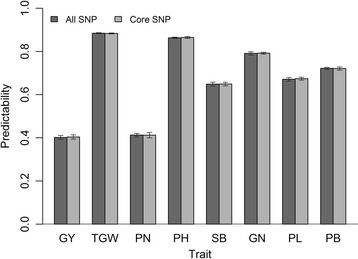
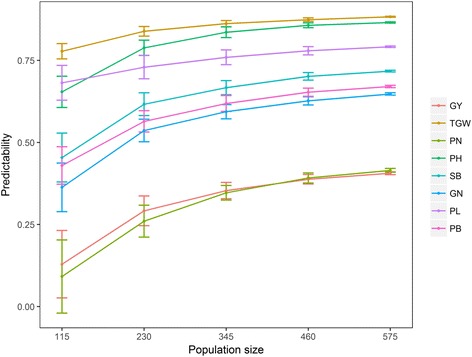
Hybrid breeding is an effective tool to improve yield in rice, while parental selection remains the key and difficult issue. Genomic selection (GS) provides opportunities to predict the performance of hybrids before phenotypes are measured. However, the application of GS is influenced by several genetic and statistical factors. Here, we used a rice North Carolina II (NC II) population constructed by crossing 115 rice varieties with five male sterile lines as a model to evaluate effects of statistical methods, heritability, marker density and training population size on prediction for hybrid performance.
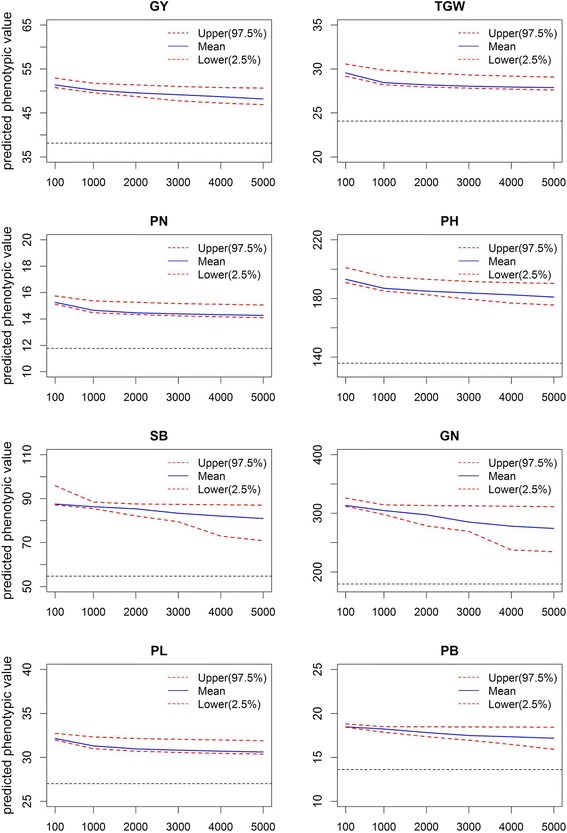
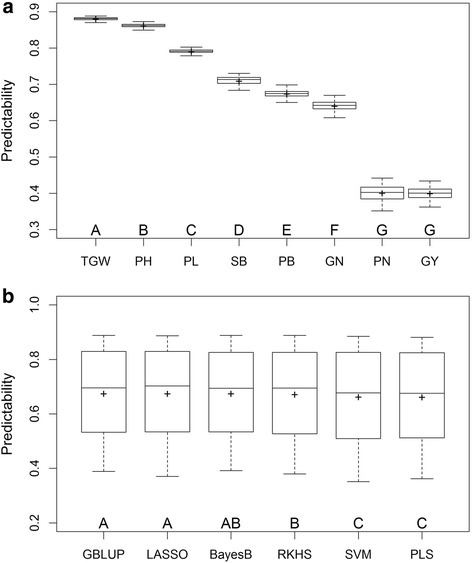
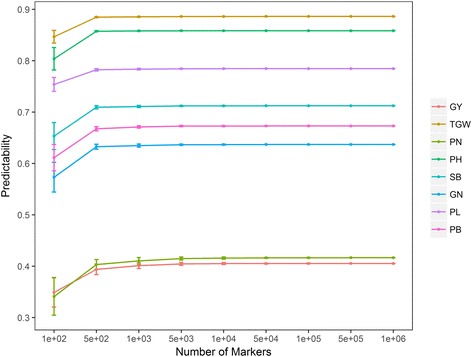
From the comparison of six GS methods, we found that predictabilities for different methods are significantly different, with genomic best linear unbiased prediction (GBLUP) and least absolute shrinkage and selection operation (LASSO) being the best, support vector machine (SVM) and partial least square (PLS) being the worst. The marker density has lower influence on predicting rice hybrid performance compared with the size of training population. Additionally, we used the 575 (115 × 5) hybrid rice as a training population to predict eight agronomic traits of all hybrids derived from 120 (115 + 5) rice varieties each mating with 3023 rice accessions from the 3000 rice genomes project (3 K RGP). Of the 362,760 potential hybrids, selection of the top 100 predicted hybrids would lead to 35.5%, 23.25%, 30.21%, 42.87%, 61.80%, 75.83%, 19.24% and 36.12% increase in grain yield per plant, thousand-grain weight, panicle number per plant, plant height, secondary branch number, grain number per panicle, panicle length and primary branch number, respectively.
This study evaluated the factors affecting predictabilities for hybrid prediction and demonstrated the implementation of GS to predict hybrid performance of rice. Our results suggest that GS could enable the rapid selection of superior hybrids, thus increasing the efficiency of rice hybrid breeding.
杂交育种是提高水稻产量的有效手段,而亲本选择仍是关键且困难的问题。基因组选择(GS)为在测量表型之前预测杂种表现提供了机会。然而,GS的应用受到多种遗传和统计因素的影响。在此,我们以通过将115个水稻品种与5个雄性不育系杂交构建的水稻北卡罗来纳II(NC II)群体为模型,评估统计方法、遗传力、标记密度和训练群体大小对杂种表现预测的影响。
通过对六种GS方法的比较,我们发现不同方法的预测能力存在显著差异,其中基因组最佳线性无偏预测(GBLUP)和最小绝对收缩与选择算子(LASSO)最佳,支持向量机(SVM)和偏最小二乘法(PLS)最差。与训练群体大小相比,标记密度对预测水稻杂种表现的影响较小。此外,我们使用575个(115×5)杂交水稻作为训练群体,预测由120个(115 + 5)水稻品种与来自3000份水稻基因组计划(3K RGP)的3023份水稻种质各自杂交得到的所有杂种的八个农艺性状。在362,760个潜在杂种中,选择前100个预测杂种将分别使单株产量、千粒重、单株穗数、株高、二次枝梗数、每穗粒数、穗长和一次枝梗数提高35.5%、23.25%、30.21%、42.87%、61.80%、75.83%、19.24%和36.12%。
本研究评估了影响杂种预测能力的因素,并展示了GS在预测水稻杂种表现方面的应用。我们的结果表明,GS能够实现优良杂种的快速选择,从而提高水稻杂交育种的效率。