Arshad Zeeshaan, Alturkistani Abrar, Brindley David, Lam Ching, Foley Kimberley, Meinert Edward
Department of Medicine, University of Cambridge, Cambridge, United Kingdom.
Global Digital Health Unit, Imperial College London, London, United Kingdom.
JMIR Public Health Surveill. 2019 May 23;5(2):e14216. doi: 10.2196/14216.
Herpes simplex virus (HSV)-1 and HSV-2 are common infections affecting the global population, with HSV-1 estimated to affect 67% of the global population. HSV can have rare but severe manifestations, such as encephalitis and neonatal herpes, necessitating the use of reliable and accurate diagnostic tools for the detection of the viruses. Currently used HSV diagnostic tools require highly specialized skills and availability of a laboratory setting but may lack sensitivity. The numerous recently developed HSV diagnostic tools need to be identified and compared in a systematic way to make the best decision about which diagnostic tool to use. The diagnosis of HSV is essential for prompt treatment with antivirals. To select the best test for a patient, knowledge of the performance and limitations of each test is critical.
This systematic review has summarized recent studies evaluating HSV-1 and HSV-2 diagnostic tools.
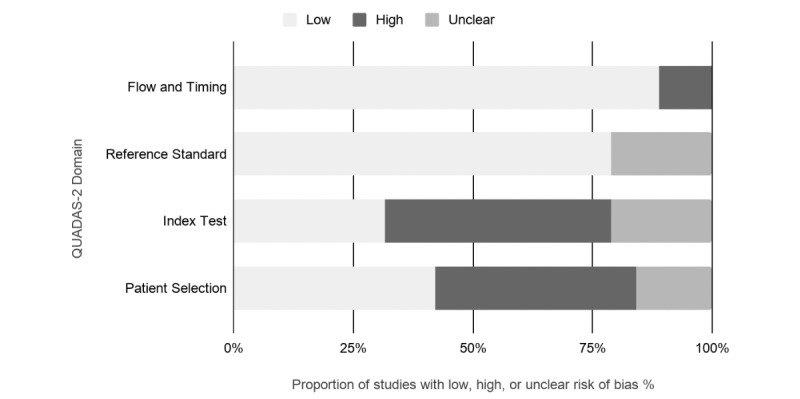
Following the Preferred Reporting Items for Systematic Reviews and Meta-Analyses guidelines, selection criteria, data extraction, and data analysis were determined before the commencement of the study. Studies assessing the specificity/sensitivity of HSV-1 or HSV-2 diagnostic tools published between 2012 and 2018 were included. Quality assessment of included studies was performed using the quality assessment of diagnostic accuracy studies (QUADAS-2) tool.
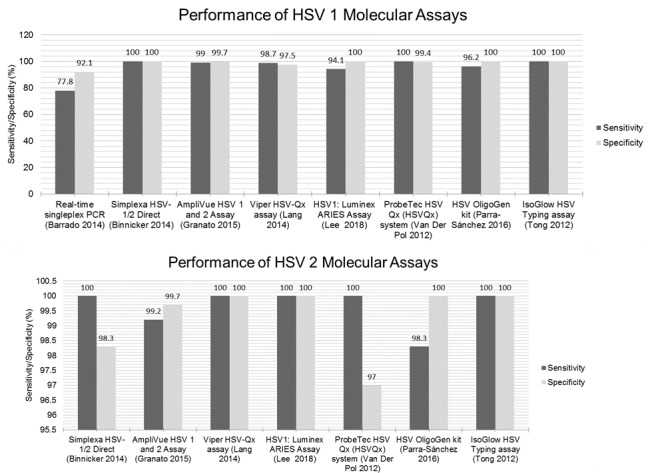
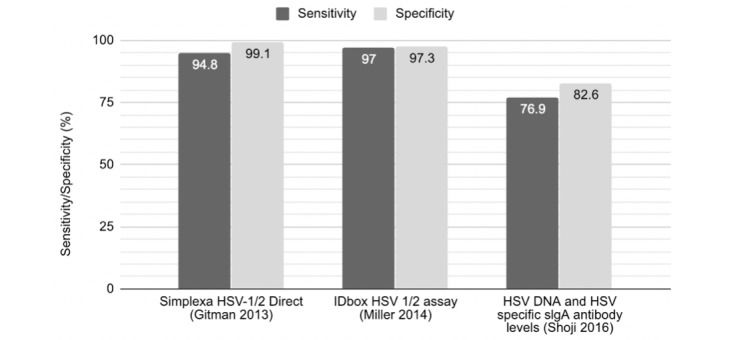
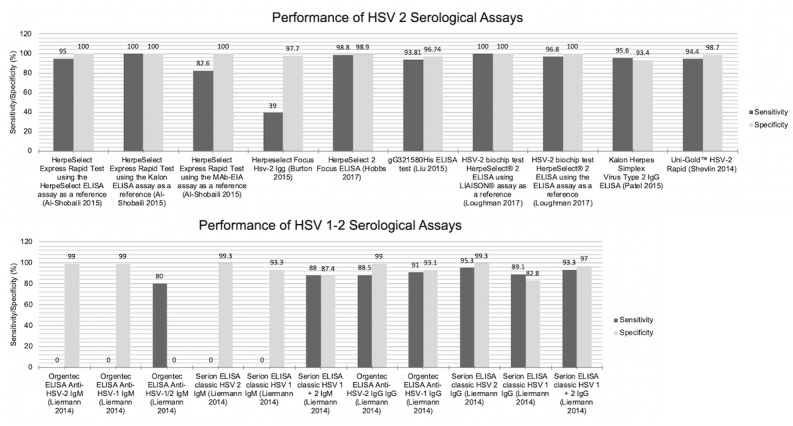
Searches of the PubMed database yielded 264 studies; 11 studies included 11 molecular assays, and 8 studies included 19 different serological assays for the detection of HSV-1, HSV-2, or both. A greater proportion of molecular assay-based tools are being developed by commercial entities. Studies that tested molecular assays mostly focused on cutaneous and mucosal HSV infections (n=13); 2 studies focused on ocular disease, whereas only 1 study focused on the central nervous system manifestations. The Simplexa HSV 1 & 2 Direct is currently the only Food and Drug Administration-approved device for use on cerebrospinal fluid. No tools focused on prenatal screening. We also present performance metrics of tests for benchmarking of future technology. Most of the included studies had a high risk of bias rating in half of the QUADAS-2 tool risk of bias domains.
The use of serologic tests to diagnose genital lesions is inappropriate because positive results may be due to chronic infection, whereas negative results may overlook recent infection. The incidence of acute infections is rising. As these infections present the greatest risk to fetuses, work needs to be done to prevent vertical transfer. Prenatal screening for primary infection and subsequent medical intervention will assist in lowering the rate of neonatal herpes. In conclusion, HSV diagnosis is moving away from culture-based methods to serology-based or polymerase chain reaction-based methods. Sensitive, rapid, and efficient HSV diagnostic tools should be adopted for the prevention of acute infections and neonatal herpes.
单纯疱疹病毒1型(HSV-1)和单纯疱疹病毒2型(HSV-2)是影响全球人口的常见感染,据估计HSV-1感染全球67%的人口。HSV可出现罕见但严重的表现,如脑炎和新生儿疱疹,因此需要使用可靠且准确的诊断工具来检测这些病毒。目前使用的HSV诊断工具需要高度专业化的技能以及实验室环境,但可能缺乏敏感性。需要以系统的方式识别和比较众多最近开发的HSV诊断工具,以便就使用哪种诊断工具做出最佳决策。HSV的诊断对于及时使用抗病毒药物治疗至关重要。为患者选择最佳检测方法时,了解每种检测方法的性能和局限性至关重要。
本系统评价总结了近期评估HSV-1和HSV-2诊断工具的研究。
按照系统评价和Meta分析的首选报告项目指南,在研究开始前确定选择标准、数据提取和数据分析方法。纳入2012年至2018年发表的评估HSV-1或HSV-2诊断工具特异性/敏感性的研究。使用诊断准确性研究质量评估(QUADAS-2)工具对纳入研究进行质量评估。
检索PubMed数据库得到264项研究;11项研究纳入了11种分子检测方法,8项研究纳入了19种不同的血清学检测方法用于检测HSV-1、HSV-2或两者。商业实体开发了更大比例的基于分子检测的工具。测试分子检测方法的研究大多集中在皮肤和黏膜HSV感染(n = 13);2项研究关注眼部疾病,而只有1项研究关注中枢神经系统表现。Simplexa HSV 1 & 2 Direct是目前唯一获得美国食品药品监督管理局批准用于脑脊液检测的设备。没有工具专注于产前筛查。我们还给出了检测的性能指标,以便为未来技术设定基准。在QUADAS-2工具的一半偏倚风险领域中,大多数纳入研究的偏倚风险评级较高。
使用血清学检测诊断生殖器病变不合适,因为阳性结果可能归因于慢性感染,而阴性结果可能会忽略近期感染。急性感染的发生率正在上升。由于这些感染对胎儿构成最大风险,需要开展工作以防止垂直传播。对原发性感染进行产前筛查并随后进行医学干预将有助于降低新生儿疱疹的发生率。总之,HSV诊断正从基于培养的方法转向基于血清学或聚合酶链反应的方法。应采用灵敏、快速且高效的HSV诊断工具来预防急性感染和新生儿疱疹。