
首次筛查时的视网膜不成熟和早产儿视网膜病变:对 1202 只早产儿眼睛进行基于图像的验证,以预测疾病进展。
Retinal immaturity at first screening and retinopathy of prematurity: Image-based validation of 1202 eyes of premature infants to predict disease progression.
机构信息
Department of Pediatric Retina, Narayana Nethralaya Eye Institute, Bangalore, Karnataka, India.
Advanced Eye Center, Postgraduate Institute of Medical Education and Research, Chandigarh, India.
出版信息
Indian J Ophthalmol. 2019 Jun;67(6):846-853. doi: 10.4103/ijo.IJO_469_19.
PURPOSE
To use the extent of retinal immaturity at the first visit to predict progression to any stage and treatment-requiring retinopathy of prematurity (ROP).
METHODS
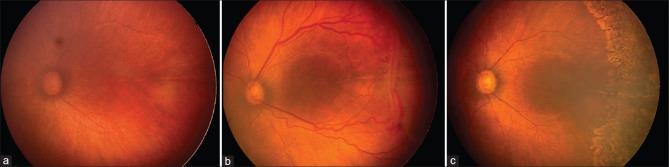
Retrospective, multicenter, nonrandomized, observational, clinical, validation study. In all, 601 Asian Indian preterm infants born < 2000 g and/or < 34 weeks of gestation completing ROP screening with RetCam images taken during each visit were included. A total of 1202 eyes of these infants were classified into three groups based on the retinal immaturity at the first screening visit into "mild" (Group 1), vessels reaching the posterior boundary of zone 3; "moderate" (Group 2), vessels entering zone 2 anterior; and "severe" (Group 3), vessels in zone 1 or zone 2 posterior. RetCam images at each subsequent visit were evaluated and the proportion of eyes that progressed to Type 1 or Type 2 ROP was correlated with the degree of retinal immaturity.
RESULTS
Of the 958 eyes in Group 1, 200 eyes in Group 2, and 44 eyes in Group 3, any stage ROP developed in 15% of eyes in Group 1, 46.5% of eyes in Group 2, and 100% of eyes in Group 3 (P < 0.001). Sixteen of 128 eyes (12.5%), 12 of 72 (16.6%), and 28 of 44 of eyes (63.6%) in Groups 1, 2, and 3, respectively, required treatment (P < 0.001).
CONCLUSION
Retinal immaturity at first screening visit predicts Type 1 and Type 2 ROP. "Severe" immaturity is more likely to progress to "treatment-requiring" disease. This could be a useful tool for prognostication, counseling, and scheduling follow-up.
目的
利用首次就诊时视网膜未成熟的程度来预测任何阶段早产儿视网膜病变(ROP)的进展和需要治疗的ROP。
方法
回顾性、多中心、非随机、观察性、临床验证研究。共纳入 601 例出生体重<2000 g 和/或<34 孕周、完成了使用 RetCam 图像进行 ROP 筛查的亚洲裔印度早产儿,这些婴儿在每次就诊时均拍摄了 RetCam 图像。根据首次筛查时的视网膜未成熟程度,将 1202 只眼分为三组:“轻度”(第 1 组),血管到达 3 区后界;“中度”(第 2 组),血管进入 2 区前部;“重度”(第 3 组),血管位于 1 区或 2 区后部。对随后每次就诊的 RetCam 图像进行评估,并将进展为 1 型或 2 型 ROP 的眼比例与视网膜未成熟程度相关联。
结果
在第 1 组的 958 只眼中,第 2 组的 200 只眼中和第 3 组的 44 只眼中,第 1 组的 15%、第 2 组的 46.5%和第 3 组的 100%(P<0.001)出现任何阶段的 ROP。第 1、2 和 3 组中分别有 16/128(12.5%)、12/72(16.6%)和 28/44(63.6%)的眼需要治疗(P<0.001)。
结论
首次筛查时的视网膜未成熟程度可预测 1 型和 2 型 ROP。“重度”未成熟更有可能进展为“需要治疗”的疾病。这可能是一种有用的预后、咨询和随访安排工具。


 Zotero 插件