
磁共振成像 SPGR 序列在膝关节早期软骨退变评估中的作用及与软骨和其他组织的关系。
Efficacy of magnetic resonance imaging with an SPGR sequence for the early evaluation of knee cartilage degeneration and the relationship between cartilage and other tissues.
机构信息
Department of Orthopedics, Peking University First Hospital, No. 8, Xishiku Street, Beijing, 100034, Beijing, China.
Department of Orthopedics, Zhejiang University School of Medicine First Affiliated Hospital, No. 79, Qingchun Road, Hangzhou, 310000, Zhejiang, China.
出版信息
J Orthop Surg Res. 2019 May 24;14(1):152. doi: 10.1186/s13018-019-1172-3.
RATIONALE AND OBJECTIVES
The aim of this study was to investigate the efficacy of magnetic resonance imaging (MRI) with a spoiled gradient-recalled (SPGR) sequence to evaluate early knee cartilage degeneration and the relationship between cartilage and other tissues using a modified Whole-Organ Magnetic Resonance Imaging Score (WORMS).
MATERIALS AND METHODS
Eighty-four patients with knee joint pain were evaluated by X-ray and MRI with an SPGR sequence from June 2015 to December 2016. Joint degeneration was graded by two experienced radiologists using the Kellgren-Lawrence (K-L) grading scale. The modified WORMS was used to evaluate cartilage lesions, bone marrow abnormalities, bone cysts, osteophytes, joint effusion and synovitis. The difference between the WORMS of the SPGR and the T2 sequences evaluated by the Wilcoxon signed-rank test was determined, and the relationships between the WORMS features were evaluated by a Spearman correlation.
RESULTS
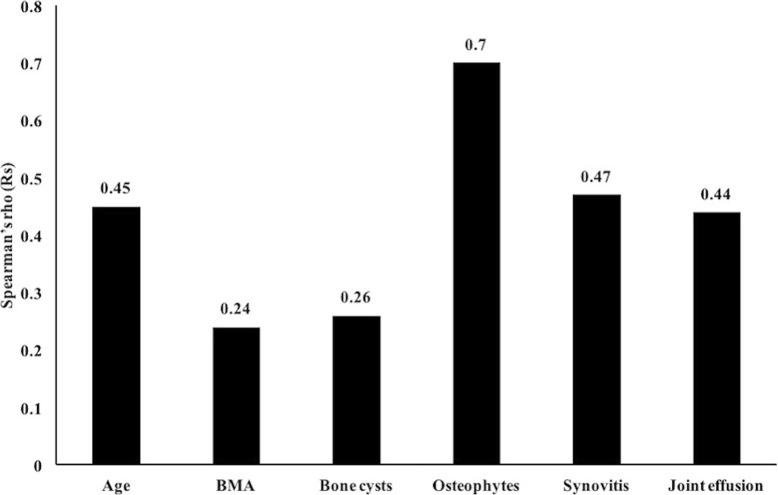
The modified WORMS for the cartilage lesion evaluation was significantly higher with the SPGR sequence than with the T2 sequence (P < 0.05). The cartilage lesions showed a moderate correlation with osteophytes, synovitis and joint effusion (Rs > 0.40, P < 0.05) and weak correlations with bone marrow abnormalities and bone cysts (Rs < 0.4, P < 0.05).
CONCLUSION
The modified WORMS evaluation using MRI with the SPGR sequence was much better than the normal sequence for early knee osteoarthritis (OA). The cartilage lesions are associated with bone marrow abnormalities and the other features of OA.
目的
本研究旨在探讨磁共振成像(MRI)中梯度回波(SPGR)序列评估早期膝关节软骨退变的功效,以及使用改良的全器官 MRI 评分(WORMS)评估软骨与其他组织之间的关系。
材料与方法
2015 年 6 月至 2016 年 12 月,对 84 例膝关节疼痛患者进行 X 线和 MRI 检查,使用 SPGR 序列。两位有经验的放射科医生使用 Kellgren-Lawrence(K-L)分级标准对关节退变进行分级。采用改良的 WORMS 评估软骨病变、骨髓异常、骨囊肿、骨赘、关节积液和滑膜炎。采用 Wilcoxon 符号秩检验比较 SPGR 和 T2 序列 WORMS 的差异,采用 Spearman 相关分析评估 WORMS 特征之间的关系。
结果
SPGR 序列评估软骨病变的改良 WORMS 明显高于 T2 序列(P<0.05)。软骨病变与骨赘、滑膜炎和关节积液呈中度相关(Rs>0.40,P<0.05),与骨髓异常和骨囊肿呈弱相关(Rs<0.4,P<0.05)。
结论
与常规序列相比,使用 SPGR 序列的改良 WORMS 对早期膝关节骨关节炎(OA)的评估要好得多。软骨病变与骨髓异常和 OA 的其他特征有关。


 Zotero 插件