Department of Dermatology, Leiden University Medical Center, Leiden, The Netherlands.
Division of BioTherapeutics, Leiden Academic Centre for Drug Research, Leiden University, Leiden, The Netherlands.
Sci Rep. 2019 May 24;9(1):7811. doi: 10.1038/s41598-019-44204-4.
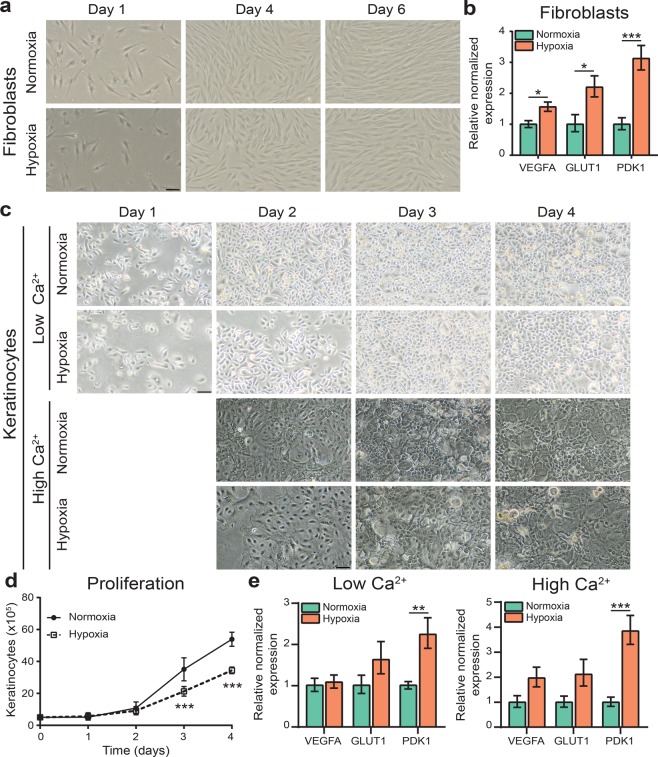
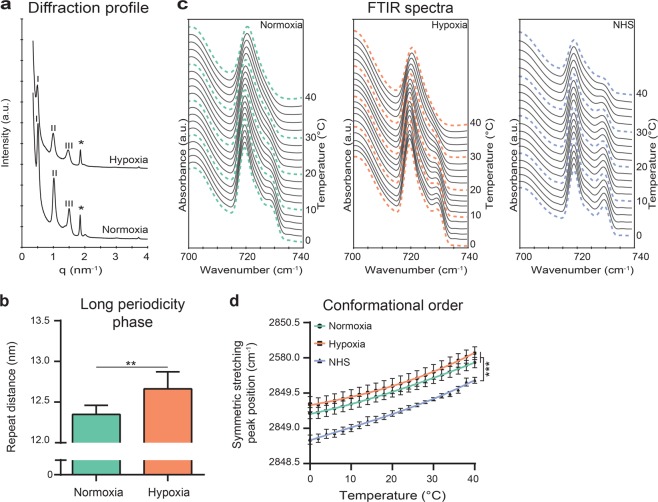
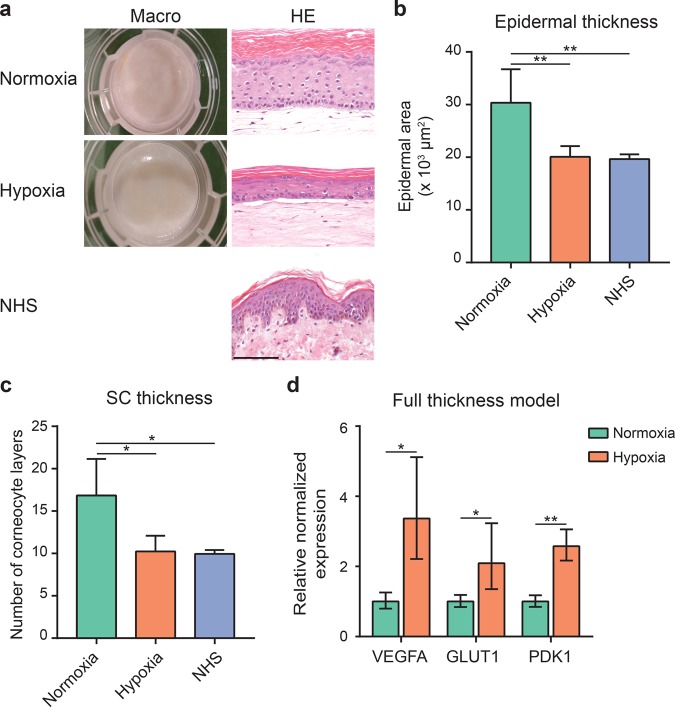
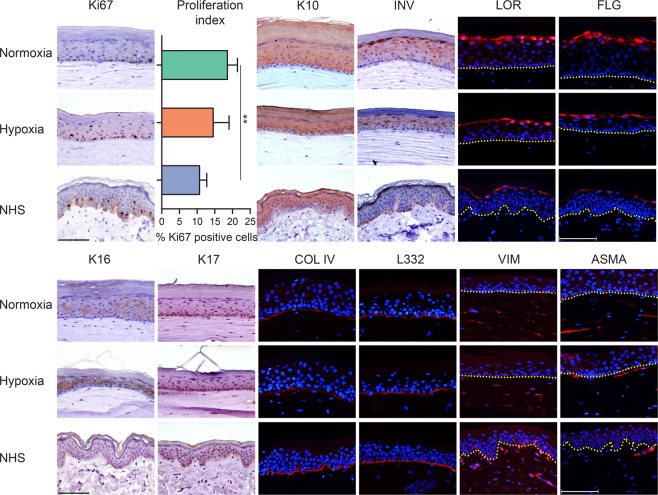
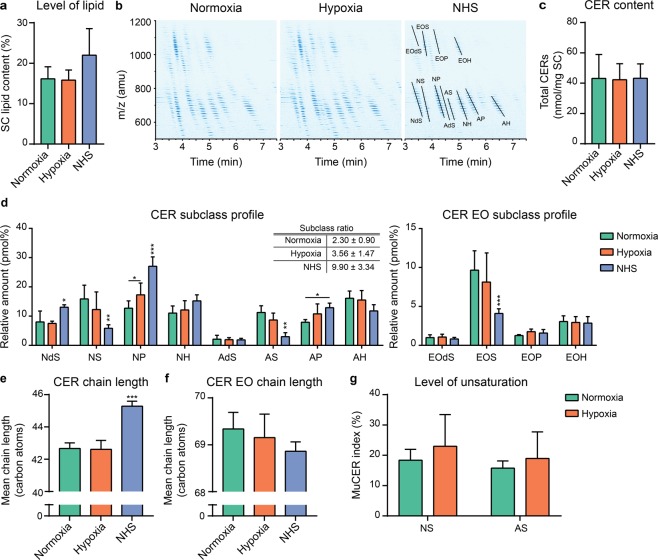
Human skin equivalents (HSEs) are three-dimensional cell models mimicking characteristics of native human skin (NHS) in many aspects. However, a limitation of HSEs is the altered in vitro morphogenesis and barrier formation. Differences between in vitro and in vivo skin could have been induced by suboptimal cell culture conditions, of which the level of oxygen in vitro (20%) is much higher than in vivo (0.5-8%). Our aim is to study how external oxygen levels affect epidermal morphogenesis and barrier formation in HSEs. In the present study, fibroblast and keratinocyte monocultures, and HSEs were generated under 20% (normoxia) and 3% (hypoxia) oxygen level. In all cultures under hypoxia, expression of hypoxia-inducible factor target genes was increased. Characterization of HSEs generated under hypoxia using immunohistochemical analyses of morphogenesis biomarkers revealed a reduction in epidermal thickness, reduced proliferation, similar early differentiation, and an attenuated terminal differentiation program compared to normoxia, better mimicking NHS. The stratum corneum ceramide composition was studied with liquid chromatography coupled to mass spectrometry. Under hypoxia, HSEs exhibited a ceramide composition that more closely resembles that of NHS. Consequently, the lipid organization was improved. In conclusion, epidermal morphogenesis and barrier formation in HSEs reconstructed under hypoxia better mimics that of NHS.
人皮肤等效物 (HSEs) 是三维细胞模型,在许多方面模拟天然人皮肤 (NHS) 的特征。然而,HSEs 的一个局限性是体外形态发生和屏障形成的改变。体外和体内皮肤之间的差异可能是由于细胞培养条件不佳引起的,其中体外的氧气水平(20%)远高于体内(0.5-8%)。我们的目的是研究外部氧气水平如何影响 HSEs 中的表皮形态发生和屏障形成。在本研究中,在 20%(常氧)和 3%(缺氧)氧气水平下生成成纤维细胞和角质形成细胞的单培养物和 HSEs。在所有缺氧培养物中,缺氧诱导因子靶基因的表达增加。使用形态发生生物标志物的免疫组织化学分析对缺氧下生成的 HSEs 进行表征,结果显示表皮厚度减少、增殖减少、早期分化相似、终末分化程序减弱,与常氧相比更能模拟 NHS。使用液相色谱-质谱联用技术研究了角质层中的神经酰胺组成。在缺氧下,HSEs 表现出更接近 NHS 的神经酰胺组成。因此,脂质组织得到了改善。总之,在缺氧条件下重建的 HSEs 中的表皮形态发生和屏障形成更好地模拟了 NHS。