LEFO - Institute for Studies of the Medical Profession, Oslo, Norway.
Institute of Stress Medicine, Gothenburg, Sweden.
BMJ Open. 2019 May 24;9(5):e026971. doi: 10.1136/bmjopen-2018-026971.
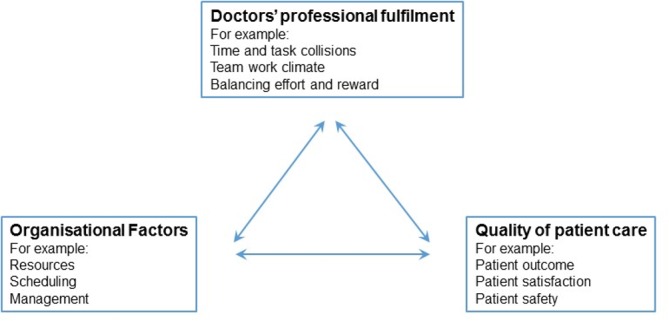
Doctors increasingly experience high levels of burnout and loss of engagement. To address this, there is a need to better understand doctors' work situation. This study explores how doctors experience the interactions among professional fulfilment, organisational factors and quality of patient care.
An exploratory qualitative study design with semistructured individual interviews was chosen. Interviews were transcribed verbatim and analysed by a transdisciplinary research group.
The study focused on a surgical department of a mid-sized hospital in Norway.
Seven doctors were interviewed. A purposeful sampling was used with gender and seniority as selection criteria. Three senior doctors (two female, one male) and four in training (three male, one female) were interviewed.
We found that in order to provide quality care to the patients, individual doctors described 'stretching themselves', that is, handling the tensions between quantity and quality, to overcome organisational shortcomings. Experiencing a workplace emphasis on production numbers and budget concerns led to feelings of estrangement among the doctors. Participants reported a shift from serving as trustworthy, autonomous professionals to becoming production workers, where professional identity was threatened. They felt less aligned with workplace values, in addition to experiencing limited management recognition for quality of patient care. Management initiatives to include doctors in development of organisational policies, processes and systems were sparse.
The interviewed doctors described their struggle to balance the inherent tension among professional fulfilment, organisational factors and quality of patient care in their everyday work. They communicated how 'stretching themselves', to overcome organisational shortcomings, is no longer a feasible strategy without compromising both professional fulfilment and quality of patient care. Managers need to ensure that doctors are involved when developing organisational policies, processes and systems. This is likely to be beneficial for both professional fulfilment and quality of patient care.
医生越来越多地经历倦怠和投入感的丧失。为了解决这个问题,需要更好地了解医生的工作情况。本研究探讨了医生如何体验专业成就感、组织因素和患者护理质量之间的相互作用。
选择了探索性定性研究设计和半结构化个体访谈。访谈逐字转录,并由跨学科研究小组进行分析。
该研究侧重于挪威一家中型医院的外科部门。
采访了 7 名医生。采用目的抽样法,以性别和资历作为选择标准。采访了 3 名资深医生(2 名女性,1 名男性)和 4 名在培训中的医生(3 名男性,1 名女性)。
我们发现,为了向患者提供高质量的护理,个别医生描述了“自我拓展”,即处理数量和质量之间的紧张关系,以克服组织上的不足。体验到工作场所对生产数量和预算的重视,导致医生之间产生疏远感。参与者报告说,他们从作为值得信赖、自主的专业人员转变为成为生产工人,专业身份受到威胁。他们感到与工作场所的价值观不一致,此外,他们对患者护理质量的管理认可有限。管理部门很少采取主动措施让医生参与制定组织政策、流程和系统。
接受采访的医生描述了他们在日常工作中平衡专业成就感、组织因素和患者护理质量之间固有紧张关系的挣扎。他们传达了这样一种信息,即如果不牺牲专业成就感和患者护理质量,“自我拓展”以克服组织上的不足,不再是一种可行的策略。管理者需要确保在制定组织政策、流程和系统时让医生参与进来。这可能对专业成就感和患者护理质量都有好处。