Ballintyn Benjamin, Shlaer Benjamin, Miller Paul
Neuroscience Program, Brandeis University, Waltham, MA, 02453, USA.
Department of Physics, University of Auckland, Auckland, New Zealand.
J Comput Neurosci. 2019 Jun;46(3):279-297. doi: 10.1007/s10827-019-00717-5. Epub 2019 May 27.
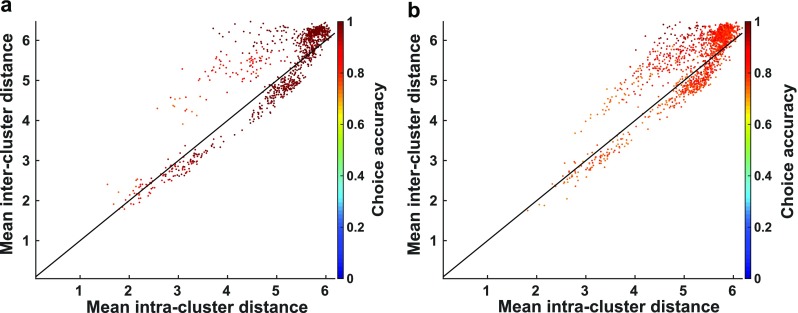
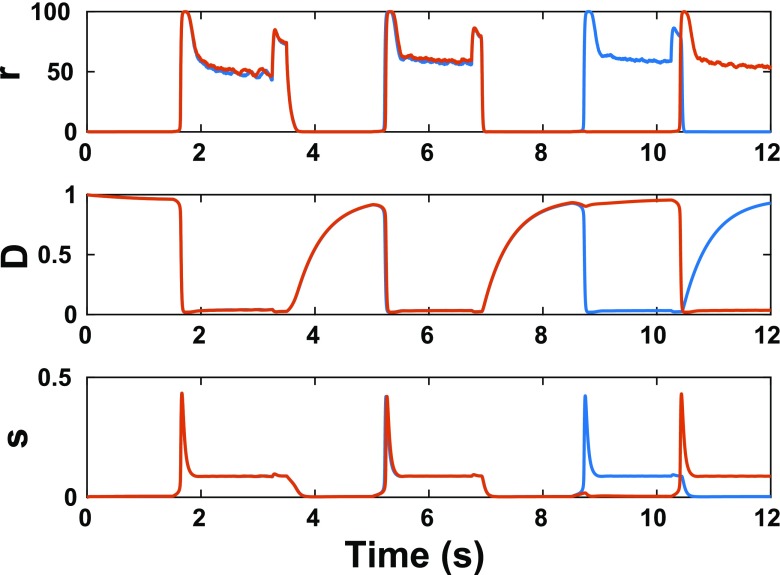
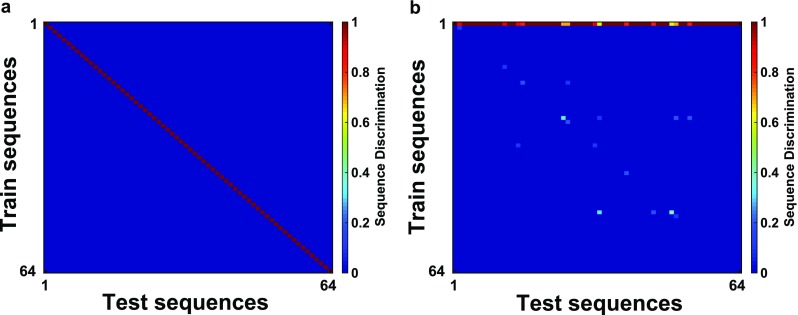
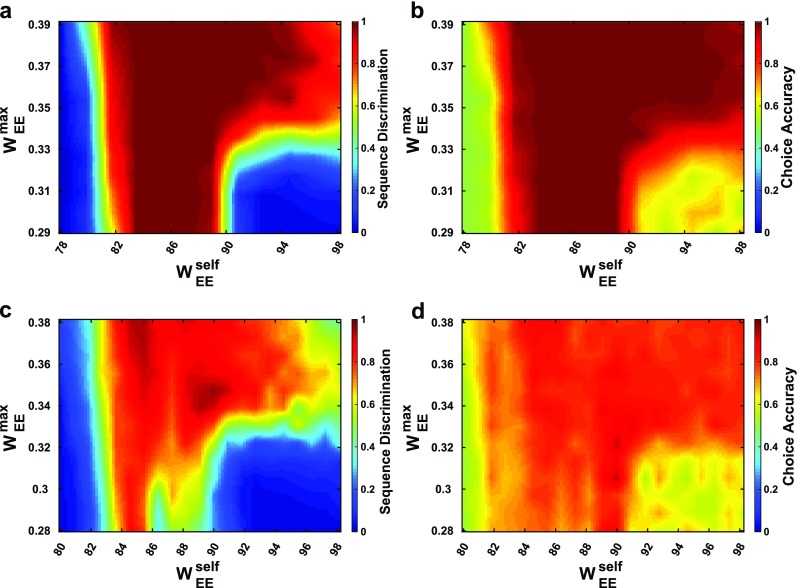
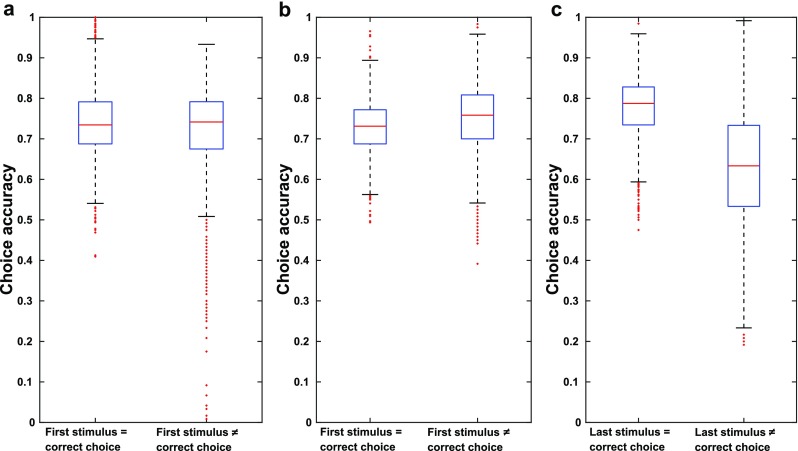
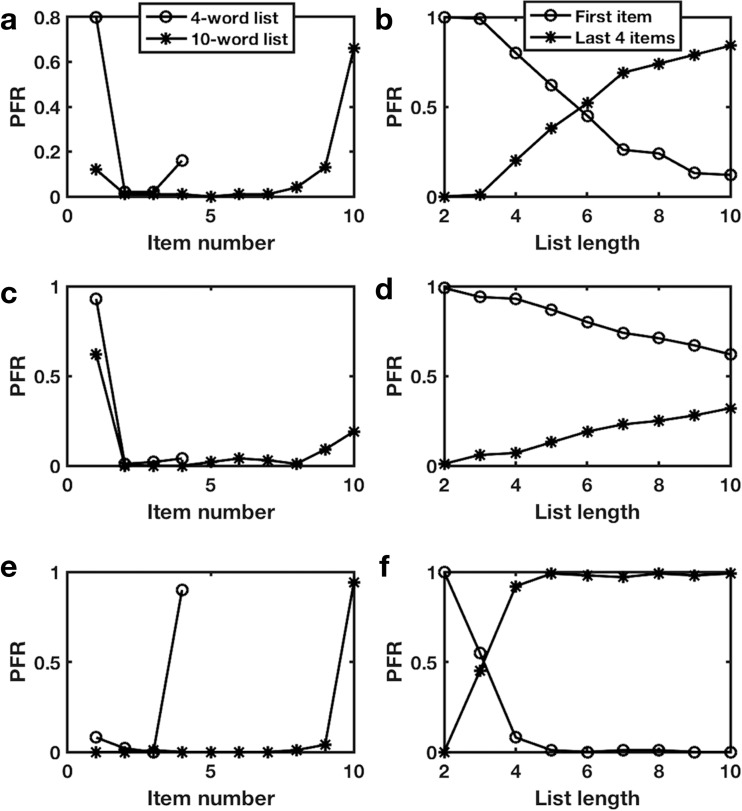
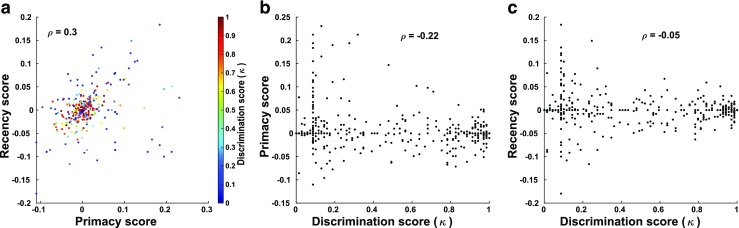
We demonstrate that a randomly connected attractor network with dynamic synapses can discriminate between similar sequences containing multiple stimuli suggesting such networks provide a general basis for neural computations in the brain. The network contains units representing assemblies of pools of neurons, with preferentially strong recurrent excitatory connections rendering each unit bi-stable. Weak interactions between units leads to a multiplicity of attractor states, within which information can persist beyond stimulus offset. When a new stimulus arrives, the prior state of the network impacts the encoding of the incoming information, with short-term synaptic depression ensuring an itinerancy between sets of active units. We assess the ability of such a network to encode the identity of sequences of stimuli, so as to provide a template for sequence recall, or decisions based on accumulation of evidence. Across a range of parameters, such networks produce the primacy (better final encoding of the earliest stimuli) and recency (better final encoding of the latest stimuli) observed in human recall data and can retain the information needed to make a binary choice based on total number of presentations of a specific stimulus. Similarities and differences in the final states of the network produced by different sequences lead to predictions of specific errors that could arise when an animal or human subject generalizes from training data, when the training data comprises a subset of the entire stimulus repertoire. We suggest that such networks can provide the general purpose computational engines needed for us to solve many cognitive tasks.
我们证明,具有动态突触的随机连接吸引子网络能够区分包含多个刺激的相似序列,这表明此类网络为大脑中的神经计算提供了一个通用基础。该网络包含代表神经元集群集合的单元,优先存在的强循环兴奋性连接使每个单元呈现双稳态。单元之间的弱相互作用导致多种吸引子状态,在这些状态中,信息可以在刺激消失后持续存在。当新的刺激到来时,网络的先前状态会影响传入信息的编码,短期突触抑制确保活跃单元组之间的巡回。我们评估这样一个网络编码刺激序列身份的能力,以便为序列回忆或基于证据积累的决策提供模板。在一系列参数范围内,此类网络会产生人类回忆数据中观察到的首因效应(对最早刺激的最终编码更好)和近因效应(对最新刺激的最终编码更好),并且能够保留基于特定刺激呈现总数做出二元选择所需的信息。由不同序列产生的网络最终状态的异同,会导致对动物或人类受试者从训练数据进行泛化时可能出现的特定错误的预测,前提是训练数据仅包含整个刺激库的一个子集。我们认为,此类网络能够提供我们解决许多认知任务所需的通用计算引擎。