National Research Center for Protozoan Diseases, Obihiro University of Agriculture and Veterinary Medicine, Nishi 2-13 Inada-cho, Obihiro, Hokkaido, 080-8555, Japan.
Department of Pharmacology and Therapeutics, Faculty of Veterinary Medicine, Damanhour University, Damanhour, 22511, El-Beheira, Egypt.
Parasit Vectors. 2019 May 28;12(1):269. doi: 10.1186/s13071-019-3520-x.
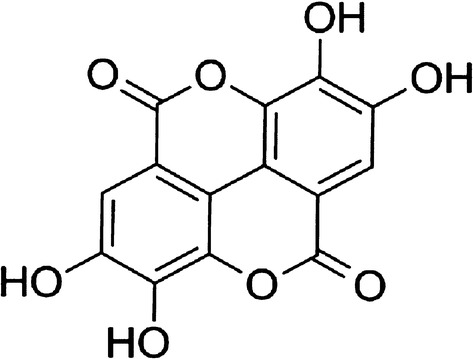
There are no effective vaccines against Babesia and Theileria parasites; therefore, therapy depends heavily on antiprotozoal drugs. Treatment options for piroplasmosis are limited; thus, the need for new antiprotozoal agents is becoming increasingly urgent. Ellagic acid (EA) is a polyphenol found in various plant products and has antioxidant, antibacterial and effective antimalarial activity in vitro and in vivo without toxicity. The present study documents the efficacy of EA and EA-loaded nanoparticles (EA-NPs) on the growth of Babesia and Theileria.
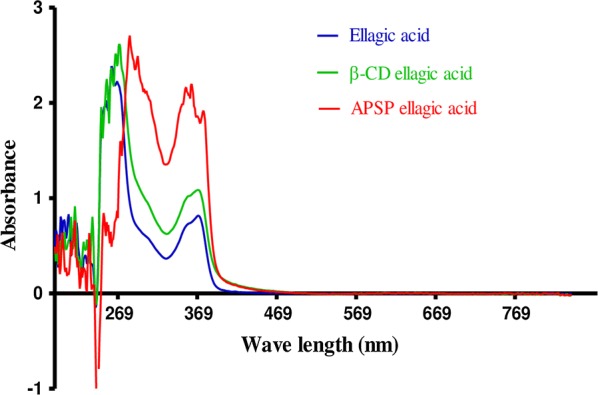
In this study, the inhibitory effect of EA, β-cyclodextrin ellagic acid (β-CD EA) and antisolvent precipitation with a syringe pump prepared ellagic acid (APSP EA) was evaluated on four Babesia species and Theileria equi in vitro, and on the multiplication of B. microti in mice. The cytotoxicity assay was tested on Madin-Darby bovine kidney (MDBK), mouse embryonic fibroblast (NIH/3T3) and human foreskin fibroblast (HFF) cell lines.
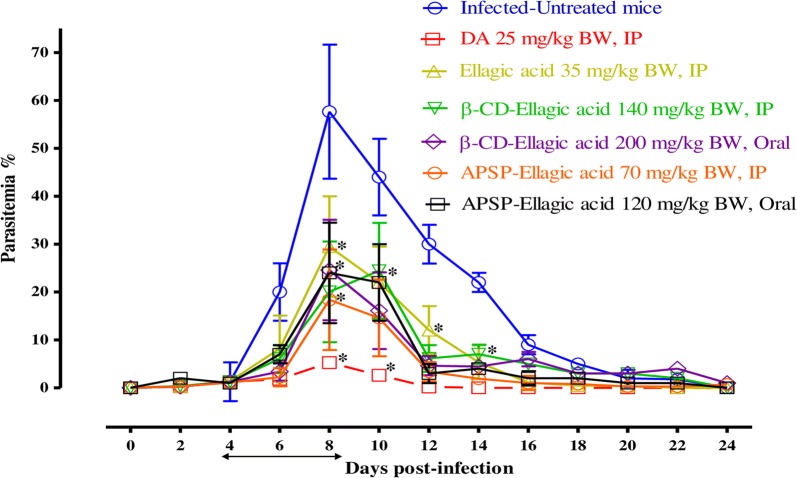
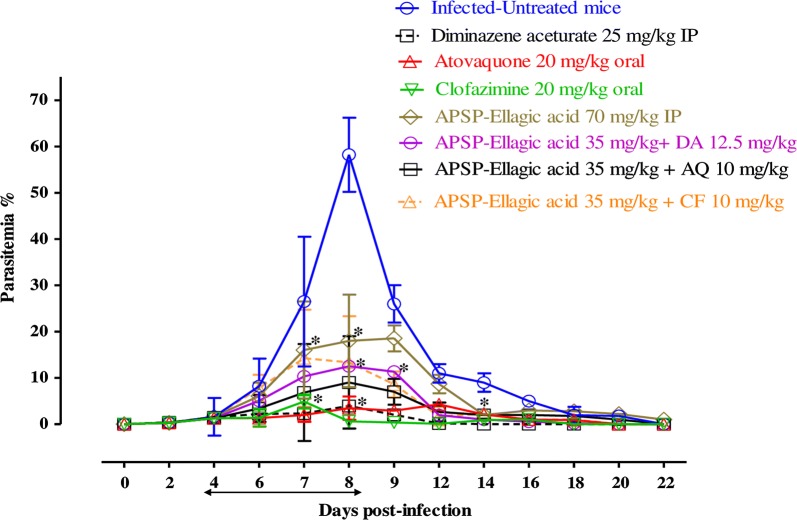
The half-maximal inhibitory concentration (IC) values of EA and β-CD EA on B. bovis, B. bigemina, B. divergens, B. caballi and T. equi were 9.58 ± 1.47, 7.87 ± 5.8, 5.41 ± 2.8, 3.29 ± 0.42 and 7.46 ± 0.6 µM and 8.8 ± 0.53, 18.9 ± 0.025, 11 ± 0.37, 4.4 ± 0.6 and 9.1 ± 1.72 µM, respectively. The IC values of APSP EA on B. bovis, B. bigemina, B. divergens, B. caballi and T. equi were 4.2 ± 0.42, 9.6 ± 0.6, 2.6 ± 1.47, 0.92 ± 5.8 and 7.3 ± 0.54 µM, respectively. A toxicity assay showed that EA, β-CD EA and APSP EA affected the viability of cells with a half-maximal effective concentration (EC) higher than 800 µM. In the experiments on mice, APSP EA at a concentration of 70 mg/kg reduced the peak parasitemia of B. microti by 68.1%. Furthermore, the APSP EA-atovaquone (AQ) combination showed a higher chemotherapeutic effect than that of APSP EA monotherapy.
To our knowledge, this is the first study to demonstrate the in vitro and in vivo antibabesial action of EA-NPs and thus supports the use of nanoparticles as an alternative antiparasitic agent.
目前尚无有效的巴贝斯虫和泰勒虫疫苗;因此,治疗主要依赖于抗原生动物药物。治疗梨形虫病的选择有限;因此,对新的抗原生动物药物的需求变得越来越迫切。鞣花酸(EA)是一种存在于各种植物产品中的多酚,具有抗氧化、抗菌和有效的抗疟活性,在体外和体内均无毒性。本研究记录了 EA 和载 EA 纳米粒子(EA-NPs)对巴贝斯虫和泰勒虫生长的抑制作用。
在这项研究中,评估了 EA、β-环糊精鞣花酸(β-CD EA)和通过注射器泵制备的抗溶剂沉淀法(APSP EA)对四种巴贝斯虫种和马泰勒虫在体外以及对 B. microti 在小鼠体内的增殖的抑制作用。细胞毒性试验在马-达比牛肾(MDBK)、小鼠胚胎成纤维细胞(NIH/3T3)和人包皮成纤维细胞(HFF)细胞系上进行。
EA 和 β-CD EA 对 B. bovis、B. bigemina、B. divergens、B. caballi 和 T. equi 的半最大抑制浓度(IC)值分别为 9.58±1.47、7.87±5.8、5.41±2.8、3.29±0.42 和 7.46±0.6 μM 和 8.8±0.53、18.9±0.025、11±0.37、4.4±0.6 和 9.1±1.72 μM。APSP EA 对 B. bovis、B. bigemina、B. divergens、B. caballi 和 T. equi 的 IC 值分别为 4.2±0.42、9.6±0.6、2.6±1.47、0.92±5.8 和 7.3±0.54 μM。毒性试验表明,EA、β-CD EA 和 APSP EA 以高于 800 μM 的半最大有效浓度(EC)影响细胞活力。在对小鼠的实验中,APSP EA 以 70 mg/kg 的浓度可使 B. microti 的峰值寄生虫血症减少 68.1%。此外,APSP EA-阿托伐醌(AQ)联合用药的化疗效果高于 APSP EA 单药治疗。
据我们所知,这是第一项证明 EA-NPs 具有抗巴贝斯虫活性的体外和体内研究,因此支持将纳米粒子用作替代抗寄生虫药物。